Bodybuilding Classic Physique Division Offseason log
You know you who it is already. Can't recall my old password or even what email I used so here we are. I promised I'd st
Hey everyone I've done some more writing I'd like to share. No creative fiction this time, although that was fun AF and very rewarding. This time I wrote a long form article about bodybuilding culture and virtue signaling vs legitimately helpful advice and what actually moves the needle vs what sounds cool. It's basically the story of why progress was slow from 2012-2015, and then non existant/regression from 2017-2022 despite trying REALLY hard in the gym, but obviously a more generalized take which reflects modern IG social media fitness and bodybuilding culture. Although I've written "bodybuilding", this pretty much applies to powerlifting/oly/fitness/getting in shape in general. Long form essays are kind of a dead medium but I still like whatever seems to happen in my brain when I sit down and focus my attention to write something. I suppose forums like this full of dinosaurs are the last place anyone still has the attention span to read stuff like this. I plan to record a video just reading it in front of the camera, no edits, no pictures as long form audio/video isn't dead at all and still attracts a lot of views/listens among the midwit and higher crowd who are found on youtube rather than tiktok/ig. You can replace "bodybuilders' with "fitnesspeople". IDK if he checks my log but this also perfectly explains ExpectedV, although he's largely integrated these lessons and back to making very good progress again based on his latest update.
Recovery is the scarce resource, not stimulus.
Among experienced bodybuilders, there exists a curious tendency to misidentify the primary constraint on progress. When development stagnates, the instinctive response is often to increase training volume, increase intensity, increase frequency, or otherwise seek additional stimulus. The assumption underlying this reaction is rarely stated explicitly, but it is nevertheless pervasive: if progress has slowed, the athlete must not be working hard enough.
For novices, this conclusion is often justified. Many beginners train with insufficient effort, fail to approach muscular failure, or simply lack the consistency required to produce meaningful adaptation. In such circumstances, more stimulus is frequently the correct prescription. However, bodybuilding advice has a habit of persisting long after the conditions that made it useful have disappeared.
The recommendation to "train harder" is one such example. A beginner and an advanced bodybuilder are often given identical advice despite facing fundamentally different physiological realities. The former is commonly limited by an inability to generate a sufficient stimulus. The latter is far more likely to be constrained by an inability to recover from one. This distinction is not trivial. It lies at the heart of how muscular development actually occurs. Training itself does not build muscle. Training merely initiates the adaptive process. The workout is the disruption. Growth is the response. Without adequate recovery, the stimulus remains little more than accumulated fatigue. Yet bodybuilding culture frequently behaves as though the stimulus is the adaptation.This is understandable. Hard training is dramatic. It is visible. It photographs well. It produces compelling stories and memorable anecdotes. A brutally difficult set of squats can be observed, recorded, and admired. The athlete's effort is immediately apparent. Recovery, by contrast, possesses none of these qualities. Nobody receives applause for maintaining a consistent sleep schedule. Nobody garners admiration for declining late-night social obligations in order to protect recovery. There are no viral videos celebrating eight months of uninterrupted cardiovascular training or disciplined nutritional adherence. The behaviours that often contribute most substantially to long-term progress are also the least visible. As a result, bodybuilding culture develops a predictable bias toward those variables that can be publicly displayed.
One thing I've noticed is that "train harder" often functions as a status signal rather than a practical recommendation. The phrase frequently serves a social purpose that extends beyond its literal meaning. It communicates seriousness, commitment, and a willingness to endure discomfort. In many contexts, the statement is less an attempt to diagnose the source of a problem than an attempt to demonstrate membership within a particular culture. The difficulty arises when this symbolic function becomes confused with useful guidance. The fact that an athlete is capable of generating additional fatigue does not necessarily imply that additional fatigue is what they require.
Indeed, among advanced bodybuilders, the opposite is often true. Generating fatigue is relatively easy. Adaptation is comparatively difficult. Almost anyone can design a training program that leaves them exhausted. It requires remarkably little expertise to exceed one's recovery capacity. What is considerably more challenging is identifying the precise amount of stimulus necessary to provoke adaptation while still allowing the body to recover effectively. This becomes increasingly important as an athlete accumulates years of training experience. In the early stages of a bodybuilding career, progress is forgiving. The body responds enthusiastically to almost any reasonable training stimulus. Sleep can be inconsistent. Nutrition can be imperfect. Recovery habits can be suboptimal. Despite these shortcomings, meaningful growth still occurs.
As development advances, however, this margin for error narrows considerably. The body becomes less responsive to training. Each additional pound of muscle requires a greater investment of resources. Adaptation slows. Recovery assumes a larger role. The athlete gradually discovers that the ability to generate stimulus is no longer the primary challenge. The challenge is creating an environment in which that stimulus can be successfully converted into growth. This is where many otherwise intelligent bodybuilders encounter difficulty. When progress slows, they attempt to solve the problem by increasing the very variable that is already abundant. More exercises are added. More sets are performed. Rest days are reduced. Training sessions become increasingly elaborate and increasingly exhausting.
For a brief period, these interventions create the reassuring sensation of action. The athlete feels productive. They feel committed. They feel as though they are attacking the problem directly. Yet objective outcomes often fail to improve. Strength stagnates. Recovery deteriorates. Joint discomfort increases. Sleep quality declines. Motivation erodes. The athlete begins expending greater effort while receiving progressively smaller returns. The issue was never a deficiency of stimulus. The issue was an insufficiency of recovery.
An analogy from economics may be instructive. If a factory is already operating at maximum production capacity, increasing incoming orders does not increase output. The bottleneck is no longer demand. It is production. Attempting to solve the problem by generating additional demand merely exacerbates the underlying constraint.
The same principle applies to bodybuilding.
Once a sufficient training stimulus has been established, recovery becomes the limiting factor. Additional workload may increase fatigue without increasing adaptation. In such circumstances, the athlete's greatest opportunity for progress may not lie in training harder but in recovering more effectively.
It is also worth acknowledging that performance-enhancing drugs occupy an important place within this discussion. Among advanced bodybuilders, pharmacology is frequently framed as a means of increasing the body's capacity to recover from and adapt to training. To a certain extent, this is true. Anabolic agents, growth hormone, insulin, and numerous ancillary compounds can profoundly influence recovery, work capacity, nutrient partitioning, and the overall adaptive response to training.
However, the relationship between pharmacology and recovery is often misunderstood. A common assumption within bodybuilding culture is that optimization consists primarily of identifying the highest tolerable dosage of a given compound or combination of compounds. This view is appealing because it is simple. If a particular intervention improves recovery, then more of that intervention should improve recovery further. Yet physiology rarely operates in such a linear fashion.
Individuals differ substantially in their responses to pharmacological agents. Variations in neurochemistry, receptor expression, metabolic pathways, side-effect susceptibility, and countless other biological factors ensure that identical protocols can produce dramatically different outcomes across individuals. A dosage that enhances recovery capacity in one athlete may impair it in another. A compound that improves performance for one bodybuilder may produce sleep disruption, anxiety, appetite suppression, cardiovascular strain, or other consequences that ultimately undermine the very adaptation it was intended to facilitate.
For this reason, intelligent pharmacological optimization is not merely a process of escalation. It is a process of selection and refinement. The objective is not to maximize milligrams. The objective is to maximize the ratio between benefit and cost. An effective protocol is one that meaningfully enhances performance and recovery while imposing the smallest possible burden on the physiological systems that support those outcomes.
Indeed, one of the more paradoxical realities of advanced bodybuilding is that additional drugs can, under certain circumstances, reduce an athlete's capacity to recover. Sleep quality may deteriorate. Cardiovascular fitness may decline. Appetite may become impaired. Mood and cognition may worsen. Systemic stress may increase. At some point, the pursuit of greater pharmacological assistance can begin eroding the very recovery resources it was intended to augment.
This is why thoughtful bodybuilders often devote considerable attention not only to performance-enhancing compounds themselves, but also to the strategic use of ancillary interventions designed to mitigate unwanted effects. Blood pressure management, lipid management, glycemic control, sleep quality, cardiovascular health, and other aspects of physiological maintenance are not secondary concerns. They are integral components of recovery management. Every side effect successfully attenuated represents a recovery resource preserved. Every unnecessary physiological burden removed increases the likelihood that training stress will be translated into productive adaptation rather than accumulated fatigue.
Viewed through this lens, pharmacology is best understood not as a substitute for recovery, but as one variable within the broader recovery equation. Like training itself, its value is ultimately determined by its contribution to adaptation. The most effective approach is therefore seldom the most aggressive. More often, it is the approach that expands recovery capacity while imposing the fewest competing demands upon it.
This observation has profound implications for how advanced bodybuilders should allocate their attention.
Sleep ceases to be a lifestyle consideration and becomes a performance variable.
Circadian alignment becomes a performance variable.
Stress management becomes a performance variable.
Cardiovascular fitness becomes a performance variable.
Nutritional consistency becomes a performance variable.
These practices may lack the emotional appeal of a brutally difficult workout, but they directly influence the body's capacity to adapt. The mature athlete eventually undergoes a subtle but important shift in perspective. Rather than asking, "How much work can I tolerate?" They begin asking, "How much work can I productively recover from?" Although these questions appear similar, they reflect fundamentally different philosophies. One seeks to maximize fatigue. The other seeks to maximize adaptation. Only one of those objectives is rewarded by the sport.
This is why many elite bodybuilders ultimately adopt approaches that appear surprisingly restrained to outside observers. Their training often becomes more focused rather than more complicated. Their exercise selection becomes more deliberate. Their recovery practices become increasingly structured. They cease pursuing the maximum amount of work they can survive and instead pursue the maximum amount of work they can benefit from.
Such an approach may appear less heroic, but it is considerably more rational. Bodybuilding is not a contest of suffering.
It is not a competition to determine who can accumulate the greatest amount of fatigue.
Nor is it a moral examination of one's willingness to endure hardship.
It is a process of biological adaptation.
The athlete who understands this recognizes that stimulus and recovery are not opposing forces but complementary components of the same system. One creates the demand for growth. The other determines whether that demand can be fulfilled. Consequently, among advanced bodybuilders, the central challenge is rarely finding ways to train harder. There is seldom a shortage of stimulus. There is often a shortage of recovery.
The athlete who recognizes this reality gains a significant advantage. While others remain preoccupied with demonstrating effort, he becomes focused on cultivating adaptation. While others seek to maximize workload, he seeks to optimize outcomes. Over the course of months this distinction may appear insignificant. Over the course of years, it becomes decisive.
Recovery is not the absence of productive work. It is the mechanism through which productive work acquires value.
And for the advanced bodybuilder, it is very often the scarcest resource of all.
WRT to the teaching conversation, I have made this point before in various ways; but once you accept that we are already living in a partial UBI world, and this constitutes most lower level white collar work, ESPECIALLY public sector, then everything all starts to make more sense.
Most of my criticisms of "get the rich" populism that is taking over the left and right in the US is these ideologies willfully fail to understand and acknowledge how Pareto distributions (RIP Jordan Peterson) work in our economy. And how truly economically useless most downwardly mobile white collar middle class are (except as consumers) and in the case of teachers glorified baby-sitters. And how important a small number of "Epstein class billionaires" are in generating the economic growth necessary to keep the ship afloat.
As far as Chinese culture, one can appreciate the honesty and pragmatism. But at the same time, I think the zero sum tribalism inherent in Chinese culture is very self limiting. Which is why "grow the pie" functional liberal market economies will generally outcompete them (in the short term at least)*.
*Of course the Chinese zero sum solution to this is to cynically corrupt the liberal market economies so they aren't functional (at the end of the day this is the purpose of much Chinese foreign relations and international business practices). But again, this is a very limiting, make the entire pie smaller approach which will have downstream consequences which I think will be bad for everyone, including China. And we are already seeing this start to play out.
sorry Dunyain you created a new page and people might miss this post and it's literally the most important thing I've written about fitness and what I wish I would have known when I was first exiting beginner territority around 2011-12. By then I was already at a level of muscularity/development where recovery was the bottleneck rather than stimulus. Same story for like 90% of people who were logging actively on 2p2 back then, especially REALB.
Recovery is the scarce resource, not stimulus.
Among experienced bodybuilders, there exists a curious tendency to misidentify the primary constraint on progress. When development stagnates, the instinctive response is often to increase training volume, increase intensity, increase frequency, or otherwise seek additional stimulus. The assumption underlying this reaction is rarely stated explicitly, but it is nevertheless pervasive: if progress has slowed, the athlete must not be working hard enough.
For novices, this conclusion is often justified. Many beginners train with insufficient effort, fail to approach muscular failure, or simply lack the consistency required to produce meaningful adaptation. In such circumstances, more stimulus is frequently the correct prescription. However, bodybuilding advice has a habit of persisting long after the conditions that made it useful have disappeared.
The recommendation to "train harder" is one such example. A beginner and an advanced bodybuilder are often given identical advice despite facing fundamentally different physiological realities. The former is commonly limited by an inability to generate a sufficient stimulus. The latter is far more likely to be constrained by an inability to recover from one. This distinction is not trivial. It lies at the heart of how muscular development actually occurs. Training itself does not build muscle. Training merely initiates the adaptive process. The workout is the disruption. Growth is the response. Without adequate recovery, the stimulus remains little more than accumulated fatigue. Yet bodybuilding culture frequently behaves as though the stimulus is the adaptation.This is understandable. Hard training is dramatic. It is visible. It photographs well. It produces compelling stories and memorable anecdotes. A brutally difficult set of squats can be observed, recorded, and admired. The athlete's effort is immediately apparent. Recovery, by contrast, possesses none of these qualities. Nobody receives applause for maintaining a consistent sleep schedule. Nobody garners admiration for declining late-night social obligations in order to protect recovery. There are no viral videos celebrating eight months of uninterrupted cardiovascular training or disciplined nutritional adherence. The behaviours that often contribute most substantially to long-term progress are also the least visible. As a result, bodybuilding culture develops a predictable bias toward those variables that can be publicly displayed.
One thing I've noticed is that "train harder" often functions as a status signal rather than a practical recommendation. The phrase frequently serves a social purpose that extends beyond its literal meaning. It communicates seriousness, commitment, and a willingness to endure discomfort. In many contexts, the statement is less an attempt to diagnose the source of a problem than an attempt to demonstrate membership within a particular culture. The difficulty arises when this symbolic function becomes confused with useful guidance. The fact that an athlete is capable of generating additional fatigue does not necessarily imply that additional fatigue is what they require.
Indeed, among advanced bodybuilders, the opposite is often true. Generating fatigue is relatively easy. Adaptation is comparatively difficult. Almost anyone can design a training program that leaves them exhausted. It requires remarkably little expertise to exceed one's recovery capacity. What is considerably more challenging is identifying the precise amount of stimulus necessary to provoke adaptation while still allowing the body to recover effectively. This becomes increasingly important as an athlete accumulates years of training experience. In the early stages of a bodybuilding career, progress is forgiving. The body responds enthusiastically to almost any reasonable training stimulus. Sleep can be inconsistent. Nutrition can be imperfect. Recovery habits can be suboptimal. Despite these shortcomings, meaningful growth still occurs.
As development advances, however, this margin for error narrows considerably. The body becomes less responsive to training. Each additional pound of muscle requires a greater investment of resources. Adaptation slows. Recovery assumes a larger role. The athlete gradually discovers that the ability to generate stimulus is no longer the primary challenge. The challenge is creating an environment in which that stimulus can be successfully converted into growth. This is where many otherwise intelligent bodybuilders encounter difficulty. When progress slows, they attempt to solve the problem by increasing the very variable that is already abundant. More exercises are added. More sets are performed. Rest days are reduced. Training sessions become increasingly elaborate and increasingly exhausting.
For a brief period, these interventions create the reassuring sensation of action. The athlete feels productive. They feel committed. They feel as though they are attacking the problem directly. Yet objective outcomes often fail to improve. Strength stagnates. Recovery deteriorates. Joint discomfort increases. Sleep quality declines. Motivation erodes. The athlete begins expending greater effort while receiving progressively smaller returns. The issue was never a deficiency of stimulus. The issue was an insufficiency of recovery.
An analogy from economics may be instructive. If a factory is already operating at maximum production capacity, increasing incoming orders does not increase output. The bottleneck is no longer demand. It is production. Attempting to solve the problem by generating additional demand merely exacerbates the underlying constraint.
The same principle applies to bodybuilding.
Once a sufficient training stimulus has been established, recovery becomes the limiting factor. Additional workload may increase fatigue without increasing adaptation. In such circumstances, the athlete's greatest opportunity for progress may not lie in training harder but in recovering more effectively.
It is also worth acknowledging that performance-enhancing drugs occupy an important place within this discussion. Among advanced bodybuilders, pharmacology is frequently framed as a means of increasing the body's capacity to recover from and adapt to training. To a certain extent, this is true. Anabolic agents, growth hormone, insulin, and numerous ancillary compounds can profoundly influence recovery, work capacity, nutrient partitioning, and the overall adaptive response to training.
However, the relationship between pharmacology and recovery is often misunderstood. A common assumption within bodybuilding culture is that optimization consists primarily of identifying the highest tolerable dosage of a given compound or combination of compounds. This view is appealing because it is simple. If a particular intervention improves recovery, then more of that intervention should improve recovery further. Yet physiology rarely operates in such a linear fashion.
Individuals differ substantially in their responses to pharmacological agents. Variations in neurochemistry, receptor expression, metabolic pathways, side-effect susceptibility, and countless other biological factors ensure that identical protocols can produce dramatically different outcomes across individuals. A dosage that enhances recovery capacity in one athlete may impair it in another. A compound that improves performance for one bodybuilder may produce sleep disruption, anxiety, appetite suppression, cardiovascular strain, or other consequences that ultimately undermine the very adaptation it was intended to facilitate.
For this reason, intelligent pharmacological optimization is not merely a process of escalation. It is a process of selection and refinement. The objective is not to maximize milligrams. The objective is to maximize the ratio between benefit and cost. An effective protocol is one that meaningfully enhances performance and recovery while imposing the smallest possible burden on the physiological systems that support those outcomes.
Indeed, one of the more paradoxical realities of advanced bodybuilding is that additional drugs can, under certain circumstances, reduce an athlete's capacity to recover. Sleep quality may deteriorate. Cardiovascular fitness may decline. Appetite may become impaired. Mood and cognition may worsen. Systemic stress may increase. At some point, the pursuit of greater pharmacological assistance can begin eroding the very recovery resources it was intended to augment.
This is why thoughtful bodybuilders often devote considerable attention not only to performance-enhancing compounds themselves, but also to the strategic use of ancillary interventions designed to mitigate unwanted effects. Blood pressure management, lipid management, glycemic control, sleep quality, cardiovascular health, and other aspects of physiological maintenance are not secondary concerns. They are integral components of recovery management. Every side effect successfully attenuated represents a recovery resource preserved. Every unnecessary physiological burden removed increases the likelihood that training stress will be translated into productive adaptation rather than accumulated fatigue.
Viewed through this lens, pharmacology is best understood not as a substitute for recovery, but as one variable within the broader recovery equation. Like training itself, its value is ultimately determined by its contribution to adaptation. The most effective approach is therefore seldom the most aggressive. More often, it is the approach that expands recovery capacity while imposing the fewest competing demands upon it.
This observation has profound implications for how advanced bodybuilders should allocate their attention.
Sleep ceases to be a lifestyle consideration and becomes a performance variable.
Circadian alignment becomes a performance variable.
Stress management becomes a performance variable.
Cardiovascular fitness becomes a performance variable.
Nutritional consistency becomes a performance variable.
These practices may lack the emotional appeal of a brutally difficult workout, but they directly influence the body's capacity to adapt. The mature athlete eventually undergoes a subtle but important shift in perspective. Rather than asking, "How much work can I tolerate?" They begin asking, "How much work can I productively recover from?" Although these questions appear similar, they reflect fundamentally different philosophies. One seeks to maximize fatigue. The other seeks to maximize adaptation. Only one of those objectives is rewarded by the sport.
This is why many elite bodybuilders ultimately adopt approaches that appear surprisingly restrained to outside observers. Their training often becomes more focused rather than more complicated. Their exercise selection becomes more deliberate. Their recovery practices become increasingly structured. They cease pursuing the maximum amount of work they can survive and instead pursue the maximum amount of work they can benefit from.
Such an approach may appear less heroic, but it is considerably more rational. Bodybuilding is not a contest of suffering.
It is not a competition to determine who can accumulate the greatest amount of fatigue.
Nor is it a moral examination of one's willingness to endure hardship.
It is a process of biological adaptation.
The athlete who understands this recognizes that stimulus and recovery are not opposing forces but complementary components of the same system. One creates the demand for growth. The other determines whether that demand can be fulfilled. Consequently, among advanced bodybuilders, the central challenge is rarely finding ways to train harder. There is seldom a shortage of stimulus. There is often a shortage of recovery.
The athlete who recognizes this reality gains a significant advantage. While others remain preoccupied with demonstrating effort, he becomes focused on cultivating adaptation. While others seek to maximize workload, he seeks to optimize outcomes. Over the course of months this distinction may appear insignificant. Over the course of years, it becomes decisive.
Recovery is not the absence of productive work. It is the mechanism through which productive work acquires value.
And for the advanced bodybuilder, it is very often the scarcest resource of all.
Jordan Peterson (RIP) is so true. If you compared an excerpt from a lecture in 2011 to some nonsense he spouted in some gay as **** Chris Williamson interview in 2023 it literally doesn't even sound like it's from the same human being. I've never seen a more profound case of intellectual regression that wasn't from neurocognitive degeneration typical of something like Alzheimer's . Psych meds? selling out? Grief over losing the culture war in his own home? idk, doesn't matter. Old JP is very dead and new JP is utterly nauseating.
But you know which JP isn't nauseating at all and has only gotten better with age? this one

If there was a 120ish IQ sub5 face and/or below 5'7 18 year old boy with divorced parents who had never known anything but low status and I had to choose on of the two JPs to offer him guidance and life advice to keep him out of being a NEET loser/school shooter/drug addict/minimum wage cuck, it'd very obviously be this one. Now significantly downsized from his peak and doing BJJ.
Is it worth pointing out at this point that someone with a 120ish IQ is more than capable of getting an advanced degree? And among people with PhDs and professional degrees is only going to be slightly dumber than their average peer? (Prob right at average for many.)
Also, the difference between college grads and HS educated folks is about the same (prob smaller now) than white folks and blacks, and only slightly larger than Asians v Whites.
Dun,
Agreed.
Guy,
Your rant is well intentioned and completely correct, but I think most people get this? I'm not on fitness twitter/tk/IG, but feeder workouts, active recovery, etc have been around since we were teenagers.
Jordan Peterson (RIP) is so true. If you compared an excerpt from a lecture in 2011 to some nonsense he spouted in some gay as **** Chris Williamson interview in 2023 it literally doesn't even sound like it's from the same human being. I've never seen a more profound case of intellectual regression that wasn't from neurocognitive degeneration typical of something like Alzheimer
A few notes about Peterson
1. He developed a benzo addiction, which has by all accounts been very deleterious for his health.
2. I think his "fall off" has been a little over-determined. I subscribed to his podcast and would listen whenever the guest/topic was interesting, and I didnt notice anything that dramatically off (at least in that controlled environment). I think some of what happened was just culture shifting away from him.
3. I think a lot of what happened is that when he first burst onto the scene he was talking about stuff he had been talking/thinking/writing about for decades, so he had worked out a lot of what he wanted to say and was polished. And then when he ventured into talking about current events and social commentary it wasn't as smooth. I remember finding old clips of his from the 90s where he was talking about a lot of the same stuff he was talking about in 2010. So it was all very polished by 2010.
Sort of like when a breakout band has a "first" album of very good songs, which in reality is their 10 best songs over years. And then the second album, which is all new material made over only a year, isn't close to as good.

JP was always some kind of a clown imo. He never actually engaged in proper discourse. But, yeah, he got clownier.
[QUOTE=NotThremp;59317762
Guy,
Your rant is well intentioned and completely correct, but I think most people get this? I'm not on fitness twitter/tk/IG, but feeder workouts, active recovery, etc have been around since we were teenagers.[/QUOTE]
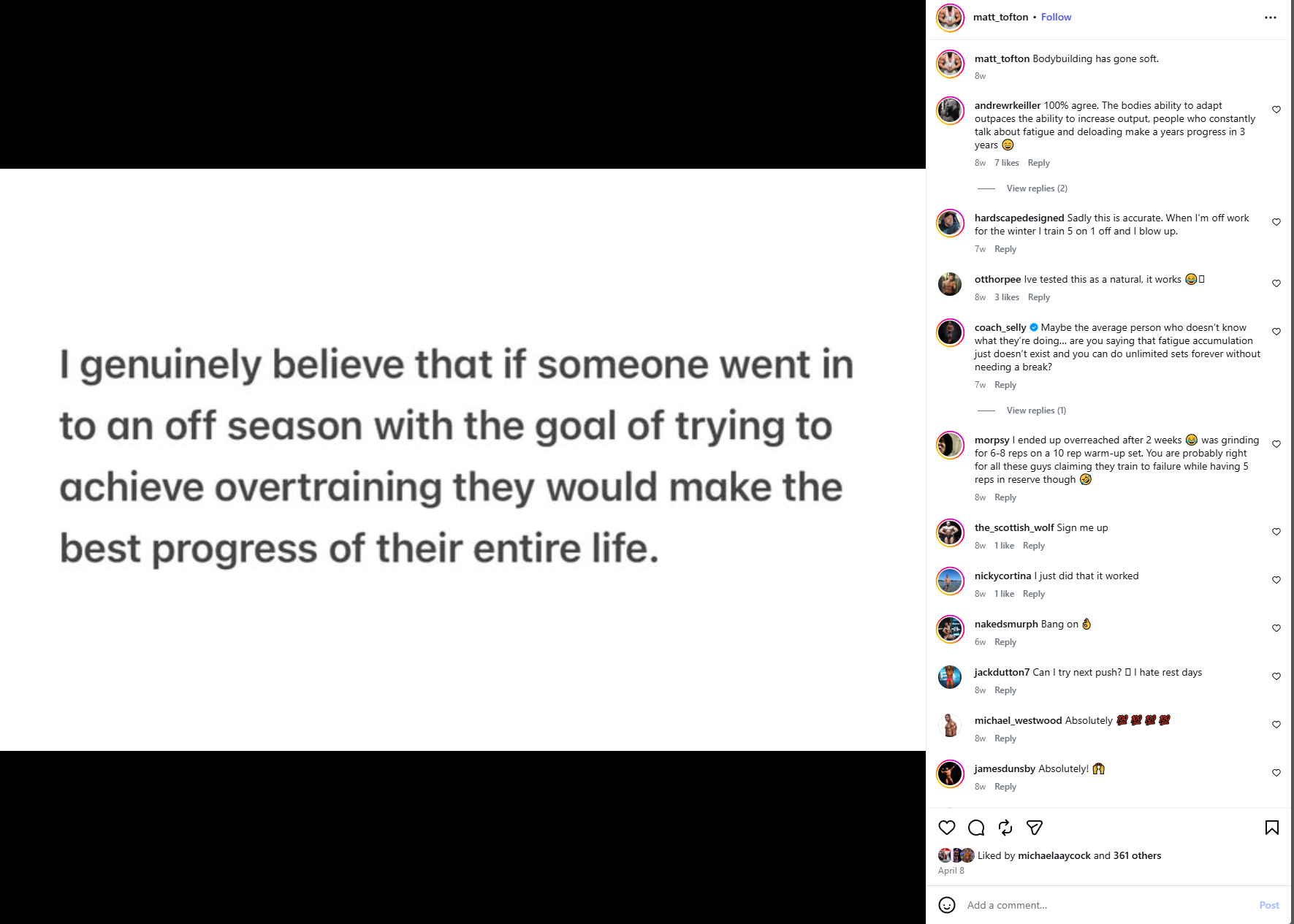

re rest, recovery, overtraining etc....a question that I don't think is covered in your detailed post above
broadly (I know it's going to change dependent on the individual)....is the key to it the time the muscle has to recover/has in between being specifically trained or is it the time the body has to recover?
eg assuming I cover the same amount of sets, reps, weight......if I do a 5 day split of say Back, Legs, Chest & Shoulders & Arms with a rest day, is that more or less efficient than doing a 5 day split that is Back & Biceps, Chest & Shoulders, Rest, Legs & Triceps, Rest
in both the muscles have the same time between being trained but in one the body has more time?
there are more extreme examples of this of course, where perhaps someone finds a way to train every day with no rest days while someone else packs more body parts into fewer days & takes more rest days
hope that makes sense?
re rest, recovery, overtraining etc....a question that I don't think is covered in your detailed post abovebroadly (I know it's going to change dependent on the individual)....is the key to it the time the muscle has to recover/has in between being specifically trained or is it the time the body has to recover? eg assuming I cover the same amount of sets, reps, weight......if I
You won't notice a significant difference. This is less about optimizing split for rest as it is optimizing outside the gym variables and even being willing to do less total work in the gym when progress stalls rather than increasing intensity/volume and work done in the gym generally.
Guy,
Welp. That is a thing.
The topic is somewhat confusing and rather difficult for normies to get. You have various elements at play wrt work capacity/training/recovery. Like lets take some kid who works on a farm. Doesn't really try to do anything weird, but will drive some posts and carry some 50lbs bags etc. And another kid who works at McDs and just stands in front of a fry cooker. Obviously person 1 will have a much higher work capacity, will recover better and be able to ramp training more aggressively despite carrying fertilizer not being considered "rest".
I think the problem we get into is people are confusing taking a leisurely hike, a swim on the lake, or pickleball with the gf with adding in another high intensity training session. Almost anyone can over train and pretty easily. I think this view of "do moar" is obviously ******ed, but again depends on how we define over training? Is it just too much work where progress is ******ed, is it where we make no progress, or where we actually attempt to develop systematic problems that require months to resolve? Obviously this depends on whether you're a strength athlete or a real athlete that kinda half-ass lifts in season and then hits it hard out of season while also balancing the metabolic requirements of your sport. It is incredibly difficult to hit the final definition, and near impossible for actual athletes to reach that stage. The first is trivially simple and anyone who's ever lifted in earnest has reached that. But it is a spectrum between "Maybe cutting out the curls to failure will help" to "I have rhabo and could've died".
I just find this amusing since T-Nation was trumpeting active recovery and work capacity when we were in high school. One of the few things they were reasonably right about and rather early. Beyond that, we're nearly 15 years past when we studied elite joggers:
about chilling out and balancing their workloads. Just seems insane that we'd come full circle back to the mid-90s.
Guy,Welp. That is a thing.The topic is somewhat confusing and rather difficult for normies to get. You have various elements at play wrt work capacity/training/recovery. Like lets take some kid who works on a farm. Doesn't really try to do anything weird, but will drive some posts and carry some 50lbs bags etc. And another kid who works at McDs and just stands in front of a fry
t-nation is like library of alexandria at this point. You probably have almost 0 exposure to competitive enhanced bodybuilding social media and have never even heard of any of the famous podcasts like Bro Chat or Trensparent with Nyle Nyaga where real gems of info get drowned out by ******ed virtue signalling. If you ask most people who are Sam Sulek fans why they think he's so successful (not financially, but like how did he build so much muscle) they'd say 'oh he outrains everyone’. Just complete misattribution.
Sorry, the younger generation just understands bodybuilding and pharmacology just way better than people around my age and older did at the same age or arguably even now. This is the comprehensive "how to use steroids" guide I wish I'd had when I was first starting. If anyone reading/lurking is curious about PEDs, this 30 minute video is a great TLDR showing exactly what to do to stay (relatively) safe and avoid side effects. I'd stay away from EQ though personally.
But if somebody isn't dialed in on nutrition and doesn't have a meal prep routine where eating a lean protein source+ rice/potato/oats/bread/etc 3x/day or more isn't just a routine part of existence you don't even need to think about, don't even ***** start steroids at all! If you can't compute a fairly good estimate of your average daily surplus or deficit from the past month, stay the **** away from all PEDs especially steroids.
The idea that you should lift x weights in some gay compound lift before you get on test is stupid. Instead, it should be more like this: get down to this % of bodyfat with some level of muscle mass, have meal prep habits in place to where they're automatic and not something you'd ever "miss". It's as routine as brushing your teeth or showering, and have cardio/and or steps in a similarly routine/automatic place. THEN you can start steroids. But the meal prep part... people just stumble on this as if it's like climbing mt. ****ing everest. And now glp1s make it even worse and people think they can dodge this part of strength sports/bbing because they can just modulate appetite with GLP1s... nope, doesn't work that way.
(obv you already are training regularly in the gym)

Once a sufficient training stimulus has been established, recovery becomes the limiting factor. Additional workload may increase fatigue without increasing adaptation. In such circumstances, the athlete's greatest opportunity for progress may not lie in training harder but in recovering more effectively.
So what you're saying is Rippetoe was right?
On this part, YES actually. This is one of the few times we can give Rip credit. The stimulus was ******ed and his idea of recovery was just absurd amounts of calories, but at least his mental model of the relationship between stimulus and recovery was correct.
I kinda wonder what Rip would think about modern UK bodybuilding Full Body Every Other Day (FBEOD) hypertrophy training. It's usually 1-2 sets of one lift for each muscle group with a squat or leg press pattern usually 1.5x/wk. Way less or often 0 barbell movements with a large variety of exercises done throughout the week (but the same ones each week), but actually quite consistent with Rippetoe's lower volume full body training philosopy. You'd do something like Leg press, lat pulldown, ham curl, machine row, incline bench machine, ez curls, tricep pushdowns, lateral delt raises 1-2 sets of 8-12 each, for example.

Think Rip underestimated that recovery is also a physical adaptation so you get better at is you increase your work capacity.
That being said power/oly is different and the increased training volume associated with the high level athletes that are smashing records now isn't purely about muscular growth/adaptation.
Obviously more ways to skin the cat, hence Mentzer/Dorian.
JP was always some kind of a clown imo. He never actually engaged in proper discourse. But, yeah, he got clownier.
Nah JBP ruled. A true hero.
Another Rippetoe apology: He championed barbells, dbs, free weights, and bodyweight exercises and poo pooed on machines, but when he himself was a lifter and even up until the peak of his popularity in the 2000s and 2010s, machines in most commercial gyms were indeed god awful. Those ****ing hammer strength plate loaded machines for most upper body lifts.... LOL. Their leg press, ham curls, leg extensions are quite good, but most other things range from alright (some of the more upper back focused back pieces) to absolutely terrible. It's easy to lol at somebody saying free weights>machines today, but today and in particularly in the last 5 years, machines have become incredibly good. They're just engineered so much better and they have really optimized resistance profiles and strength profiles to where you can get a very good physique never touching a barbell or dumbbell at all. That was not really true back in 2008 even in a first world country at a commercial gym and even at many "hardcore" gyms. So it made a LOT more sense to stick to the big basics back then because the alternative was pretty bad overall and really good machines were rare.
New program for offseason. RN I'm basically training at 5.5-7/10 effort levels 4x/wk being this close to show and depleted. I'm still not going to be training super hard in the post-show phase and I'll drop down to TRT+ for a bit to recover as its ended up being a fairly long and fatiguing diet and my mom and another cousin are visiting so I'm not exactly gonna want to be focused on bodybuilding while they're here.
Pull+Hamstrings:
NG tempo chins (paused top and bottom, 3+ second eccentrics: x2
Single arm pulldown (alternate between Panatta High Row and Forward SA pulldown): x2
Rosen Plate loaded DY row: x2
Upper back row (probably same machine, just put the seat down and execute differently): x2
RDL (alternate deficit paused barbell and belt squat machine paused RDL) x2
Hamstring curls: 2 sets
Push+Biceps
Curl variation: 3 sets
Forward plate loaded converging chest press: x2
Incline db: x2
cable delt raises: x3
cable flies: x2
tricep pushdowns: x3
Glutes+Quads
Hip thrust machine: x2
Leg press (seat up, pad beneath lower back): x2
Hack squat: x2
Leg extensions: x2
Glute kickback x2
Rotation is pull+ham/push+bicep/glutes+quads, off, pull+ham/push+biceps/off
Quads only need 1x/wk and glutes are still getting hit in lengthened position on the hip hinges so basically its glute stimulus 3x/wk
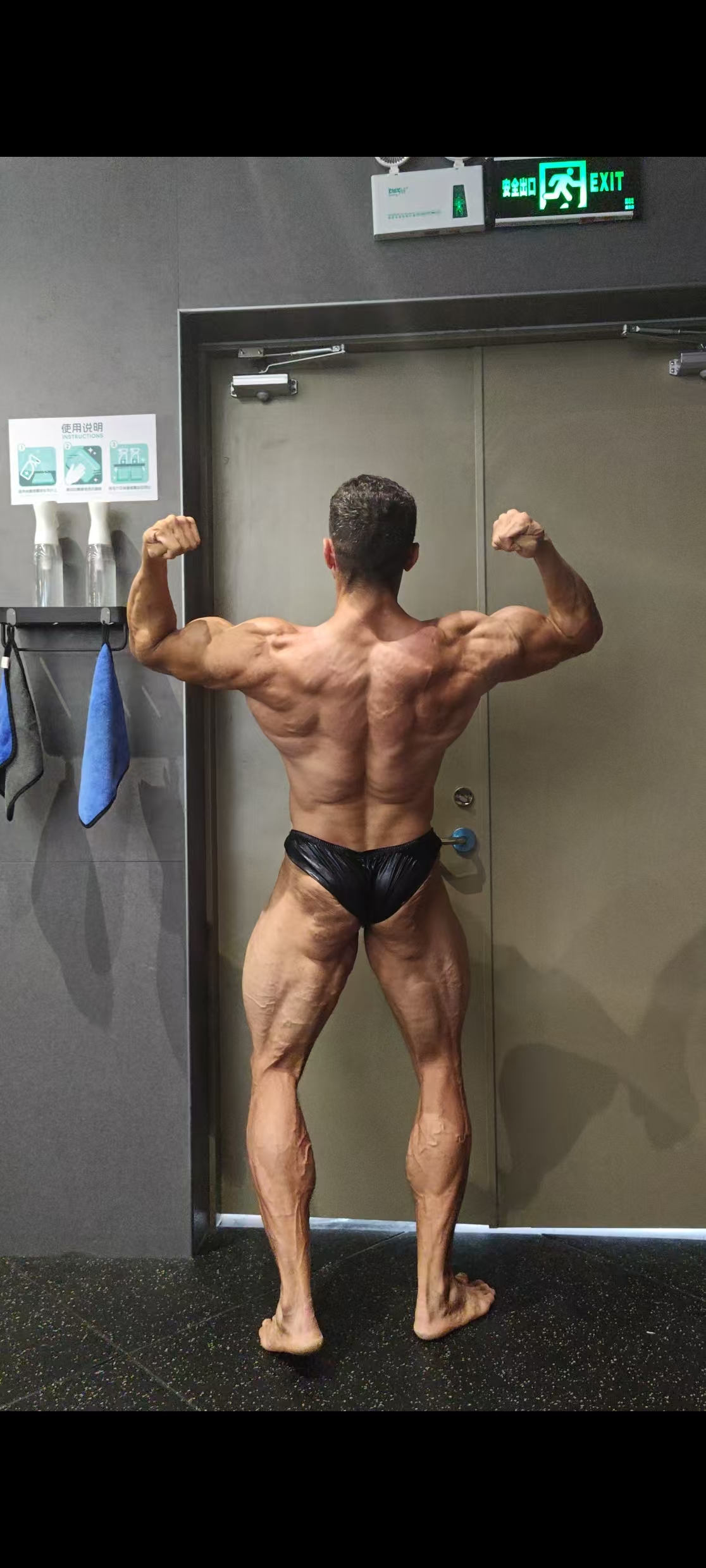
Checkin photos at 3 weeks out, taken a few days ago with a 25mg hydrochlorothyazide the night before (harmless diuretic used between 25-100mg daily for BP clinically)

[image]zgmxRE2.jpg[/im

e...]


I decided I'm gonna log my training on youtube. No parasocial bonding, rare voiceovers, no chats before or after, occasional music. More just a video training log than "content" meant for anyone else to consume. I already do this on chinese tiktok along with informative carousel posts and my page is taking off. My follower count is still quite low but my engagement metrics are ridiculously good and once I get my cousin to plug my page it will explode. Wanna get some organic growth first. Just gonna start crossposting the video training logs on youtube.
The machine I never see in gyms these days that I loved when I first started training in the 90s was the sit in tricep machine. It basically worked somewhere between a weighted dip and a rear tricep pushdown but it allowed you to add heavy weight with a lot of body control
Sent from my iPhone using Tapatalk


Guy,
I see what you're getting at. I find this stuff kinda interesting since I am definitely not down that rabbithole of aspiring professional bodybuilders. But I do find it amusing that people can't figure out how to eat X lean protein and Y carbs with some healthy fats. More potato when cutting, more pasta when bulking. It isn't really rocket science.
Keep in mind Rippletoad was geared for a person who is getting into lifting weights for the first time and has no ultimate end goal. Obviously everyone trains pretty much the same, although you can make exceptions for people who clearly want to go down the BBing route. If you're a 12y old Chinese girl looking to be a WC Olytard, you are gonna be doing more pull variants and less bench, but you'll still be doing large compound movements to develop movement patterns. Moreso "can you physically do this lift without hurting yourself" than "You must do this lift 3x5 3x a week or you will never progress". Again, we're talking about months of a program for a complete novice. If you've been running a 531 variant for years during offseason football training, this ain't you. But glad you are coming around to some of his views and have a more balanced view.
I do not use machines but it is nice to hear they aren't still identical to a 1990s YMCA with Weider shit everywhere. (Well occasionally at hotels since beggars can't be choosers.)
Looking good tho. Nice dong thong.
kc,
Glad you alive.
Guy, I see what you're getting at. I find this stuff kinda interesting since I am definitely not down that rabbithole of aspiring professional bodybuilders. But I do find it amusing that people can't figure out how to eat X lean protein and Y carbs with some healthy fats. More potato when cutting, more pasta when bulking. It isn't really rocket science.Keep in mind Rippletoad w
Most people getting into lifting weights are doing it to become more attractive to the opposite sex; this is taboo so they will often aggressively counter-signal the opposite. This population should more or less do hypertrophy programs from the start and never bother with barbells. However, if we're dealing with a 44 year old soccer mom of 3 who's got a lot of mobility and movement issues, I can see something like barbell training being useful just to restore basic movement function and coordination in a way that machines simply won't do. But a 20 year old dude in his sophmore year of college? straight to the Panatta Plate Loaded High row and the Nautilus converging chest press, ditch the barbell.

