Do I have any fight left in this position? $900 on the line...

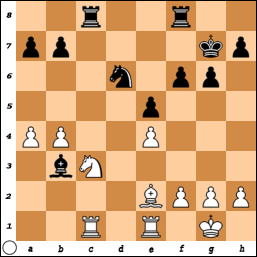
My opponent has just played e7-e5. This position occurred in the last game of a 7 round tournament. My opponent is near 1750 after winning all 6 of his games thus far, and I am 1600ish with 5 wins and 1 loss. He only needs to draw to take $1700 for clear first, but a loss will only tie him for first and net him $1000. If I win, I tie for first and win $1000. If I draw, I am clear 3rd place for $500. If I lose, I tie for 4th place and only win $100. The money is moderately significant to me, but not a huge deal. Using my poker reads, I can tell that my opponent is not used to playing for so much money and is a bit rattled. He was clearly playing for a draw early on which got him in some trouble. I was doing quite well against him before I overlooked a move that forced the exchange of queens and lost me a couple tempos. I have 52 minutes left. He has 42 minutes left. We are 19 moves away from sudden death which will give each of us 30 additional minutes + a 10 second delay. My opponent offered a draw 2 moves before which I declined, but I am almost positive that he will accept a draw on any non-blunder. I offer a draw and play 22. a5. He accepts. (After some computer bs, it turns out that 22. Nb5 is equal... but near zero chance I find the move in the game given that it appears to hang a pawn). I also seriously considered 22. f3 btw.
My reasoning was that I felt like I was slightly behind and did not want to spew $400 trying to force things. I was also extremely fatigued mentally and a bit frustrated that the game had taken a negative turn for me. That being said, I did come into the game with a "must win" attitude so I was a bit ashamed of my decision and it has been haunting me since.
I did feel like I was the slightly better player in the moment and I have been studying rook endings quite a bit. If I can somehow hold onto my pawns and get the minor pieces off the board with reasonable rook activity, I do think I should have an edge.
Did I make the right decision taking a draw? Or could it have been more +EV (financially and psychologically) to keep fighting for the win in a slightly worse position?
5 Replies
My opponent has just played e7-e5. This position occurred in the last game of a 7 round tournament. My opponent is near 1750 after winning all 6 of his games thus far, and I am 1600ish with 5 wins and 1 loss. He only needs to draw to take $1700 for clear first, but a loss will only tie him for first and net him $1000. If I win, I tie for first and win $1000. If I draw, I am cle
It’s a dead draw per stockfish.
I play 1. Nf3 and then usually transpose it into 1. d4 lines while avoiding the semi-slav, QGD, Benoni, Nimzo-Indian, Bogo-Indian, and the toughest Queen's Indian lines. After 1... c5 2. c4 Nc6 3. d4 cxd4 4. Nxd4 g6 5. e4, I had transposed him into the Maroczy Bind variation of the Accelerated Dragon which is obv extremely dangerous for black. He was trying to play a symmetrica
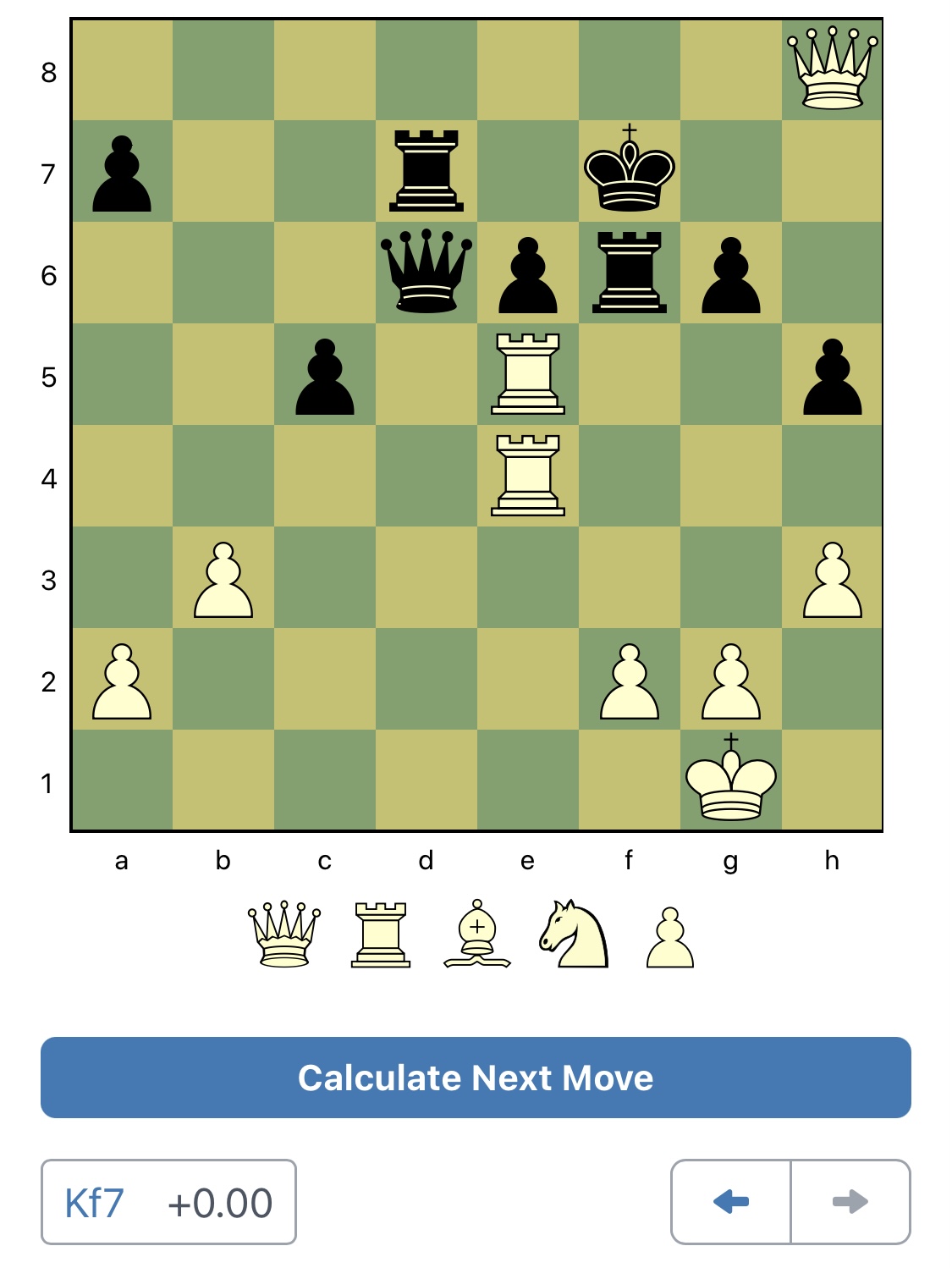
16. Nd5!! appears to win convincingly after shredding Black’s queenside pawn chain, and eventually taking the f-pawn with a beautiful combination, but Stockfish eventually manages to build a bunker around the Black king on f7-f8 that White’s rooks can’t penetrate and it’s a draw by repetition.
I’ve never seen anything like it—at one point White is +2.44!

Many grandmasters probably resign after 16. Nd5!! It looked completely hopeless until
Spoiler
I do doubt few people below FIDE 2500 if not 2600 could get a draw with Black. I only played it out because I had just reread GRRM’s Unsound Variations story after many decades.

My opponent has just played e7-e5. This position occurred in the last game of a 7 round tournament. My opponent is near 1750 after winning all 6 of his games thus far, and I am 1600ish with 5 wins and 1 loss. He only needs to draw to take $1700 for clear first, but a loss will only tie him for first and net him $1000. If I win, I tie for first and win $1000. If I draw, I am cle
From the perspectives of 1700ish rated players? I like taking the draw from your perspective because I think black's position is going to be easier to play for one simple reason: he can put his knight on d4 and you can't dislodge it. You can put your knight on d5 but he can exchange it.
Do you need to find a way to get both your bishop and knight looking at d5 so that if he establishes his knight on d4, you can establish either your knight or bishop on d5. Because his bishop is on the a2-g8 diagonal already, that's going to be difficult for you. That means you need to keep your knight around to challenge the d4 square. To me, this means black has the initiative because you have to defend. Even if you do, having his knight on d4 and yours on d5 and both bishops gone is still kind of just equal.
I'm not saying none of this is defensible or can't be worked around or even particularly difficult (like - I'm sure everything I'm saying here makes perfect sense to you in the calm of reflection); what I'm saying is when I watch 1700s play live, one of the defining weaknesses is to create a longer term maneuvering plan, which is what this position calls for for white, and your average 1700 is thinking "how do I get my queenside pawns moving" or something similarly tactical.

