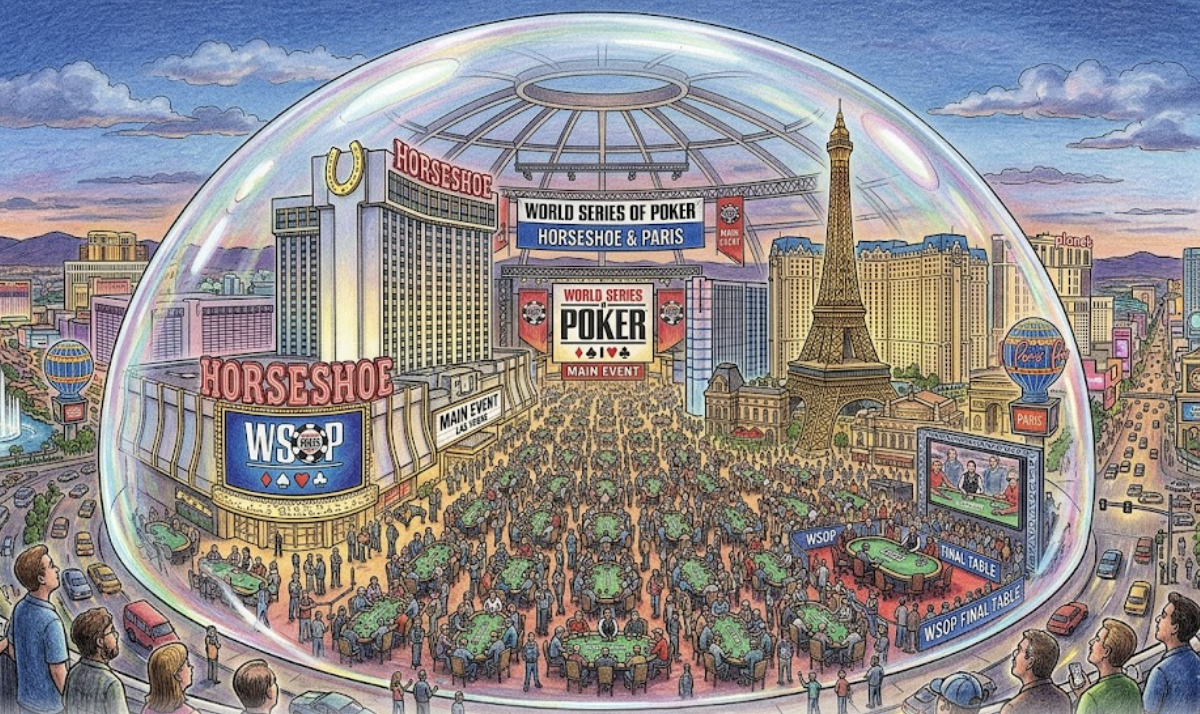
Gray-haired poker TRs: Living the WSOP dream

At the age of 62 (AARP members unite!), I have decided that I will write a trip report for my 2024 trek to the World Ser

I actually read about this specific AirBnB-scam on Twitter/X two days ago, and how it was very professionally designed and hard to spot. Glad to hear you didn't completely fall for it, and it's a good reminder to listen to spidey senses also at the poker table 😀
my partner had it happen to her too late last year
You have been warned
I am about to post a massively, massively, massively long post on risk as part of my WSOP prep work.
If you like brief and concise, I strongly recommend you skip what is about to come. Run away!
If you like meaty and in-depth, then I suspect you might find it interesting. Settle in and take your time!
WSOP prep work: Embracing poker risk ... It’s not a normal thing ... It is a necessary thing ... Do I have it in me to take more poker risk? ... A case study in risk
About a week ago in this thread, we discussed the concept of risk in poker. Specifically, my need to embrace a greater degree of risk when I am at the poker table.
So, I bought a couple of books on the subject determined to read them through the lens of my current poker play/style. I did not look for a purely poker book. I wanted something that was more about risk than poker, although some poker would be fine.
The first book I bought was Nate Silver's "On the Edge: The Art of Risking Everything." I have finished that book. I would estimate the book is 25%-30% poker. Perfect.
I didn’t know if this would be a waste of time or would open my eyes, but I thought studying the concept of risk might be good prep work for WSOP 2026. Perhaps the general concept of risk might be good mental mindset work.
Early on the book focused on poker. Almost all of the hands and anecdotes were from poker lore that I was aware of. But still, I was focusing on my mental mindset toward risk, so I plugged along.
Some sections were mildly interesting but hardly ground breaking. Things such as:
-- Doyle Brunson is quoted, saying a good player is “tight about entering the pot in the first place,” but “after he enters the pot he becomes aggressive.” OK, that’s pretty basic. It’s aggressive, but I’d hardly call it risky. I think I already do this.
-- Attack players who are capped: Silver writes, “Solvers and top players ... relentlessly attack opponents when they’re capped. If they know you can never have a top-tier hand, then they put you in a painful situation by bluffing for all your chips.” OK, this has a risk component, but it’s still on the obvious side. Plus, it’s putting the impetus, the risk, on the opponent who has to make decisions on the defensive. Again, this is something I already do (maybe not enough, but I do it).
-- Vanessa Selbst: “Most people – save the best hundred people in the world -- just aren’t that amazing at game theory.” (Most people) “were very good at playing a spot 1,000 times and knowing what to do in that spot.” (But) “over time, whenever I put someone in a new spot, they would just royally f^ck up.” In a famous 2006 WSOP $2,000 buy-in event, Selbst raised with 5-2 suited. Another player called, yet another player re-raised. Selbst went all-in and was called by a player who had A-A. On TV, Norman Chad said, “What was she thinking?” When interviewed for the book, Selbst said, “Basically after that hand, like no one folded to me ever again. Honestly, the amount of money that probably made me in my lifetime was tremendous.” OK, this is pretty interesting. Plenty of ways to utilize this approach. Usually at the start of a tournament when the table is five- or six-handed, I occasionally get too aggressive. Typically, I warn myself at the start to not overdo it. But maybe I need to change that thinking. Maybe I need to start aggressive, which ideally grows my chip stack. And if I get to showdown and have to turn over a bluff, that’s not the worst thing in the world since that will give me a loose image and then when I bet for value later I will get more action than usual. Obviously there are other approaches that can benefit from a Selbst approach. Admittedly, I’m not contemplating going total Selbst in approach since I’m not studied in that style, which seems difficult to pull off.
But all of this is kind of standard poker. We really aren’t delving into risk very deeply. The point in reading this book wasn’t really to contemplate playing a wider range of starting hands, or what types of hands to bluff with. That’s pure poker and I’ve studied plenty (by my standards) of that.
What I’m pursuing is the mental mindset needed to embrace risk more than I have in the past. This is more philosophically based, not solver based.
I have an idea. Let’s drill down into how much I do or don’t embrace risk away from poker. How much do I embrace risk in my career, in my investment strategy, in my life. As I’m reading Silver’s book I’m searching out passages that apply to this look in the mirror.
Silver writes, “I’m going to make a bold daring generalization here. For the most part – at least when it comes to financial and career decisions – people do not undertake enough risk.”
OK, this gets my attention. This talk of financial and career decisions is in my wheelhouse. In poker I have gained some experience as seen in this thread, but I’m hardly experienced and I am certainly not an expert. In the business world, however, I have put in my 10,000 hours to achieve a level of expertise.
So, let’s look at my willingness to embrace risk outside of poker.
Let’s start with career decisions. Straight out of college I worked in my dad’s manufacturing business that was prior to him selling the company and focusing his attention on real estate. I worked in sales for the manufacturing company. Lots of travel, which I didn’t care for. Lots of other things I didn’t care for. I enjoyed working with my dad, but I pretty much hated everything else about the job. After five years, I gave my dad one year’s notice that I was going to go back into sportswriting (which I had done on my college’s six-day-a-week newspaper as well as working for multiple major metropolitan newspapers and a wire service at the same time). Having decided to leave the family business in 12 months, I got a job that year covering high school sports on evenings and weekends for one of the major Chicago newspapers. When the year was up, I had a job as an editor of a non-sports magazine. After three weeks at that magazine, I was offered and took a dream sports writing job covering the National Football League that I have referenced throughout this thread.
One time I was talking to a friend about this journey, and he said, “That took a lot of guts to make that move.”
Me: “I don’t understand. Why did I need guts to do it?”
Friend: “You changed careers without knowing whether you’d be able to get back into sports writing. You had been out of sports writing for many years. It took balls to take that leap of faith without a net.”
I didn’t see it that way. I didn’t see much risk at all. I had total confidence in my abilities. I knew I could get into Northwestern’s journalism Master’s program (I was accepted but then withdrew my acceptance once I got the magazine job prior to the start of the school year). I knew I could get the part-time job covering high school sports with the major Chicago newspaper because I had a friend who did it before moving on to a much bigger job elsewhere. She had told her boss about me years earlier, and he had said if I was ever interested, he’d hire me (as a part-time writer). I also knew I was talented and had tons of experience from my college days.
Does this sound like confidence or arrogance? I suppose it is both, but I see it as confidence. Maybe confidence with the right amount of arrogance. I think my assessment of my abilities turned out to be correct, as during the 12 years of covering the National Football League I won nearly 70 national and regional writing awards/honors.
So, if it was arrogance or confidence, I think I had the right amount of both. The right amount that I don’t currently have in my poker playing abilities, but I’m working on it.
Next, let’s look at my tolerance for risk in investing.
Normally, I like the safe approach. The slow and steady approach. Wealth preservation (with a nice income stream) is my go-to style. In recent years, municipal bonds have been paying 4-5% with no taxes due federally, meaning they are the taxable equivalent of 6.7%-8.4%. No risk, a very nice return, virtually zero chance of going bad (i.e. bankruptcy and you lose your principal). Muni bonds like water and sewer for a town. Utilities for a town. Things that have virtually guaranteed revenue for their services to people in their town. Nice and boring. I sleep very well at night owning these assets.
OK, not exactly a high tolerance of risk there. But be patient, although first let’s look at another decision I made that was also risk averse.
A number of years after I joined my dad in his real estate company, I was telling him I thought there was a real estate bubble coming. I didn’t know when, but I was very confident in my belief that a crash was coming to our sector. My reasoning was the fact that commercial real estate was selling for ridiculously high prices. The sale prices were not grounded in the fundamentals of the properties. People were paying crazy high prices. I remember reading an article after the bubble burst in 2009 where a real estate investor said of the pre-bubble bursting prices people were paying for commercial real estate, “Only the crazy guy got the deal. The only way to buy a property was to be the crazy guy.”
Too much risk for me a couple of years before the real estate market crashed. I said to my dad we needed to slow down. And by slow down, this meant stop buying new properties altogether. My dad loved the action of buying real estate, but he went along with me on this. Around this time, someone I knew well was racing full speed ahead with commercial real estate projects that were massively bigger, massively riskier than what his company had done in the past. RiskTaker was in the newspaper from time to time. Nobody was writing about me. At one point I was talking to someone who knew RiskTaker, and I said, “Either I am being gutless, or he is being reckless. I guess only time will tell.” My dad and I stopped buying for the simple reason that prices were so ridiculously high that to be the winning bidder you had to be the crazy guy. I wasn’t willing to be the crazy guy. We sold our weaker properties for what I thought were inflated prices. We held on to our strong properties. Before long the bubble I thought might be coming arrived with a vengeance. We were pretty much unaffected. And RiskTaker’s company drove off a cliff in a fiery, very public, scandalous, catastrophic implosion in which there were no survivors.
OK, once again, not a high tolerance for risk here, albeit the correct aversion to risk at the time.
It’s like what Silver wrote in his book about traders: “They’d have a winning day, build up more testosterone, and take on more risk. Because most traders start out being too risk-averse, at first this helped; they were getting closer to the optimal, profit-maximizing level of risk. So they’d have more winning days, get more T(estosterone), and take on yet more risk. You can probably guess what happened next. Before long, they were the equivalent of steroid-infused meatheads, barreling right on past optimal to dangerous, potentially catastrophic ... levels of risk-taking.”
You’ve been patient with these acts of risk aversion on my part. Now comes the payoff. Although I am usually pretty conservative as an investor, there have been times when I have embraced a high amount of risk, zigging when most people were zagging.
I’ve told the story earlier in this thread about the time I brought in a new tenant to the building I office out of. They were four guys with very impressive, high-flying backgrounds, and they had an idea that was going to disrupt an entire industry. A huge industry. And they were intent on providing the product/service that would completely change the way the industry would go about its business.
I was their landlord. I also became pretty friendly with one of the co-founders. I could see how fast they were expanding in terms of employee head count and constantly needing to bust through walls to take more space as it became available. Fairly early on, I jokingly said to the CEO, “If I were smart I’d take stock instead of rent from you guys.” The CEO said that was an option. Well, I still wanted to collect the rent for the business, but instead I invested my own money with them. I was one of their earliest investors. And I kept adding, putting in additional money in five-of-the-next six rounds of fundraising. I didn’t buy into the final round because I thought it was overpriced. At the time, it was my biggest investment that I’d ever made.
I talked about this company all of the time to people I knew. I was a true believer. When the company only had four employees, I was saying it would go public some day. People would respond, “Four employees don’t turn into a publicly traded company.”
When I continued talking about them to people, a common response was, “Are you sure you aren’t just drinking the Kool-Aid?”
I was confident in my read of the situation. Eventually this company had something like 40% of my office building, and I told them I couldn’t give them anymore space because at some point they were going to outgrow the building. Turns out, the time was sort of now, because they told me that had just bought a huge property and were going to gut it to fit their needs. In time they moved out. A few years later they went public.
The Kool-Aid tasted delicious. I sold as soon as the lockup period was over, and my return on original investment was a Tenbagger+.
Another time I embraced risk as an investor was during COVID. I am not a stock market guy. I typically figure that people way smarter than me, who have way more information and analysis than me, are the ones making money in the market. During COVID, however, the stock market had crashed. At the time I did not care for the low rates you could get for municipal bonds, so I started researching dividend paying stocks. I huddled with my long-term broker and identified stocks in which the following was true:
-- Their price had been decimated because of COVID.
-- The company had a long track record of paying dividends without ever cutting those dividends.
-- The company had strong management teams that had navigated through difficult times effectively in the past.
-- The company offered a product or service that would be needed once COVID ended.
-- A company that seemed strong enough to stay in business throughout COVID.
When everyone else was selling, I was yelling, “Buy. Buy! BUY!!!!!!!!!
I bought a ton. I had to have the stomach to endure some pain initially since you never buy in exactly at the bottom. I started buying near the bottom of the crash, put up with initial paper losses, bought a ton more pretty much at the bottom, and then bought some more a little bit after bottom. Then I hung on for dear life.
There were two companies that got in trouble, but they were minor holdings of mine. I didn’t like their chances of survival and I sold. I took the bad medicine.
But everything else I hung on to. The result?
-- The overall portfolio (including the losses from the sale of the two aforementioned stocks) has a cumulative unrealized gain (including the couple realized losses) of almost 40%. I don’t really care about that gain, because I have no intention of selling. And the reason is because I bought so low, there were no dividend cuts, and I rode out the pain. The result is that I have been receiving annual dividends of 9%-10% on all of these stocks. The companies are strong and the dividends are fantastic. Even though the stock prices are all way, way up from what I bought them at, if I sell them, pay the capital gains taxes and then take the big lump sum, I will not be able to recreate 9-10% annual income. I rode out the risk, and I have no intention of giving back the reward.
So, if you look at the business I invested in that went public as well as my dividend stocks adventure, you see an uncharacteristic level of risk taking on my part. At the time, I kept buying more and more of each, hearing the voice in my head of famed investor Warren Buffett who once famously said, “Opportunities come infrequently. When it rains gold, put out the bucket, not the thimble.”
As an investor, I think I am risk averse most of the time (a nit in poker parlance) with a willingness to take huge risk if I have conviction (perhaps a maniac in poker terms?). Slow and steady wins the race most of the time, so that I can sleep well at night during turbulent times in the market. But I pick my spots to take the occasional huge swing. If you just want me to be one dot on a risk graph, I’m not really sure where you would put me. You really need two dots that are in wildly different places on the graph to describe me.
While I have embraced risk surgically outside of poker, which has worked exceptionally well for me, I don’t think it is enough frequency for use in a poker tournament. Surgical risk taking in poker means you probably don’t get paid off enough to build up much of a stack.
OK, I’ve contemplated my willingness to embrace risk in my non-poker life. It’s been highly successful, but not frequent enough to run really deep in tournaments. So, how do I embrace greater risk in my poker mindset?
Silver writes in his book: “What a high-stakes poker player needs, as I’d learned the hard way at the 2023 Main Event, is a high pain tolerance. You have to be fearless.”
This is what I need more of. But I don’t think it’s something you can will yourself to do. I think you need volume to develop the needed and hard-earned callouses required. It’s volume I don’t have at the moment.
Silver writes about Ethan “Rampage” Yau: “Rampage’s biggest strength is his YOLO fearlessness. If he senses that you care about losing your chips more than he does, he’s going to exploit that at the first opportunity.”
More Silver: “Betting sports – or almost anything else – requires a tolerance for financial swings that isn’t for everyone.”
As I read on in Silver’s book, I see that risk tolerance is not just a poker thing or a betting thing or an investing thing. It’s a thing across all sectors.
Former NFL wide receiver Dave Anderson was a slot receiver, which requires a player to go over the middle where linebackers are just laying in wait, ready to decimate an opponent who can’t see a big hit coming but knows it is imminent. Anderson said, “Your willingness to hit and be hit is ultimately what separates players. You can have a big beautiful football player that doesn’t want to run into people and you know what – I don’t blame him. It’s not a normal thing.”
It's why I have a difficult time deciding to go all-in on the river with nothing more than 9 high. It’s not a normal thing.
I tuck this away in my brain. It’s not a normal thing. It’s not a normal thing. It’s not a normal think. A mantra is forming in my head.
Unrelated to Anderson’s quote but relevant to the discussion about risk-takers, Silver writes, “Being calm when other people lose their sh^t is a rare quality – and one that’s essential for a winning gambler.”
Silver’s book quotes astronaut Kathryn Sullivan on boarding a space shuttle, especially after the space shuttle Challenger disaster: “There’s a classic moment, two days before launch, where you have your final visit with your family. I took my brother aside, and flat out told him, ‘Look, I know the day after tomorrow, I’m getting on top of a bomb. And wanting my friends to light it. I get that. I’m riding a bomb. If something goes really horribly ugly wrong, don’t be tearing yourself up that I didn’t know. I knew. I knew and I’m here. Because I believe in the purpose, I believe in the value of what we’re doing here to the country, to mankind.’ “
It's not for everyone. It’s not a normal thing. It’s not a normal thing. It’s not a normal thing.
It requires not caring about the massive 2% bad beat that may be coming.
I like something Victor Vescovo, whose passion is insanely difficult exploration quests (Mount Everest, Argentina’s Mountain of Death, etc.), said in Silver’s book about 2 percent chances that show up out of nowhere. Discussing mountaineer Ueli Steck, Vescovo says, “He was the first guy to climb up Annapurna solo – I mean, probably the most dangerous mountain in the world ever. And he climbed it solo, like in seventy-two hours, insane. And what happens? He dies on Mount Everest. On a practice climb. You know, there’s always that little percent out there that can bite you in the butt.”
Silver talks about raise-or-fold situations in poker, meaning calling is the worst option. Applying this to a non-poker situation, Silver quotes H.R. McMaster, the former U.S. national security advisor and army lieutenant general, who said of the attitude he’d taken in the Gulf War tank battle, “You have to recognize that you have agency and authorship and sometimes bold action is the best course of action, even if the conditions and the outcome (are) uncertain. The riskiest course of action is oftentimes just remaining passive. I’m paraphrasing (Prussian general Carl von Clausewitz) here, but once you’ve taken into account all the factors you can account for, then you must march boldly forth into the shadows of uncertainty.”
It's not a normal thing. It’s not a normal thing. It’s not a normal thing.
When you have the option to raise or fold, you can take the fight to your opponent with a raise. A raise might be light, but it has fold equity. But sometimes the only choice is call or fold, if your opponent goes all-in. In that situation it is a lot more difficult since you can no longer put your opponent to the test. You are the one taking the test. Is 51% certainty enough to make the call? Is 55% certainty enough? Just how high does the number have to be to embrace the risk associated with making that call? Maria Ho is quoted in Silver’s book as saying, “I’m always assessing risk versus reward in everything I do. I’m always going to weigh out the pros and cons of any situation. Whereas somebody (else) might need ninety percent good reasons to do something, ... if it’s fifty-five/forty five good reasons, then I would be happy to take the risk.”
And if you get it wrong? Well, you’ve got to break some eggs to make an omelet. At least that’s how risk takers think. Like, for example, risk takers in the world of start-ups. Silver writes, “In Silicon Valley, you’re supposed to feel like you have permission to express unpopular and possibly quite wrong or even stupid ideas.”
So, what does this somewhat deep dive into risk mean for me as a poker player?
It’s not like I can just read a book, acquire some inspiration and just like that I am a competent poker risk taker. I can’t just say I’m going to increase my risk tolerance by 43.76%. I think it will be a gradual change where I keep pushing myself incrementally. I think it will be trial and error. I think what this semi deep dive into risk does is it achieves the goal of getting me to think more about risk. Think about looking for some spots I’d previous miss to ramp up the aggression, to take additional risk. Think more about taking a line, making a decision that is not a normal thing.
I’m not going to go full blown lunatic at the table. That would be a disaster. But this exercise/post has risk front of mind for me at the moment. It means I will look for some spots that I might previously have missed. Controlled aggression plus a little bit extra. Steadily increasing risk to a point.
Maybe I take the occasional high-variance bluffing opportunity, telling myself that while “it’s not a normal thing,” it might be a profitable, stack-building thing.
And I’m thinking that I might take one bullet at some point in my WSOP and play every spot I consider to be borderline just to see what happens. I’ll probably crash and burn, but maybe I’ll find something that works. I won’t know until I try. Trial and error. Having the ability to re-enter most tournaments will lessen my attachment to my tournament life on Bullet #1, meaning I can pursue a more creative style. Take some chances that are tougher to pull the trigger on in a freezeout.
I’m not sure if I am about to light a match to my WSOP 2026 or if I am on the verge of a break through if I go down this path. Silicon Valley has long had a “move fast and break things” mentality. Am I really ready to go down this path? Should I go down this path given I have put in a lot of volume (by my standards) since WSOP 2025 ended, and isn’t it kind of crazy to contemplate this change in approach just three weeks before WSOP 2026?
Maybe I start my WSOP playing my game as it has evolved over the last year and then turn up the risk tolerance as my series goes on.
It’s not a normal thing. I need to have that mantra in mind as a tool in my poker toolbox. Will I have the guts to keep saying this mantra and finding places to put it in play? Will I dare boldly, or will I chicken out? It’s one thing to think about risk now, but will I be able to go against my normal, measured instincts in the moment at the WSOP? I guess I won’t know until I’m at the poker table in a few weeks. But a game plan is percolating in my brain. If nothing else, it appears I may have something new to write about when I start posting my 2026 WSOP journey.
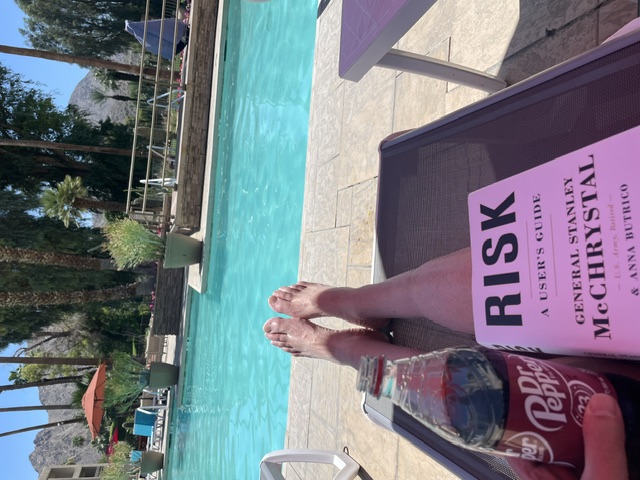
Palm Springs, California
Away from the still chill of the Midwest for the much warmer climate of the Left Coast. Here for my nephew's wedding.
Other than the flight here, I basically spent the rest of my day baking by the hotel pool.
Continuing to read up on the concept of "Risk" while on the plane and then by the pool.

Risk is the wrong question. It's risk versus reward! My profession was as an options and commodity trader on the floor of the CBOT. Everyday we would weigh risk versus reward on every trade/decision. No salary, you eat what you kill! Poker is the same. What are the odds my draw comes in, what are the odds he folds to my (bluff) shove, what are the odds he calls my shove and pays me off. It's all arithmetic. Learn what to do and when to do it. That's the whole game!
You just gotta be willing to flip a coin at some point (hopefully at a chip advantage). QQ vs AK? At some point you gotta be happy with either side of that and accept the outcome.
The bolded is the key part.
Early in a rebuy with an opportunity to build a substantial stack and play from a position of power? Sure, spin it up, or rebuy if you lose the flip.
On or near the bubble in a situation where losing would either eliminate or cripple you, and you're the calling stack (with action behind)? Probably not the right point to do so, unless you're a short stack.
After the bubble bursts but still a considerable time before reaching the final table, and with slow pay jumps? Yes, build a stack that can make a deep run!
On the final table bubble of the Main (or any bracelet event, for that matter)? It depends...see Jonathan Tamayo folding QQ pre with ten players remaining in the Main a few years ago.
Risk vs reward. Does the potential reward justify the anticipated risk?
This is a great post. Thanks TopGun!
Priorities
My daughter is close to buying her first condo. The price has been agreed upon. Final contract wording, inspector review and attorney review still to follow. The question of the closing date came up.
The seller requested a date that is smack dab in the middle of my upcoming WSOP trip. I told our broker the dates I would be out of town. The question came up as to how involved I would be in the process since we already have a broker and attorney. I said I hope I will not be needed at all if everything runs smoothly. But, I said, if any speed bumps/problems come up at closing I will be very much involved since my daughter has zero experience in this kind of transaction.
I didn't say it in so many words, but my WSOP dates are sacred ground, not to be unduly intruded on by the outside world. I can deal with a quick question/issue during a WSOP tourney break. I've dealt with that regarding my business in the past at the WSOP. But I'm not navigating a real estate closing during WSOP tourney breaks.
The buyer came back with a requested closing date of the day after I return from the WSOP. I'm not thrilled to return late at night and then have to turn around the next day for the closing. I'm sure after two weeks away, my desk will be piled high with items for me to address.
But while it's not ideal, it is workable. I agreed.
Sometimes life gets in the way of poker excitement
Feeling stressed. All kinds of stuff going on, none of it poker related.
My mom just got out of the hospital after an "episode" of some sort. She was having trouble find her words a few days ago. We had her go to the hospital in an ambulance and met her there. Initially, the ER neurologist said she was not having a stroke. A bunch of tests were run that showed no problems. They had her stay a few days, ran a bunch more tests and ... found nothing. As they prepared her to go home, the diagnosis was ... well, they're not sure ... maybe a mini stroke ... but none of the tests showed anything ... who knows. My mom's concierge doctor's opinion is that it was not a mini stroke. Lots of opinions, no facts. In any event, she went home today. My wife drove her home. As my mom's two-weeks-at-a-time medicine pill box preparer I had to make some changes in her pill boxes at her home tonight, I have to pick up a couple new prescriptions for her at the pharmacy tomorrow morning, then I have to go to her place and make additional changes to her pill boxes.
In addition, there are a million (OK, that a slight exaggeration) details I have to deal with regarding my daughter's pending condo purchase. Today I had to meet her at the bank to redeem bonds of hers to be used for a portion of the purchase. Tomorrow I have to proof/approve a Trust document created for her by my estate attorney to be used for the purchase, there is an earnest money payment to be made, there are documents to be accumulated to get the ball rolling on an insurance policy, the inspection date of the condo by our inspector keeps changing, her broker needs answers, her real estate attorney needs to provide some answers, etc., etc., etc.
And then there is work. I drove 90 minutes today each way to do my semi-annual on-site inspection of a shopping center with our property manager . Paperwork is piling up. Reports I have to read are piling up on my office desk. E-mails are piling up. I have to head over to my accountant's office at some point tomorrow regarding quarterly tax payments for my wife and I, my mom, my kids (everyone but my dog Astro) that will be due when I am at the WSOP, so I've got to get this done before I leave.
And my daughter is having us meet her boyfriend for the first time tomorrow night.
Other stuff is also happening, but ... enough ... you get the idea.
I am really, really, really good at compartmentalizing things, but even I am feeling a bit overwhelmed.
I should be enjoying the excitement that accompanies the start of the WSOP drawing near, but life is getting in the way. Deep cleansing breaths ... deep cleansing breaths ... Calming meditation ... Ommmmmmmmmmm ... I will be the rare WSOP MTT player who goes to Las Vegas to relax.

Hi RPP,
I can relate. Work is insane for me right now, I've got school aged kids going through there own stuff, and plenty of family things as well. I wish you the best to be able to continue to compartmentalize and at least settle enough for when WSOP begins so you can lock in and really have that needed getaway we all look forward to!
I'll be reading!
PardoG

Sometimes life gets in the way of poker excitementFeeling stressed. All kinds of stuff going on, none of it poker related.My mom just got out of the hospital after an "episode" of some sort. She was having trouble find her words a few days ago. We had her go to the hospital in an ambulance and met her there. Initially, the ER neurologist said she was not having a stroke. A bunc
How old? UTIs are often overlooked as a cause for confusion/delirium in older people.


Minor suggestion on quarterly IRS and state tax estimates - create an online account if you haven’t already done so for each. I finally pulled the trigger last year and I wonder what the heck I was thinking all those years. Can schedule them wait in advance to pullon a certain day, like June 15 when you’ll hopefully be hip deep on day two or three of a tournament.
How old? UTIs are often overlooked as a cause for confusion/delirium in older people.
85
Astro gets a free ride on our coattails in every aspect of his life.
How old? UTIs are often overlooked as a cause for confusion/delirium in older people.
This was true for my mother.
Created what is called a Delerium event which accelerated a descent from very early Dementia (which we hadn’t even recognised yet) to quite advanced.
Sent from my iPhone using Tapatalk
12 days to Las Vegas ... trying to get my house in order work wise ... time to scale back on poker studying ... fine tuning my mind ... avoiding last second new concepts that might blow up in my face ... excitement growing
I went in to work today (Saturday) and powered through a ton of stuff. I am pretty close to completely current. I hope I can maintain that the next 12 days until I head to Las Vegas.
I've also decided to take my foot off the accelerator from a poker perspective. I'm backing off poker studying. I think at this point I know what I know. It's not like cramming for a test at the last second. I don't want to fiddle around with new concepts this close to my WSOP. Instead, I will go into battle with the poker weaponry I have grown comfortable with over the last year since my WSOP 2025 ended. Trying out a poker weapon in the WSOP that I have barely practiced with is more likely to result in me shooting myself in the foot than it is to wreak havoc on my opponents.
The hay is in the barn.
What does that saying mean? Artificial intelligence (Gemini) says it "means that all the hard work, preparation, and training are complete, and there is nothing left to do but trust that effort and wait for the outcome." As I said earlier, at this point I know what I know. That will have to be good enough.
I will watch new episodes of Inside the Mind of a Pro (Leo Margets 2025 WSOP Main Event Final Table run) as they are posted, but that's it. New episodes only come out once a week or so. I want to head into WSOP 2026 with my mind feeling fresh.
I will fill my time the next 12 nights reading some of the stacks of books I have purchased but still not read. No poker books allowed. I always have a backlog of 30-50 books in my home office closet bookshelf, waiting for me to read them. I am currently reading a 748-page monster of a book titled "Those Guys Have All The Fun: Inside The World of ESPN." It was written in 2011. I bought it a few weeks ago in a used bookstore in my home town. My happy places are Michigan Stadium, the WSOP, and bookstores (new and used).
It's starting to feel real. My excitement for the WSOP is growing. Yet I know I have to pace myself. It's still almost two weeks until I set foot in Las Vegas. But the anticipation is building. Thanks to a growing number of LVL acquaintances that I will try to meet up with during overlapping schedules, I truly believe this will be my most enjoyable WSOP yet.
Enjoying a calm, peaceful day off work for the holiday. Building a reservoir of serenity in anticipation of the long hours and tough decisions at the felt to be made at the upcoming WSOP.
60% tranquility, 40% excitement that the WSOP is getting so close. The excitement meter is increasing rapidly by the day.
I did not plan on writing a love letter about the WSOP, but it just took on a life of its own
I watched the latest installment of Inside The Mind Of A Pro (episode 21, 2025 WSOP, Leo Margets) just for entertainment value tonight. Without looking for it, a certain hand I have been working on how to approach came up a couple of times, and Margets' play reinforced my thinking. I guess you never know when you can gain clarity on a poker situation. On a side note, Margets seems likely an incredibly likable poker player.
Then I watched the second half of Daniel Negreanu's $25K Fantasy Draft (2026 WSOP) on live stream for no apparent reason other than, why not?
I'm trying not to be one-dimensional, but I find myself increasingly consumed by poker thoughts. If I possessed the super power of time travel, I would fast forward to my plane landing in Las Vegas in just a little over a week.
I have an epiphany. Playing poker at the WSOP and watching Michigan football/basketball bring me equal joy. I never thought I'd see the day that I'd write/believe such a thing.
And large prize money has nothing to do with it. I don't really care about the money. I mean, I won't turn down the money. But what I really love is just being at the table during the WSOP. I can't really describe it other than to say I am in an incredibly happy place when I am seated at the WSOP.
What I am feeling now is the same anticipation and excitement as I felt in the build up to attending Michigan's national title game victories that I attended the last few years in both football and basketball. The passion I feel is similar to getting ready to go to the Michigan-Ohio State football games in The Big House in recent years when it has become a competitive rivalry once again.
The difference is I am just a (rabid, hard-core, obsessed) fan at Michigan games. Emphasis on the word "fan." At the WSOP I am a player. I get to compete, which is what I wrote about when I first started this journey and this thread. Let me repeat, I get to COMPETE. When I think ahead, I don't fantasize about winning a bracelet. I think about the sheer competition at my table of nine players. Just being at the table is enough for me.
Sure, I'd like to win a bracelet. Everyone would. But I don't need to win a bracelet to feel satisfied. I don't need to win a bracelet to feel vindicated. When my mind wanders, it does not go to me being at a final table. It simply has me at a table. A WSOP table. Just being at a WSOP table where I get to match wits with opponents in the most important poker series of the year feels bigger than life to me.
I get to compete at the WSOP. Again. And with every passing year, I feel a greater sense of belonging. I can't wait for the start of my WSOP 2026!
I didn't mean to write a love letter about the WSOP in this post. I thought I was simply going to write two paragraphs about what I watched tonight. Instead, out of nowhere, my poker emotions came bursting out of my fingers as I tap, tap, tapped away.
What I am feeling reminds me of a scene from the movie (original version) Point Break. The Johnny Utah character (played by Keanu Reeves) has caught the surfing bug and has just done an adrenaline-filled late-night surfing outing with a group of far, far, far more advanced surfers. Everyone else has called it a night except for Utah and a female surfer named Tyler (played by Lori Petty) who linger on their surf boards in the water. (https://imsdb.com/scripts/Point-Break.ht...)
TYLER
Look at you.
UTAH
What?
TYLER
Well, usually you have this sort of
intense scowl of concentration, like
you're doing this for a school
project or something... I don't
know, like something's driving you.
(she puts her
fingertip to his
forehead)
See, it's gone. If I didn't know
better I'd say you looked almost
happy.
UTAH
I... I don't know. I can't describe
what I'm feeling.
TYLER
(smiling)
You don't have to.
I watched the latest installment of Inside The Mind Of A Pro (episode 21, 2025 WSOP, Leo Margets) just for entertainment value tonight. Without looking for it, a certain hand I have been working on how to approach came up a couple of times, and Margets' play reinforced my thinking.
You are ready to 3-bet AJo like a madman? 😀
Your read is correct. A-J was the holding pre flop.
I wouldn't say I am looking to 3-bet AJo "like a madman," but I am prepared to 3-bet the hand opponent- and position-dependent. For example, if UTG is a very, very tight player and opens, I am folding AJo in the small blind. On the other hand, if it folds to the CO who is playing way too many hands and opens the betting, then I am 3-betting from the BTN. Or if the player who opens has shown a tendency to back down to aggression, this perhaps becomes another spot to 3-bet. In addition, my takeaway from the hands Leo Margets 3-bet with AJo in this episode had as much to do with her plan should villain 4-bet as it did with her decision to 3-bet in the first place.
In addition, my takeaway from the hands Leo Margets 3-bet with AJo in this episode had as much to do with her plan should villain 4-bet as it did with her decision to 3-bet in the first place.
Yes, gotta watch the stack sizes so that we don't become committed + actually follow through with the decision you have made. I sometimes have a problem with that, even if I originally have made the decision to 3-bet fold or similar.
Another good takeaway from Leo's hands is that you can actutally 3-bet fold off a 20 big blind stack, instead of going all-in. I think that is a very important consept in tournaments, although it's obviously easier to do so in Main Event (2 hour levels) compared to a tournament with 30 minute blinds.
Another good takeaway from Leo's hands is that you can actually 3-bet fold off a 20 big blind stack, instead of going all-in. I think that is a very important consept in tournaments, although it's obviously easier to do so in Main Event (2 hour levels) compared to a tournament with 30 minute blinds.
totally agree with this.
Albeit of course, there is so much more FE when you're 30 left in the Main than on day 1 of a standard event.
A different type of poker bubble
I'm currently watching Game 5 of the OKC-San Antonio Western Conference Finals on TV. I have pretty much watched every game of the NBA playoffs during this postseason. But I am certain from past experience that when I am at the WSOP and the NBA Finals will be taking place, I won't be watching any of it.
It's like everything in the outside world ceases to exist for me when I am at the WSOP. I don't watch sports. I don't have any idea what is taking place in the outside world in terms of the news. And it's not just me. No one at my tables ever talks about politics, current events, etc. It's a poker bubble (not the money bubble), and nothing from the outside world finds its way inside.
I love the single-mindedness of the ParisShoe during the WSOP.