Gray-haired poker TRs: Living the WSOP dream

At the age of 62 (AARP members unite!), I have decided that I will write a trip report for my 2024 trek to the World Ser

WSOP prep work: Should I hire Alex & Kristen Foxen, as well as Chance Kornuth, to coach me before the start of the WSOP?
Kristen and Alex Foxen and Chance Kornuth have announced that they are offering a three-day WSOP bracelet hunter bootcamp May 12-14, which is just a couple of weeks before the start of the WSOP
https://x.com/ChancesCards/status/205061...
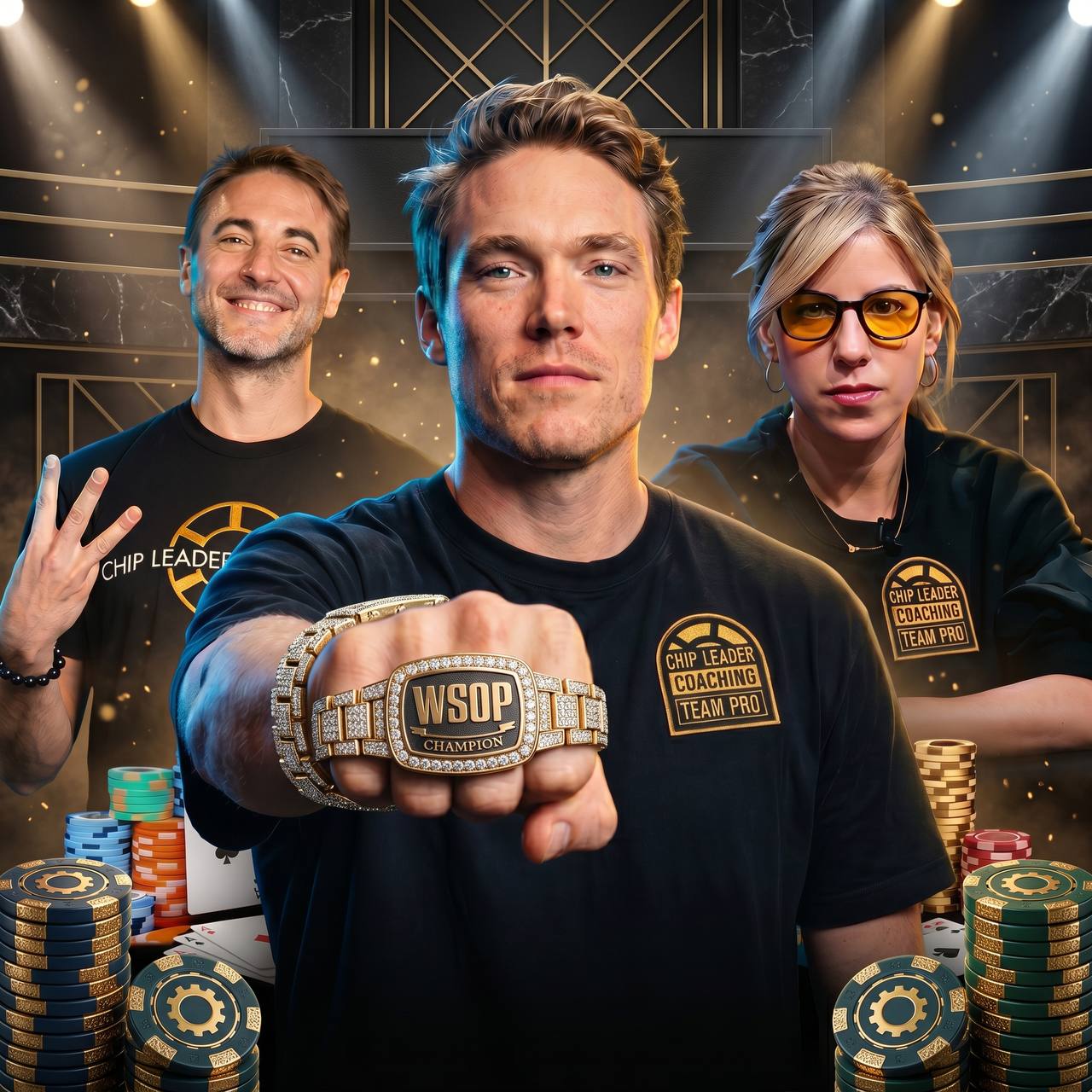
Their website proclaims, “Join this 3-day challenge and we’ll show you, step by step, how to dominate WSOP tournaments without confusing solver sims or complex strategies.”
The cost is $697 for general admission, $997 for VIP admission.
The site says this Bracelet Hunter Bootcamp “is designed for intermediate to advanced poker players who want to take their tournament game to the next level.”
Their itinerary is as follows:
Day 1: “Discover why most poker content is making you worse. We’ll reveal our exploit blueprint that earned is over $92M and teach you how to build a bullet-proof mindset.”
Day 2: “Learn how to build massive stacks on Day 1 and arrive at final tables with the chip lead. We’ll simplify ICM and show you how to punish opponents on the bubble.”
Day 3: “Master ‘Street Wars’ with inducing and bet sizing tactics for tough players. Learn the optimal frameworks for crushing multiway pots and our live tells secrets.”
The three nights of 2-3 hour sessions each will take place online.
I study their offering. I contemplate if it is worth doing.
There is no denying that the Foxens and Kornuth have a treasure trove of poker knowledge.
Nonetheless, it’s a really easy decision.
I will not partake. My reasons are as follows:
Reason #1: In my opinion, the timing of this poker bootcamp is terrible. I think they could not pick a worse time to do this. Since WSOP 2025, I have put in more volume than I’ve ever done before. I’ve played in a bunch of regional WSOP Circuit and MSPT tournaments. I also put in a lot of work in online tournaments (until my state government sent a cease and desist letter to the poker site). I am not claiming I have put in more volume than a professional poker player. I have not. But by my standards I have put in a lot of work on my game. To go to a poker bootcamp that will have me look at poker in a way completely different than I ever have just a couple weeks before the WSOP seems insane. A golfer doesn’t change his swing two weeks before The Masters. A tennis player doesn’t fire her coach two weeks before Wimbledon. This reminds me of the time 30+ years ago when I was golfing three times a week, and at the start of one golf season I decided to take golf lessons. In the short term it destroyed my game. Every week the golf pro I took lessons from would have me fix a new flaw in my game. After a month of this my swing was contorted into an unplayable knot. I was playing significantly worse than I was playing before the lessons. By the end of the summer, however, I was scoring better than ever on the golf course. I had to take two steps back before I took three steps forward
I don’t rule out the possibility/likelihood that the Foxens and Kornuth have thoughts that can help my poker game. But the ideal time for a WSOP poker bootcamp is after the WSOP, not two weeks before it starts. After the WSOP ends a player can take inventory of what worked and what didn’t in their game at the WSOP. Armed with an honest self-assessment, that is the time to hear what the Foxens and Kornuth have to offer. I get why they are doing the WSOP poker bootcamp when they are. From a marketing standpoint, now is the time to strike while the iron is hot. Players are fired up, panting for the start of the WSOP. Offering them a road map to WSOP success is advertising gold. But is it fool’s gold in the short term? Blowing up your game that you’ve spent the last 10-11 months working on for the WSOP seems like terrible timing. Tear it down to build it up AFTER the WSOP.
Reason #2: The promises seem too good to be true. They’ll “teach you how to build a bullet-proof mindset.” ... They’ll teach students “how to build massive stacks on Day 1 and arrive at final tables with the chip lead.” ... They’ll share “live tells secrets.” ... They'll "show you, step by step, how to dominate WSOP tournaments without confusing solver sims or complex strategies.” And they’ll do it in three short nights. I have no doubt the Foxens and Kornuth possess the knowledge and skills to be able to do all of these things when THEY play. But it took them many, many, many years - probably decades - to master the mysteries of poker. Contrary to the slick marketing, I find it impossible to believe three nights of bracelet hunting bootcamp can wave a magic wand and students will be able to suddenly crack the code in this WSOP. What they are offering is probably an interesting fork in the road that extends for miles and miles and miles and miles. It’s probably a nice step in the right direction. It isn’t going to get me to the Final Table with the chip lead two weeks later at the WSOP.
Reason #3: I don’t think I’m good enough to grasp the concepts I suspect the Foxens and Kornuth will share. As I wrote earlier, their web site says this Bracelet Hunter Bootcamp “is designed for intermediate to advanced poker players who want to take their tournament game to the next level.” I am all over the part about wanting to take my game to the next level. But I suspect that the Foxens’ and Kornuth’s concept of intermediate to advanced poker players are levels above the level of poker that I play. I suspect their thinking is six or seven levels higher than the poker thinking I am capable of at this time, which leads me to ...
Reason #4: Great players do not typically make great teachers. Back when I used to cover the National Football League for a national publication, I noticed that it was rare for a true great of the game as a player to become a great coach. I’m not saying it never happened, but it was not common. I talked to some NFL coaches about this and the consensus was that superstar players have a difficult time teaching others. The reason is that they played the game at such an elite level that they have difficulty coaching players who cannot do things that the all-time great thinks is the norm. That is my concern about elite poker players like the Foxens and Kornuth. Can they teach at the level of lesser players? I’m not saying they can’t, but it is a very difficult skill set for superstars.
I hope the Foxens and Kornuth do well in this endeavor. I hope the product is great. I hope that players of a caliber better than me are able to find success from this bootcamp.
But they’ll have to do it without me. I’m going to take a pass.
WSOP prep work: Tipping
I'd like to call upon the expertise of LVL regs who know their way around the payout desk/cage at the WSOP.
I'm never sure what to do when I cash in a WSOP tournament and when I am at the payout desk /cage they ask if I'd like to tip the dealers/staff/etc.
Let's use the upcoming Colossus as an example. $500 buy-in. With four Day 1s and one re-entry per day a person can conceivably be in for up to eight bullets. Also factor in the fact that the structure sheet states that 11.9% from each entry will be held withheld for entry fees, and 5.1% from each buy-in will be withheld for tournament dealers.
Scenario 1: If you min cash on one bullet and you get $1,000 (your buy-in was $500). So you have made a $500 profit. How much do you tip?
Scenario 2: If you min cash on two bullets and you get $1,000 (your buy-in was $500). So you break even. How much do you tip?
Scenario 3: If you min cash on four bullets and you get $1,000 (your buy-in/re-entries were $2,000). So you have lost $1,000. How much do you tip?
Scenario 4: If you run deep on a single bullet and turn an $80,000 profit, how much do you tip?
Scenario 5: If you win the tournament and win $542,540 (last year's winner), how much do you tip?
Please respond: No tip, a dollar amount or a percentage.
No tip. They already take a % as a staff fee so in effect you're tipping every time you buy-in to the tournament weather you cash or not.
Maybe if the cashier was super nice or someone went above and beyond to help me then I might give something additional, but they would still have to pool that I think.
If I see dealers or staff outside of work at the bar or something I would always buy them some drinks.
WSOP prep work: The difficult path to “I don’t f^*king care”
Brian Rast and Phil Laak have just started a brand-new podcast titled “Late Reg Podcast.” Their guest in Episode 1 was Eric Wasserson (career live tournament earnings $8,907,467 per Hendon Mob).
The podcast ran a bit over two hours. There was one passage that grabbed my attention. They were talking about when a tournament takes a turn for the worse for you where you go from a huge amount of chips to a just above-average stack and you are thinking about all the chips you once had. Initially I thought to myself, “I never go on tilt. This doesn’t apply to me.”
As the discussion continued, it became clear to me that this had nothing to do with tilt avoidance. Instead, it had to do with something entirely different that very much applies to me. The subject was caring too much about your tournament life. I know I place way too much emphasis on staying alive in a tournament, which can be exploited. My aversion to getting knocked out of a tournament means I don’t go for thin value enough, I don’t three-bet bluff enough, and I probably fold too much when an opponent asks for all of my chips with their betting aggression. I have been working on all of this the past 11 months ... but ... pause ... man I love being in a tournament. I don’t want to give up my seat. The problem has been identified. Can I do something about it? Back to the podcast ...
Rast: “Dude, you’ve got to go Buddhist. Attachment to the past is suffering.”
Wasserman: “Is it fun to not have any suffering? I don’t know.“
Laak, “I don’t know either, but I do believe that attachment is the root of all suffering. And it is very wise and very strong. I try to get to a place of non-attachment but even though I know that is the trick ...”
Wasserman: “It’s hard. Also, you are really lying to yourself if you’re like, ‘It’s fine.’ You’re lying.”
Rast: “I don’t find that to be, one of the things I tell myself, and when I know I believe it, two things I tell myself when I’m feeling this way and I’m being authentic and true and I know I’m going to play great is having fun and the other one is, I don’t f^*king care.”
About a specific Razz tournament, Rast said, “That whole tournament I had this great monologue with myself because it was so swingy. I’m like, whatever happens I’m very happy and satisfied. If I go out the next hand, because I’ve played great and that’s all I can do, then I don’t f^*king care. Because when you care about the result, that’s when the sh#t starts happening.”
Wasserson: “You’re attached to the result, which then makes you attached to not losing. And when you’re thinking about not losing, it’s hard to win.”
Rast: “... It doesn’t matter. If I go out next hand all that matters is how I’m playing. I’m satisfied with that ... great. I don’t f^*king care. I’m having fun and I don’t f^*king care.”
Wasserson: “Not being scared to not be in the tournament any more is a huge edge.”
Rast: “It is.”
Wasserson: “Which is hard to get to.”
Laak: “I overfolded, it was like 8-9-Queen, I folded A-Q like a total banana head. And I remember thinking, ‘Oh, it’s because I was so attached to being in the tournament.”
Wasserson: “Everyone but one person is going to lose at some point. It’s just a matter of when.”
As Wasserson said about not being scared to bust out, it’s a hard place to get to. I suspect this is something that I will have difficulty achieving in a few weeks at the WSOP.
I need to get to a point where my reaction is “I don’t f^*king care.”
The reality is, I do care. Too much. Which is a problem.
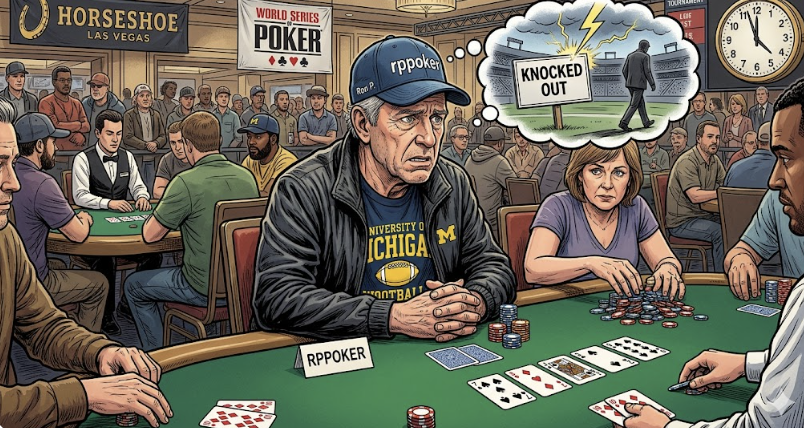
(Interesting aside, I did not tell A.I. to have me wear a Michigan sweatshirt. A.I. did this on its own. A.I. is learning.)
WSOP prep work: The difficult path to “I don’t f^*king care”
The reality is, I do care. Too much. Which is a problem.
I hope your efforts to care less bear fruit. As I've said to you before, your best weapon is that you don't have to play for a living. They should be afraid of you, not the other way around.
Any player who's played a ton of cash can attest to the following- when you're playing in your comfort zone, within your bankroll, you can play with a freedom betting/raising/moving at speed in a way that is really hard to describe. It's moving in a flow state almost- practiced motions and decisions that are made subconsciously, bc you've done them so many times before, AND you're comfortable executing without thinking. Importantly, players who've played in this state many times can recognize when others AREN'T in this state. Whether they're fumbling chips, taking too long to make trivial decisions, giving off tells etc- the uncomfortable/scared player just gives off waves of, well, feeling uncomfortable.
The few times I've played above my bankroll I've never been able to achieve this state. And every single time I've just run over a table I've been in this state. Lastly, I can tell you I will target scared players without mercy (as anyone would). I'm curious to hear what you're going to do to change your current mental attachment.

I don't care! Lemme explain. I care a lot! But what I care about is making the "right" play. Getting it in good and accepting the result and knowing I wasn't stupid about it. Then again sometimes I am stupid about it and I get knocked out and I obsess over that stupid play for months. But every time I do/have done that is a learning experience and I vow to focus extra hard the next time. I need to take a breath and focus so I don't act too impulsively which is a leak of mine. Take a breath, give it a deeper thought and then act. That is my credo for this summer.
Also I am working hard on a non-poker activity to help this summer. I am working hard on a body clock shift which is difficult (for me anyway). I have always been an early to bed early to rise type. My professional career demanded it. This is problematic when shifting to Pacific time from Central time. Plus I seem to always sleep bad in an unfamiliar (ie hotel) bed. So I am trying to stay up way past more normal "bedtime" and sleeping in. Problem is I often doze off in my lazyboy and even when I stay up my bodyclock still gets me up way too early. But I still have a month and am optomistic I will get on Vegas time by the time I get there.

It's natural to feel a heightened sense of pressure when most of your poker "season" is compressed within a few weeks. A local reg or traveling grinder can shrug off a run of bad results and fall back on the comfort of "Tomorrow." That's harder when there's less leeway to fire volume. If you brick a WSOP trip, you might be waiting 12 months for another chance. That will naturally create a fear of busting and an exaggerated sense of pressure. A perspective shift might help the mindset.
My spreadsheet shows I've played 229 live MTTs since 2018 with 42 cashes (18.3%). Even with an ITM% well above random chance, I've had cashless streaks of 16, 14, 13, 14, 18, and 14. My longest streak online in my PokerStars heyday was much longer, and that account was profitable on a sample in the thousands. I've been fortunate to have never had an 0-for-summer yet, but I've had many 0-for-trips in live poker. I've had several Vegas trips without a cash. If we isolate a specific venue, I'm currently on an 0-for-20 streak at the Venetian. All of which is to say that anyone who fires reasonable volume is going to go splat sometimes. It's an inevitability.
Knowing that these cold streaks are always lurking can help us emotionally detach from outcomes so that we can focus on process instead. It goes back to what I mentioned previously about putting less emotional stock in cashing/not cashing. If we view cashing as success and not cashing as failure, we are setting ourselves up for disappointment when we run bad. We also might push ourselves towards sub-optimal decisions in spots where we can overvalue the prospect of survival and cashing compared with our pure EV.
Consider this insane spot from the hand-for-hand bubble of last year's $10k Main:
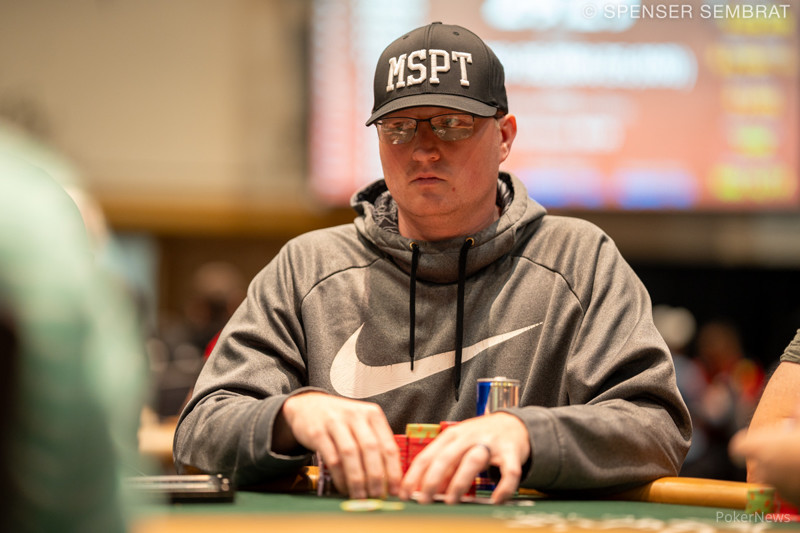
I couldn't make that call. Probably 98+% of the players in that field couldn't make that call in that spot. Most recreational players would value the prospect of cashing the WSOP Main over the chance of being right and winning a huge pot. They would be terrified of going broke there. They would rather be able to say, "I cashed the Main Event." Reichard was able to find the call because he's a veteran grinder who was operating without fear of failure. It's something to aspire to if we are really trying to maximize our results.
If you step back and look at your situation, I think you have some big advantages that can help you play in a more carefree manner. You've already cashed a couple WSOP tournaments. The first cash is psychologically important. That's a been-there, done-that for you. There is no pressure on you to cash for the sake of being able to say you cashed. Nobody who understands MTTs will think you're a fish or a failure if your trip ends with an 0-for-everything. Additionally, you aren't playing poker to pay the bills. Bricking your schedule won't compromise your everyday life. Nobody is backing you. There's no danger of make-up. You aren't going to be on anyone's 25k fantasy team. They aren't going to be bad-mouthing you if you have a brutal summer (I overheard some of this last year from two A-list pros about another known pro on their team 😃).
Step back and look at the bigger picture. What pressure is there on you to get results? Only the pressure that you put on yourself. That should be liberating. You can fail spectacularly and it won't have any significant tangible impact. With that in mind, you are in great position to play fearlessly. My advice would be to play your A game, make the best decisions you can in the spots that arise, and let it ride. Hopefully you get some great results. If not, you shouldn't linger on outcomes if your decisions were sound.
And while 12 months is an agonizingly long time to wait, there will eventually be another WSOP. You will have a chance to do it all again.
A+ post by DogFace. What he said.

This thread, namely the last 15-20 posts has me rethinking my start for my trip one month from today. My upcoming TR will need some rewrites.
Leon, you wrote, "I'm curious to hear what you're going to do to change your current mental attachment."
I'm not going to puff my chest out, work myself into a testosterone crazed state of aggression so that I don't ... get ... pushed ... around.
What I will do is not think to myself, what happens if I'm wrong? I will not ask myself, how many chips will I have left if I'm wrong? What I will try to do is study the spot, take my time and decide what I think the right play is, and then letting the chips fall where they may. Giving myself the grace and permission to be wrong, but hopefully be right.
I don't think I can give myself a pep talk or say ahead of time I'm going to do X to avoid being overly attached to my tournament life. I think I simply have to try to stack as many good decisions as possible, regardless of outcome/variance.
There really is no magic potion. I don't think I can say I am going to do X, Y and Z to avoid playing scared, to avoid over attachment to my tournament life. I just need to instinctively not be scared. That takes work. That takes time. That doesn't happen overnight. It comes from experience and having success. It's hard. It's something to aspire to. It's something to work toward.
While I'd love to tell you I have unlocked the mystery, that would just be bluster.
I have identified the problem. That is an important first step. But it's just the first step. Now comes the even harder part. Let's see how my trip goes and then I can say whether I made any progress or not. I will say this, with every passing WSOP I play in, getting knocked out of a tourney gets less painful than prior years.
Dogface, thank you for an incredibly insightful post. You should become a poker wellness coach because you always seem to get me and get what I am feeling.
One thing you wrote that especially resonated with me was, "If you step back and look at your situation, I think you have some big advantages that can help you play in a more carefree manner. You've already cashed a couple WSOP tournaments. The first cash is psychologically important. That's a been-there, done-that for you. There is no pressure on you to cash for the sake of being able to say you cashed. Nobody who understands MTTs will think you're a fish or a failure if your trip ends with an 0-for-everything."
This is something that I have absolutely been feeling in the build up to this WSOP. I have felt it, and I actually put it into words for something of a rough draft for the prelude to my WSOP that I have been working on.
In my first WSOP, I did not cash, which I found embarrassing at the time. Which in hindsight is absurd. That said, I actually played very well only to get brutalized by horrible variance and one major cooler. I left looking for answers, but the answer was I would have cashed (maybe more than once) were it not for terribly bad luck and the one major cooler near a money bubble. But when friends would ask if I cashed, I'd feel bad saying no. It's not like you can go into a lengthy litany of bad beat stories. No one wants to hear it. Looking back, I bricked four tournaments which is nothing shameful and there was no way to have avoided the horrendous run outs I experienced.
In my second WSOP I cashed. I had crumbs when the bubble burst, but I cashed. That took the pressure off. In my third WSOP last year, I cashed again and this time I ran quite a bit deeper than my previous cash. Two WSOPs in a row with a cash. Now it's a trend. It's a small trend, but it's a trend. I've taken progressively bigger steps each year. In the rough draft of my build up to this summer's WSOP, I identified a goal. You'll read about it down the road. But here is the thing, it is a goal without me feeling any pressure to achieve the goal. If I do not cash this year, I will not be destroyed. Disappointed, yes. Destroyed, no. It's a really freeing feeling.
I'm also looking forward to two straight weeks of volume. When I have played live non-WSOP events the last 10 months it has typically been one single tourney. It's tough to get a result when it's one tourney and done. And even at that, I did get a result, finishing third in a tourney in Florida for my biggest financial score to date (not massive, but it was a high water mark). Playing in a tournament every day for two weeks eliminates single tournament pressure. Get eliminated. Re-enter. Get eliminated again, there's a new tournament tomorrow. I think this will go a long way toward me not getting overly attached to a specific tournament.
I can't wait.

WSOP prep work: Excerpts from podcasts I found interesting
Mustapha Kanit on Jonathan Jaffe’s GTO Lab podcast
Mustapha Kanit: “You have three things to make a decision. One comes from your head, one comes from your heart, one comes from your gut. Sometimes they say three different things. Like one is right and the other is wrong. Like sometimes your gut is so strong, telling you like something is off, something is off, something is off.”
........
Joao Vieira on Jonathan Jaffe’s GTO Lab podcast
Jaffe: “A few weeks ago, I’m playing table tennis against a guy I play a lot with. We’re very familiar with each other’s game. He puts me in a really bad spot and I take a desperation shot from very far away very aggressively. And if I’m being honest, I would guess I’m probably about 3 to 5 percent to put this shot on the table. And in that moment, I actually believed it was going on like as I swung the racket. And I missed. I actually missed by a fair amount, which is exactly what would happen most times. But I was playing phenomenal for me up until that point. And that’s why I somehow believed this. And I told him after that game, before our next game, I was like, ‘This is some pretty delusional sh^t, I actually thought that was going on.’ And in our little conversation, I was saying to my playing partner, I actually view that as a good thing. That I was that delusional correlates to me playing really well and continuing to play well. And there’s this weird thing that I think most athletes will agree to, which is in many ways, you don’t want to feel like a rational objective arbiter when it comes to your game. You kind of want to just believe you can. Now, you don’t want to believe you can do anything where you’re just going to pull up from half court and shoot threes. But you want to believe you’re going to make it when you drive to the bucket if you’re maybe 45 percent in reality, I think it’s healthy to have this belief that you’re 60%. Except for when it comes to, hey, you’re supposed to pass instead. But navigating that in poker, it’s much less clear. I think most of us are just like, whoa, you can do some really bad sh^t if you’re too confident. How do you view this? And how has it been in your own journey throughout the years as far as being too confident, not confident enough? How do you find that sweet spot. And do you have any identifiers that help you say, ‘I’m in the sweet spot right now,’ or, ‘I’m playing with too much or too little confidence.’ “
Vieira: “It’s how you just detach yourself from the decision as well. So, if you want to believe you’re going to make the shot, that’s extremely important. But you also want to choose which shots you take because ... that’s the hot hand bias in the NBA or this culture. You’re running hot, give him the ball, and then the guy is shooting with two guys just hanging by his neck and he’s also taking terrible shots. ... Maybe being overconfident will make you underperform. I think underconfident would definitely make you underperform. Just the right amount of confidence I think is the best.”
Jaffe: “How do you ... (find just the right balance?)
Vieira: “That’s one of the most important talents in poker.”
WSOP structure sheets
I printed out the structure sheets today for the WSOP tournaments I will be playing in.
It was not easy to find these structure sheets, which means either, 1) I am lame and missed the obvious place to find them, or 2) Inexplicably, the WSOP has made the structure sheets difficult to find.
Assuming I'm not lame and the structure sheets are in fact difficult to locate, here is the link ...
WSOP structure sheetsI printed out the structure sheets today for the WSOP tournaments I will be playing in.It was not easy to find these structure sheets, which means either, 1) I am lame and missed the obvious place to find them, or 2) Inexplicably, the WSOP has made the structure sheets difficult to find.Assuming I'm not lame and the structure sheets are in fact difficult to
You are absolutely correct. I just added that link to my Structure Sheets page, but there should already be a WSOP Las Vegas link on the
, and that should point to a list of tourneys with their structure sheets.
I'm still working with them to get 2025 results posted, so please don't bother them yet ;-).
https://assets.wsopcdn.com/wsop/a74347e9-7a68-40bc-9cd6-3e01db3d3234.pdf
Is an updated link to the structures. Unknown what might be changed specific to you but the main event no longer has dinner breaks on day 1-3 and rest of day are shortened.
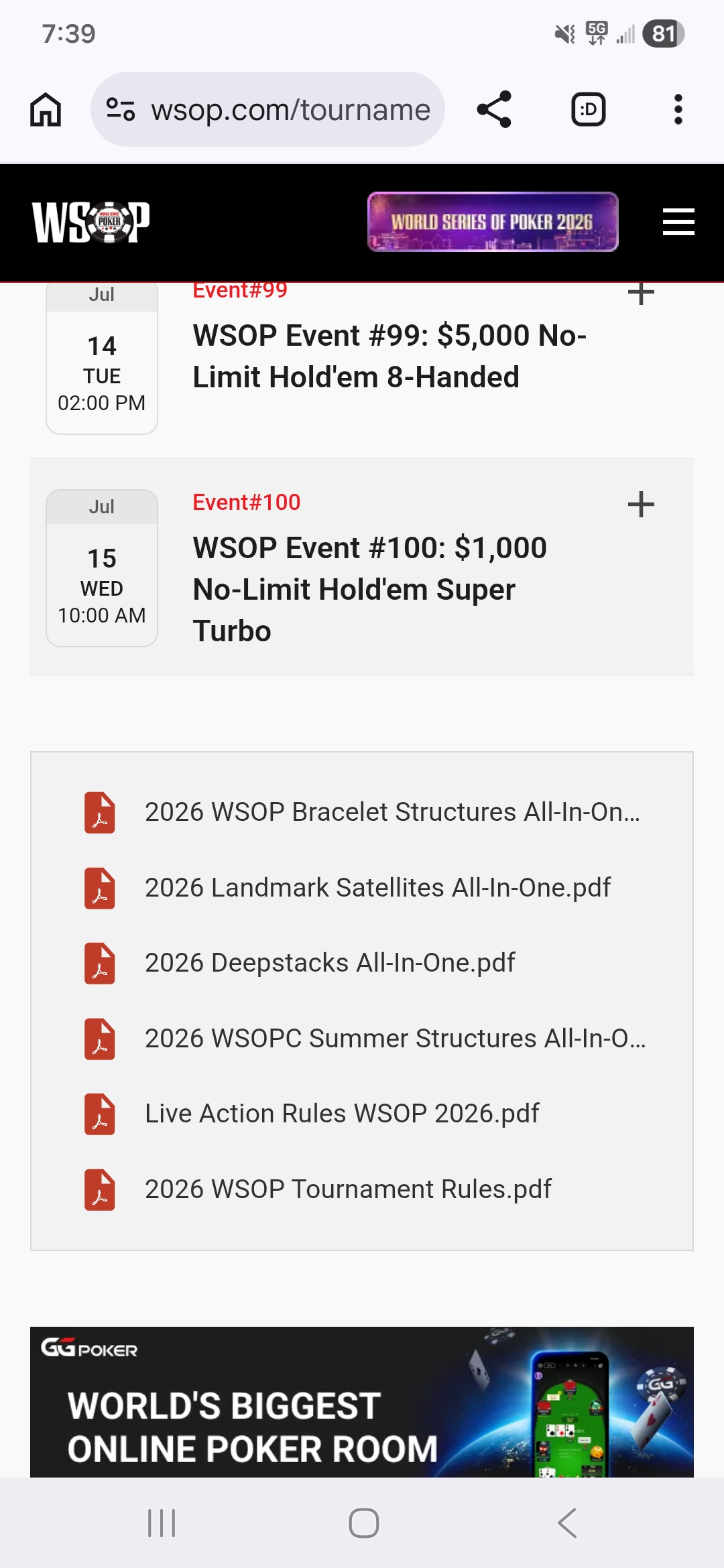
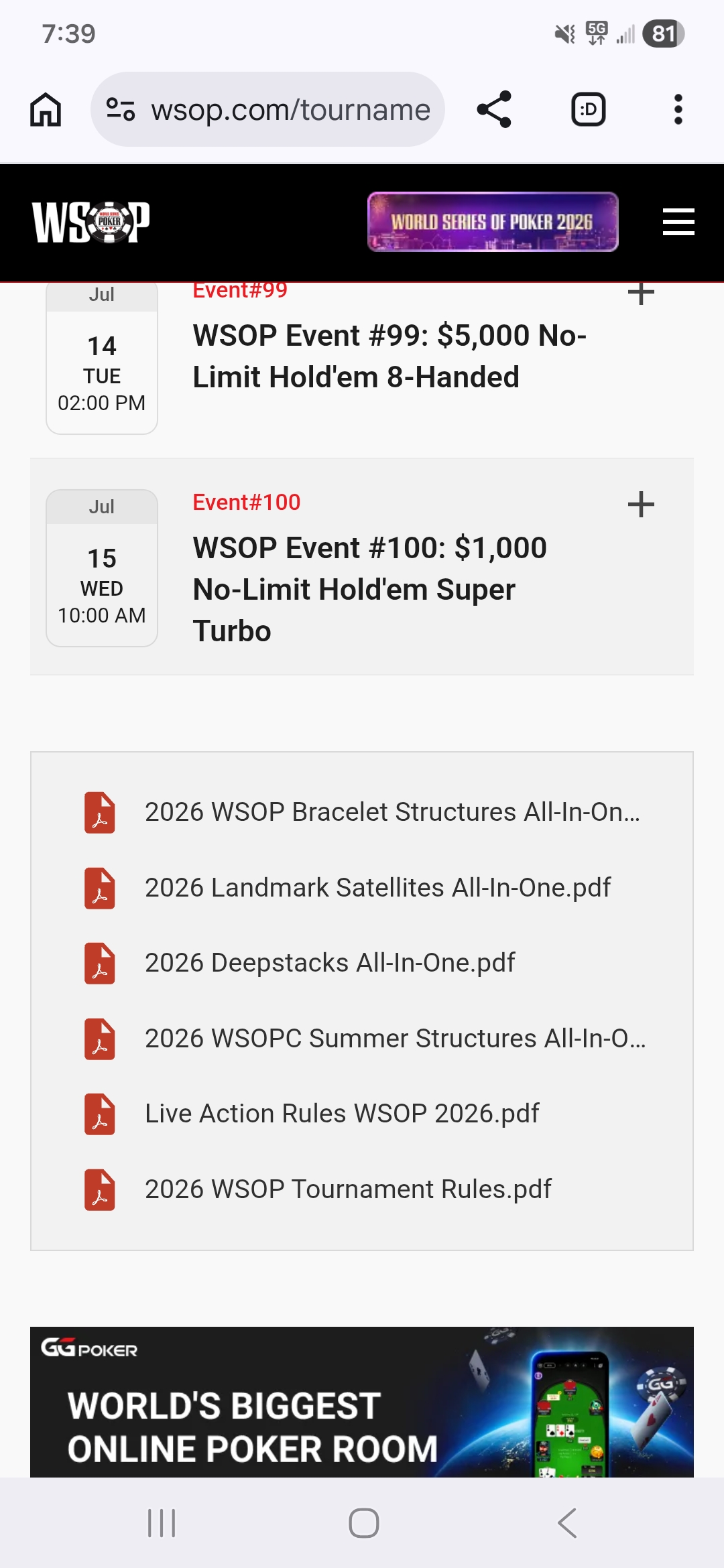
But anyway, the structure can ve found on the bottom of the schedule page if on mobile. Maybe to the right on desktop.
WSOP prep work: A deep(ish) dive into the concept of risk
I went to dinner tonight with Mrs. rppoker, and afterward she had some shopping to do at a couple of stores in the shopping center we were at. There was a Barnes & Noble next store to one of the stores she wanted to go to. She knows that I can entertain myself for very long stretches in a book store. Win-win ... she can shop for as long as she wanted, and I won't get impatient.
While I was wandering around the bookstore, I had a thought. I have finished watching the WSOP Paradise Super Main videos where the viewer gets to see every players cards at a featured table, and my intention of watching Day 1 videos of WSOP Europe went by the wayside a day or two ago when I realized that the coverage included three featured tables at all times, which they bounced around very frequently, so I determined that I can't really get reads on players at one specific table. One featured table is a learning opportunity. Three featured tables significantly reduces what can be learned. This undesirable three table approach has caused a gap in my tournament preparation since I have bailed on watching WSOPE. Now what? What do I work on? That is when the aforementioned thought popped into my head at the bookstore.
Here in this thread, Leon has frequently encouraged me to have more gamble, to take more risk in my approach to poker. That is the thought that popped into my head.
Risk.
I decided to see if I could find some books on risk. Not pure poker books dedicated to risk. I mean, come on, the only poker book I could find in the entire store was an old copy of Doyle's Super System. One pure poker book. One! Instead, I looked for books dedicated to simply risk.
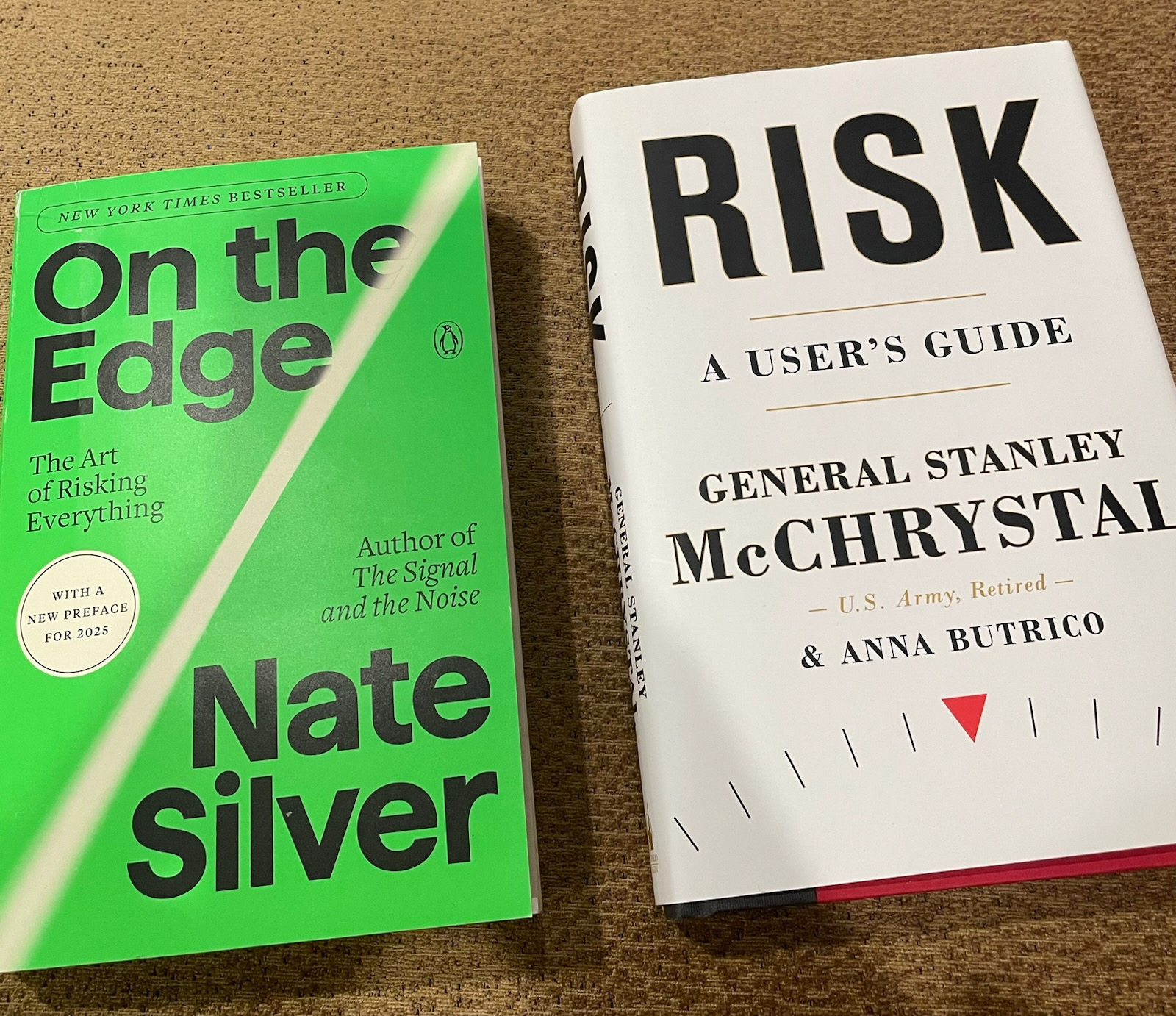
The first book I found was Nate Silver's book "On the Edge: The Art of Risking Everything." Risk. Yes, there is a poker component to the book, but poker is simply one aspect of the story that wiil be told. According to the back cover of the book ...
"In a world wired for chaos, these players are rewriting the rules. High-stakes, high-IQ, and often high on their own mythologies, they are driving the next era of finance, tech, and politics. But what happens when the bets go too far?
"Nate Silver's On the Edge reveals the hidden world of the River. It is the domain of gamblers and like-minded folks who move markets and change the fabric of society: poker legends, hedge fund titans, crypto speculators, and even those willing to bet the world's future on AI. They are obsessives with a deep hunger for volatility and an unrelenting desire to exploit every edge over the rest of us. Silver embeds with them, competing in the World Series of Poker, visiting Sam Bankman-Fried's FTX compound, and attending wild Miami yach parties at the height of the crypto bubble."
The next book I found is simply titled "Risk."
On the inside cover of the book, it states, "Retired four-star general Stanley McChrystal has lived a life associated with the deadly risks of combat. From his first day at West Point, to his years in Afghanistan, to his efforts helping business leaders navigate a global pandemic, McChrystal has seen how individuals and organizations fail to mitigate risk. Why? Because they focus on the probability of something happening instead of on the interface by which it can be managed.
"In this new book, General McChrystal offers a battle-tested system for detecting and responding to risk."
As I see it, this outside-the-box approach to contemplating poker risk through the eyes of these books will either be inspiring or a complete waste of time.
At this point, however, since WSOP 2025 ended I have watched a ton of poker streams, I have played more live poker than ever before and I played a whole bunch online for a stretch. In terms of WSOP 2026 prep, I think I have advanced as far as I can using these opportunities given the fact that the WSOP is almost upon us. So why not try something different?
Best case scenario, I learn something about risk that perhaps applies to tournament poker if my intellectual curiosity allows me to connect some dots. Worse case scenario, this is a complete waste of time from a poker perspective, but the book worm in me enjoys a couple of otherwise entertaining books.
From a risk perspective, there is upside and very little downside (unless I take these lessons in risk and apply them incorrectly/stupidly to poker). My instincts say this is a win-break even scenario, which strikes me as a good bet.
WSOP prep work: I take zero offense at this characterization of tournament poker players
Excerpt from book I'm reading by Nate Silver On the Edge: The Art of Risking Everything discussing tournament poker:
"I'm not sure there's another popular activity where complete failure is such a common outcome.
"At most poker tournaments, only 10 to 15 percent of the field is paid out. Good players will have a higher cash rate than that, but not necessarily a lot higher -- part of their advantage is in being able to accumulate lots of chips and being one of the top finishers and not just garner a 'mincash.' Indeed, in large tournaments, the real money only goes to roughly the top 2 percent of the field. Most of the time, it's just lose, lose, lose, mincash, lose.
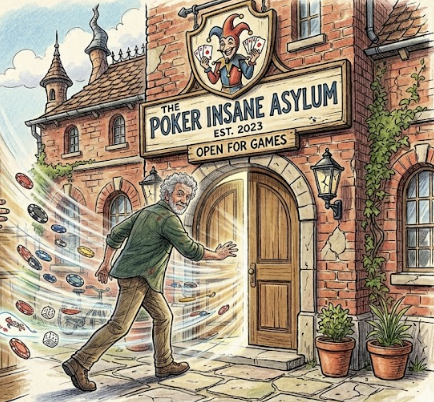
"That's why tournament players are inherently a bit insane."
I can't argue with this assessment. I'm not offended by this characterization. And yet, here I am, just a few weeks away from playing two weeks of nonstop tournament poker at WSOP 2026. It is one of the highlights of my year.
Insane?
I think tournament poker is insanely fun. Insanely challenging. Insanely exciting. Insanely difficult. Insanely exhilarating.
I don't fear the insanity. I embrace the insanity.
[B][U]
I think tournament poker is insanely fun. Insanely challenging. Insanely exciting. Insanely difficult. Insanely exhilarating.
I don't fear the insanity. I embrace the insanity.
Yes! Being in a poker tournament is one of my favorite places to be. Even better yet is being in one with a large stack. Even better with that stack in the money and better yet with that stack at the final table. The competition, pressure and exhilartion are hard to match anywhere else. Just gotta know you will brick a high percentage of chances (often through no fault of your own). The few deep runs make up for it.
If you're tired of your bank constantly blocking transactions because of weird merchant codes, you should probably try Evoplay Arena. I’ve had zero payment drama there since I switched, which is honestly a miracle these days. Link to the platform: https://arenaevoplay.games/?utm_source=forum&utm_medium=shilling&utm_campaign=aren_launch
WSOP verification is live on the WSOP app. It is incredibly easy to get verified. Even an old-timer like me found it simple to navigate. I didn't even need to ask my kids for help. You will need to find your password that you created last summer.
The WSOP app introduced last year was/is such an enormous improvement over prior years that it cannot be overstated. Just a massive leap forward in customer service. I need to remember this when I have something I want to complain about next month at the WSOP (the overwhelming early favorite being, it's too cold in the primary poker ballrooms).
A near WSOP 2026 bad beat even though I won’t arrive in Las Vegas for several weeks
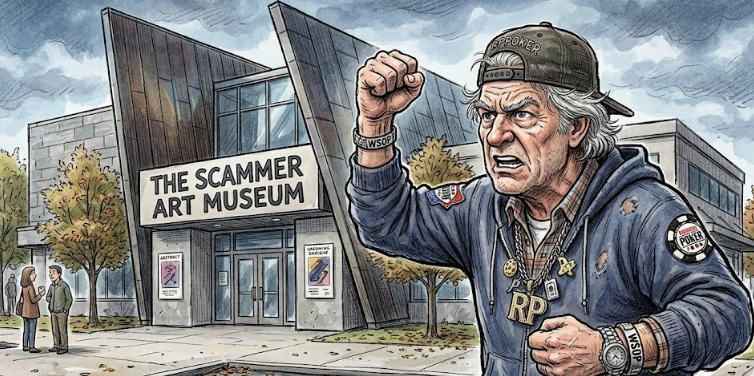
People suck. Not all people. But people who are scammers suck. And it seems like the number of potential scams just keeps getting bigger and bigger and bigger.
The amount of scam e-mails that I move to the junk bin on my laptop keeps growing and growing.
I think I am pretty good at recognizing a spam/scam e-mail. But sometimes one almost gets through my defenses. Today was such a day.
I got an e-mail from the Airbnb host of the place I will be staying at for the upcoming WSOP. It said I needed to reconfirm my reservation. The e-mail was perfect. The e-mail address it came from was not like the ridiculously long addresses you so often see in spam e-mails. Also, no typos or strange phrasing. So, I clicked on the link provided. It took me to like an identical version of my Airbnb portal page. Everything was pristine. A perfect recreation right down to all of the correspondence I had with my Airbnb hosts in half-a-dozen trips over numerous years.
I clicked on the link provided to reconfirm (the e-mail said the reservation wouldn’t become official until I did so) and they asked for things like my credit card info and how much my booking was for. I typed in my credit card info but I did not fill out the box asking for how much my booking was for. This made no sense. Why would they need this information?
So, I bailed and went to the official Airbnb site and logged in. The same request for me to reconfirm was there. I mean, I went thru the official site. I logged in. I guess my spidey senses were wrong.
I filled out the reconfirmation information but I did not fill in the box asking for how much I booked for. I hit send. It did not go thru, and it redlined the box I had not filled out with how much I had already booked for/paid previously.
You know what, my spidey senses were screaming to me, “Abort. ABORT!!!”
I listened. I aborted. Then I looked at my original reservation document, and I found a phone number for my Airbnb host. I called and to my surprise a person answered. Usually, Airbnb hosts want you to send a text thru the portal. I told the woman who answered why I was calling. She immediately said, “It’s a scam. Our I.T. people are looking into it. You do not have to reconfirm. Don’t send them any information.”
I got off the phone, and I immediately called my credit card company. I asked for fraud protection. I told them what had happened, and we canceled the credit cards Mrs. rppoker and I use. We are getting ready to go to a wedding out of state, and I asked if there is a way to expedite the new credit cards so they get sent overnight. The person I was talking to said that service is available, but it was an hour too late to do so. We arranged for the new credit cards to be sent to the hotel I will be staying at for the wedding.
Which is inconvenient but not cataclysmic. Problem solved, I guess. But it will be a pain in the neck traveling without my main credit card. There are work arounds, so it’s not catastrophic. I’m trying to maintain a positive mindset.
But I am getting sick and tired of all the scammers. It seems like I have to cancel my credit card every 3-4 months because of fraud. I actually had to cancel my credit card when I made the hotel reservations for this wedding a few months ago, because there was a scam site for the hotel where the wedding is being held that we ended up on. Fraud protection canceled the charges the scam site/company tried to put thru.
It’s amazing the sophistication of some of these scam sites. The Airbnb hack/spoof and the fake hotel site absolutely look like the real thing. Tremendous realism and attention to detail. A scammer work of art if you take the emotion out of it.
On the other hand, these scammers suck as human beings!
As I was typing this, the real Airbnb host for my stay sent an e-mail acknowledging that their Airbnb account “may have been compromised.” And by “may” they really meant “was compromised.” They spelled out the hack, said what not to do, and said if you did what they said not to do to call your credit card company and cancel the card and request a new one.
Not their fault, but a little bit late to do me any good. But all things being equal, they did send the e-mail pretty quickly. Just not timely enough for me to avoid having to cancel my credit card.
I haven’t even set foot in Las Vegas for the 2026 WSOP and I am already having to dance thru the raindrops of a potential trip bad beat.
People suck. Not all people. But people who are scammers suck. And it seems like the number of potential scams just keeps getting bigger and bigger and bigger. The amount of scam e-mails that I move to the junk bin on my laptop keeps growing and growing.I think I am pretty good at recognizing a spam/scam e-mail. But sometimes one almost gets through my defenses. Today was such
I actually read about this specific AirBnB-scam on Twitter/X two days ago, and how it was very professionally designed and hard to spot. Glad to hear you didn't completely fall for it, and it's a good reminder to listen to spidey senses also at the poker table 😀

