[extracted] New(?) 9-11 stuff
KSM got a plea deal. The guy who supposedly masterminded the 9/11 attacks is not getting the death penalty.
If you still

Of all the nonsense billy talks this approximation is trivial. It's just the result of taking only the first two (linear and quadratic) terms of the Maclaurin expansion for cosθ, which for small values of θ is very accurate. Assuming I did the calculation correctly then even over distances of hundreds of miles it's accurate to within 0.1% (I think it creeps over that
Yeah, with the coefficient he arrives at, it looks to be a decent enough approximation around the point of tangency:
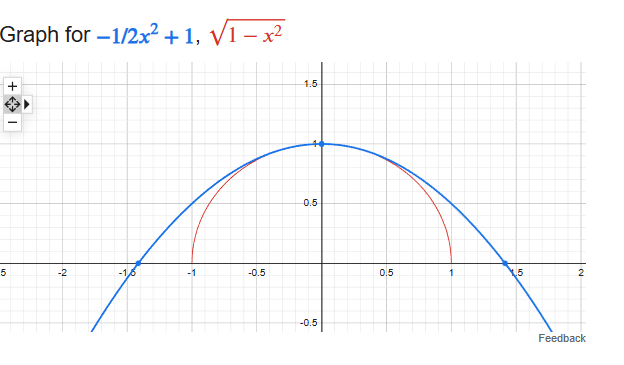
Error:
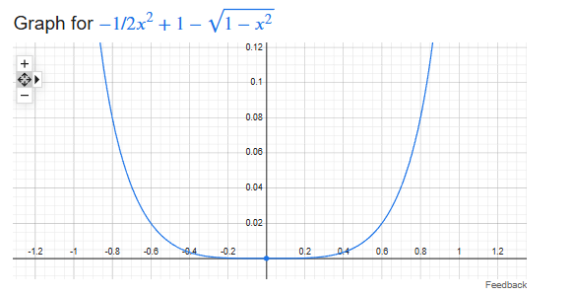
Actually, it's an even better approximation than I thought. The variable s is not the value of the x co-ordinate, it's the arclength along the circle (=angle theta), which is the inverse sine of the x-coordinate. It actually looks like this (and it's not a parabola, due to the arcsin term):
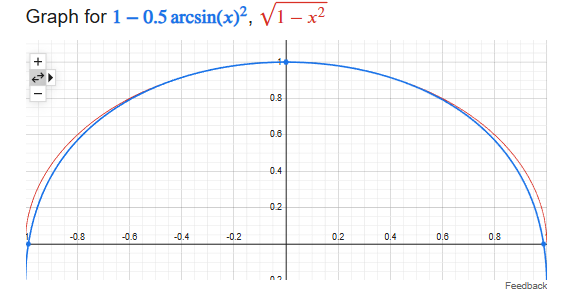
The reason it matches so closely with the parabolic plot above close to the point of tangency is the small angle approximation sin(a)=a. At least I think that's what's going on here, I'm trying to work this all out in my head as I don't have a pen and paper handy.
ETA: I'm also finding it a bit difficult to do in my head because the way it makes sense to look at this diagram in context, we are measuring the angle clockwise from the y axis whereas most of the time you're looking like at plots like this, you're measuring angle anti-clockwise from the x axis. So "our" theta is the complementary angle of the "usual" theta, and therefore x becomes sin(theta) rather than cos(theta).
Also, it's probably fairly obvious, but I'm actually finding the whole approximating a circle discussion a lot more interesting than the flat earth nonsense that spawned it. I have now learnt a nice easy formula for finding the approximate vertical co-ordinate of a point on a circular arc using the radius and the distance to the point measured along the arc, who knows when that might come in handy (well, I mean, not really, by the time I figure out all the parameters, I might as well use the circle equation in the first place).

It's not like the circle equation is that much harder. It's a truly bizarre concept to me to try to use a parabola as an approximation. I mean unless you are just insisting on doing it in your head or something, what's the point?
It's not like the circle equation is that much harder. It's a truly bizarre concept to me to try to use a parabola as an approximation. I mean unless you are just insisting on doing it in your head or something, what's the point
It's not a parabola - the input variable s is not linear, it's measured along the arclength of the circle, so it's equivalent to taking the inverse sine of x (x = the horizontal component of the distance, so ax^2+c would be a parabola) before squaring it. So it actually kinda makes sense if those are the inputs you have and you want an easy to use approximation, to use in your head, once you've pre-calculated the drop per unit arclength squared. Obviously for anything requiring accuracy, such as, I dunno, refuting centuries of established science, I'd probably prefer to use the exact formula just to, you know, remove any doubt.

I cannot vouch for all this but interesting links here

Sent from my SM-A366B using Tapatalk
Thanks. That actually has some of the videos I enjoyed watching.
Deuces, If I start a capitalism socialism communism which one is best for humans thread, will you be interested enough to particpate so we can let this thread be? If not, I will not start it and that is fine.
Lesson 2: atmospheric refraction.
Homework. Optics expert Andrew Thomas Young (aptly named) on how to calculate ray bending:
https://aty.sdsu.edu/explain/atmos_refr/...
Cliffs notes to follow.
Sent from my SM-A366B using Tapatalk
Lesson 2: atmospheric refraction.
Homework. Optics expert Andrew Thomas Young (aptly named) on how to calculate ray bending:
https://aty.sdsu.edu/explain/atmos_refr/...
Cliffs notes to follow.
Sent from my SM-A366B using Tapatalk
Before you do, can you tell us about the observations you think are irreconcilable with a round earth and where I can read about how these were made?
Before you do, can you tell us about the observations you think are irreconcilable with a round earth and where I can read about how these were made?
They are in abundance. You can go into debunking mode on whatever you want. But I will not post myself until refraction is sorted. Because they claim you can theoretically see your own backside in a telescope (literal ball-tard claim) hence any horizon measurement cannot be used as not-a-globe proof.
First we need agreement on what effects refraction can or cannot produce.
Sent from my SM-A366B using Tapatalk
They are in abundance. You can go into debunking mode on whatever you want. But I will not post myself until refraction is sorted. Because they claim you can theoretically see your own backside in a telescope (literal ball-tard claim) hence any horizon measurement cannot be used as not-a-globe proof.
I'm not particularly interested in "debunking" random goofballs on the internet who think the Earth is flat, or that some sky daddy made it 5,000 years ago, or whatever other gobbledygook they come up with. If you want me to look at something specific, you can post it yourself.
First we need agreement on what effects refraction can or cannot produce.
Sent from my SM-A366B using Tapatalk
I'd imagine that's a lot more complicated than the basic geometry stuff and optics is not something I know much about, but I'll give it a shot.
What about diffraction? Can you see something beyond the horizon because the light waves are spreading out? I have no idea btw, not something I've researched, just occurred to me now.
I'm not particularly interested in "debunking" random goofballs on the internet who think the Earth is flat, or that some sky daddy made it 5,000 years ago, or whatever other gobbledygook they come up with. If you want me to look at something specific, you can post it yourself.
Probably closer to 6,000 years ago, per Bishop Usher's chronology.

I got it!
What about diffraction? Can you see something beyond the horizon because the light waves are spreading out? I have no idea btw, not something I've researched, just occurred to me now.
Refraction, rather than diffraction, means you can sometimes see mirages of objects beyond the horizon. Distant buildings, or ships, can even appear to be floating in mid-air.
Refraction, rather than diffraction, means you can sometimes see mirages of objects beyond the horizon. Distant buildings, or ships, can even appear to be floating in mid-air.
I understand this part, although I wouldn't know how to calculate it out, and I'm pretty sure that for the purposes of refraction we can treat light rays as line segments. I was asking about a different (additional) effect which is specific to waves, which light also is, which is diffraction.
I understand this part, although I wouldn't know how to calculate it out, and I'm pretty sure that for the purposes of refraction we can treat light rays as line segments. I was asking about a different (additional) effect which is specific to waves, which light also is, which is diffraction.
Diffraction, is, for example, is one of the reasons you can hear sounds without a direct line of sight to the source of the sound. My understanding is that sound diffracts much more than light, but I don't know how (if at all) diffraction of light at visible wavelengths may contribute to horizon effects.
Diffraction, is, for example, is one of the reasons you can hear sounds without a direct line of sight to the source of the sound. My understanding is that sound diffracts much more than light, but I don't know how (if at all) diffraction of light at visible wavelengths may contribute to horizon effects.
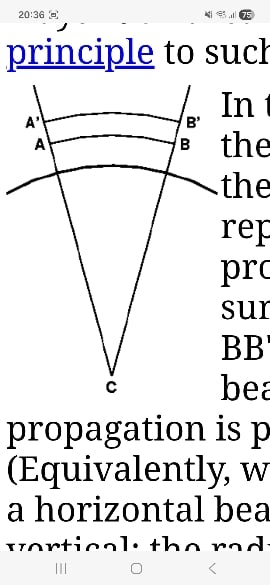
Diffraction of light occurs through narrow apertures of comparable size to the wavelength, i.e. diffraction gratings. But of relevance somewhat is Young's explanation (see calculating ray bending link above) as to why a "horizontal" (actually a curved beam running "parallel" to earth curve) beam of light would be caused to bend in sync with earth curve, given it does not traverse a density gradient. Good question. He gets around this by citing Huygens wavefront theory, whereby the upper part of the wavefront moves more quickly than the lower part. See picture attached - the primed vertices give faster propagation but with the same optical path length. He acknowedges the unsatisfactory explanation and cites a lot of additional reading. No point getting into those weeds, we have weeds enough already.
We continue...
Summary of the above - from final paragraph:
"Example 1: the Standard Atmosphere :
In the Standard Atmosphere, the lapse rate is 6.5°/km or γ = 0.0065 K/m. The numerator of the formula above becomes .034 − .0065 = .0275, so the ratio k is about 1/5.6 or 0.179. In other words, the ray curvature is not quite 18% that of the Earth; the radius of curvature of the ray is about 5.6 times the Earth's radius.
Example 2: free convection:
In free convection, the (adiabatic) lapse rate is about 10.6°/km or γ = 0.0106 K/m. The numerator of the formula above becomes .034 − .0106 = .0234, so the ratio k is about 1/6.6 or 0.152. In other words, the ray curvature is about 15% that of the Earth; the radius of curvature of the ray is about 6.6 times the Earth's radius. This is close to the condition of the atmosphere near the ground in the middle of the day, when most surveying is done; the value calculated is close to the values found in practical survey work."
These are the values to be used as a starting point.
Next, dip to the horizon:
https://aty.sdsu.edu/explain/atmos_refr/...
Sent from my SM-A366B using Tapatalk
Useful diagram here that supports applying the 8 inches rule of thumb.
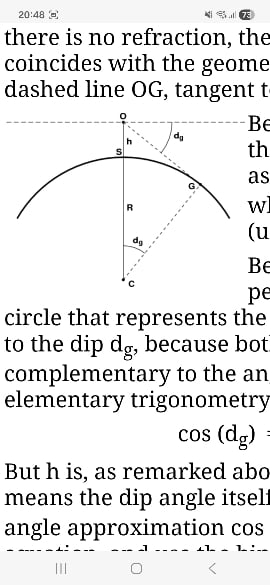
Sent from my SM-A366B using Tapatalk
And this one inclusive of refraction.
But how much refraction?
Let us state openly now that Young advocates the backside-in-telescope prediction, i.e. that light can bend indefinitely around the ball until it extinguishes itself. But, the calculations are done for standard refraction and this is what is applied for surveying and all useful purposes. I urge full reading of Andrew's website.
Quoting from the horizon dip section:
"In other words, everything is the same with refraction as it would be on a fictitious planet with a radius of R/(1 − k) and no refraction. So, as long as k is much smaller than 1. the numbers aren't greatly changed by refraction.
... So how big is k? It depends on the temperature gradient; see the ray-bending page for details. It turns out that in “normal” conditions — when the Standard Atmosphere is a fair approximation — k is about 1/6 or 1/7 at sea level, and less on sunny afternoons, or at higher elevations. Values of k around 0.13 have been used in correcting surveyors' data for a century or more..."
Therefore we can consider a value of k to be 15% as per previous calc. This gives an effective earth radius of (R/0.85).
New calculation for 8 inches rule inclusive of refraction:
63 360/(2 × (3959/0.15))
= 6.8 inches per mile squared.
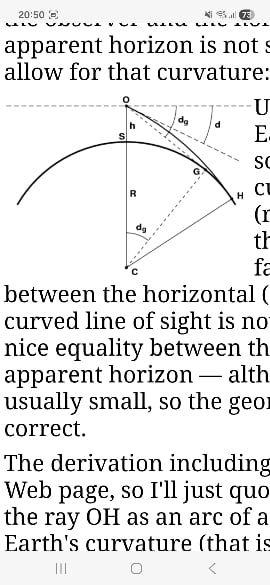
Sent from my SM-A366B using Tapatalk
And this one inclusive of refraction.But how much refraction?Let us state openly now that Young advocates the backside-in-telescope prediction, i.e. that light can bend indefinitely around the ball until it extinguishes itself. But, the calculations are done for standard refraction and this is what is applied for surveying and all useful purposes. I urge full reading of Andrew'
*should state 3959/0.85.
Sent from my SM-A366B using Tapatalk


