Please help me to stop bleeding in the SB

In the SB I take this strategy mostly:
Open or 3-bet TT+, AQs+ (shallow-stacked, no callers, or deep-stacked tight-aggres
Why? Assuming stack sizes and player tendencies are the same, what's the difference? You're still out of position on every street. The fact villain might be a few extra seats away doesn't change the cards.I'm guessing you're giving a player opening in the CO a wider/weaker range than the opener UTG. That's probably going to be true and it deserves prominent consideration when d
Right, I would assume any reasonable player is opening much wider from late position than from early position. And I agree, either way I want to play a narrow and value-heavy (“linear”) range from the SB.
The difference is that against a wide, weak range, I can 3bet for value with a much wider range. A hand like AQo is a fold against a UTG open from the SB but it’s a slam dunk 3bet against a CO range. When the CO is opening stuff like QJo and ATo I can even 3bet hands like KQo and AJo. There is a lot more fold equity against a late position open too.
Again, I’m not some GTO robot. Balance isn’t my priority either, and I rarely go to war with A5s pre-flop (and especially not against a loose passive fish).
Right, I would assume any reasonable player is opening much wider from late position than from early position.
Maybe, but I think that very often our opponent is not what you would describe as "reasonable". I think tons of players just think Hand X is good so they play it. Maybe there's a portion of the player pool has figured out that A9-AJo doesn't play great from up front and built a little discipline there. But I don't think the positional adjustments are happening anywhere near the frequency you're describing at live games 2/5 and below. Again....people are playing 20 hands an hour. They didn't drive to the casino to fold. They're gonna wanna see a flop with KJ regardless.
The difference is that against a wide, weak range, I can 3bet for value with a much wider range
Why do you say this? Can you prove it with math?
A hand like AQo is a fold against a UTG open from the SB but it’s a slam dunk 3bet against a CO range
I totally disagree
When the CO is opening stuff like QJo and ATo I can even 3bet hands like KQo and AJo.
Can you?
Based on that sentence, I'm guessing you're assuming that UTG would NOT open QJo and ATo which means you're putting their range as something like 99+, ATs+, KJs+, QJs, AJo+, KJo+. In a prior post, I suggested our 3-bet range should be TT+, AJs+, AQo+. If I put those ranges into an equity calculator we are a 59/41 favorite.
You're claiming a CO player will open a wider range that includes QJo and ATo. So maybe their range looks like this: 77+, A8s+, KTs+, QTs+, JTs, T9s, ATo+, KJo+, QJo. If I keep our range static, we are a 62/38 equity favorite. A little better because villain brings a few more worse hands.
Now let's look what happens when we widen our range. You suggested we can add hands as low as KQo and AJo. How about this: 88+,ATs+,KJs+,AJo+,KQo
If we play that adjusted range against the CO's range, our equity drops. We are only a 56/43 favorite.
Now you might say "That's still +EV". However, I would argue that all of the hands we added have reverse implied odds, and we under-realize our equity when out of position in general. So those factors drag our value way down. We need to bring a range with a large enough equity advantage to overcome our positional disadvantage and avoid RIO.
On a strictly mathematical basis, playing worse hands is going to bring worse results. CO's range would have to swing wildly from UTG for us to add hands and maintain our equity advantage. I just don't think you see that in live low stakes poker at all.
Maybe, but I think that very often our opponent is not what you would describe as "reasonable". I think tons of players just think Hand X is good so they play it. Maybe there's a portion of the player pool has figured out that A9-AJo doesn't play great from up front and built a little discipline there. But I don't think the positional adjustments are happening anywhere near the
I agree that some players don't make this adjustment. This is an easy thing to pick up on at the table. If I see a player open A9o from UTG then I will adjust and 3bet a wider range against their UTG open from all positions. Similarly, if I see a player limpcall AKo from EP, then I am going to tighten way up when I see this player open raise.
As far as the rest of your post, there is a lot going on there. I'm not sure why you are so skeptical of the things I am posting.
If a player is opening 28% of hands from the CO (a reasonable range, similar to GTO), AJo has something like 56% equity against that range. So AJo is a favorite against that range, plus by 3betting we get to capitalize on fold equity. AJo has decent equity against the range that calls, and I am comfortable playing it OOP in a 3bet pot if I need to. KQo isn't doing as well in terms of raw equity but it is still a +EV 3bet with fold equity.
Here is SB vs CO open on GTOWizard FWIW.
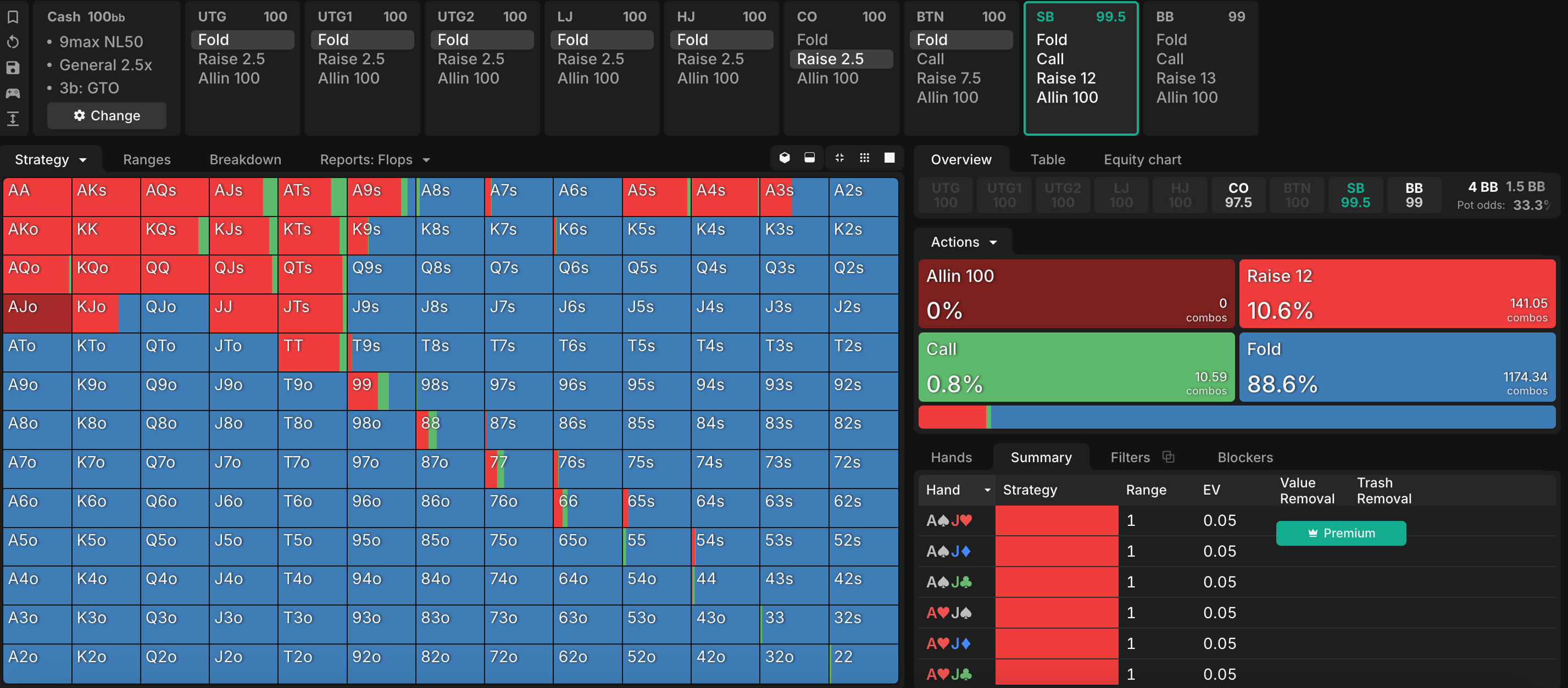
I think you are exceedingly and tremendously overstating both how much villains ranges open up with position and how much you can open your range to counter.
If a player is opening 28% of hands from the CO (a reasonable range, similar to GTO),
Hang on a minute partner. A minute ago you said an UTG opener doesn't have QJo or ATo. That sorta limits them to something like 99+, ATs+, KJs+, QJs, AJo+, KJo+. Thats 124 combos or roughly 9% of hands. Now you're telling me a reasonable CO range is 28% of hands. That's 19% more hands!!! Are you saying that a typical live low stakes villain has identified 250+ hand combinations that are good enough for a raise from the CO, but muck from UTG??? That doesn't sound right to me at all.
AJo has something like 56% equity against that range. So AJo is a favorite against that range, plus by 3betting we get to capitalize on fold equity.
No, not "plus". You don't get to add fold equity to 56%. You get V's fold frequency x his bet size PLUS you go to the flop against his continuing range and you are probably NOT a 56% favorite against that.
From the SB, ignoring balance, not caring about exploitability, we will counter V's opens with hands that have an equity advantage that is large enough to 1) Overcome reverse implied odds 2) Overcome the fact that you will under-realize equity due to your position 3) maintain an equity advantage that overcomes #1 and #2 against V's continuing range. I would strongly argue that a 56% baseline is nowhere near strong enough to overcome those 3 things.
I think you are exceedingly and tremendously overstating both how much villains ranges open up with position and how much you can open your range to counter. Hang on a minute partner. A minute ago you said an UTG opener doesn't have QJo or ATo. That sorta limits them to something like 99+, ATs+, KJs+, QJs, AJo+, KJo+. Thats 124 combos or roughly 9% of hands. Now you're telling
Yes a full ring UTG range is ~10% of hands and a CO opening range is ~28% of hands. Do I expect all of my opponents to follow those ranges? No, I would expect almost none do. At $1/$2 most of my opponents are limping a wide range from EP. But at $2/$5 and against decent $1/$2 players, I would expect dramatically more hands to be opened from LP vs EP. Compared with GTO ranges, I think most people open too many hands from EP. I know I do.
Beyond that, I am done responding to this thread. We clearly have different philosophies on how to play pre-flop. I know that mine works for me (although I am far from perfect and am trying to improve daily), and you seem satisfied with yours as well. Fortunately there are many ways to win at live low stakes poker.
I just think that the claims you're making can be checked with math, and the math is not on your side.
So I played just raise or fold in the SB for about six months. I like the strategy because you never go broke in a limped pot. Then, I started seeing pros limping multiway in the SB facing a passive BB. I started doing it too. More hands=more fun!
This doesn't have to be a binary, one-or-the-other decision that you make before you sit down or are dealt a hand. The "pros" you see limping in the SB either aren't pros, or they're not doing it willy-nilly. Pros limp in when there's an exploitative reason for it.
My standard default setting is to play raise-of-fold from every position that isn't the BTN or the BB (or the straddle, when applicable). But I'll deviate from my default settings when I see a reason to.
Like me, you're mostly playing low stakes, right? I think you mostly play 1/2? That's generally going to be a high-rake game, where we have an increased incentive to take pots down pre-flop (pre-rake), or build a bigger pot that we expect to win post-flop.
I'm going to deviate when I see a lot of fish limping in, but not folding enough to a raise, especially when the raise comes from the blinds. I'm going to deviate when I see that the BB just isn't squeezing enough, and is over-defending with too wide a range. I'm going to deviate when I see EP players who like to limp-3B. I'm going to deviate when there are players at the table who are capable of 3B'ing light. I'm going to deviate when there's a maniac or whale at the table.
This is what I meant when I said we should observe what they're doing and adjust accordingly.
When I see the fish limping in and not folding to a raise from the blinds, I'm going to tighten up my raising range, and go larger with my raise sizes, and just flat with that portion of my usual raising range that doesn't really want to raise large and get 3B, or play multi-way and OOP.
Like, if I'd usually raise with 77-TT, I might just flat those hands to set-mine, but then I'd raise bigger with JJ+. If I have AA/KK, raise big, and someone 3B's me, I'm 4B'ing huge, which at 1/2 and 1/3 mostly just means I'm jamming.
One of my favorite plays to make is to limp-3B from EP when the player on my direct left is playing raise-or-fold, but generally raising too wide, and the fish aren't giving his raises any respect. Likewise, if I'm in the SB, and there's an EP player doing a lot of raising, and getting a lot of calls, it can be unbelievably profitable to 3B light in the SB.
When the BB isn't squeezing enough, I'm going to flat call with some more speculative hands, and when I smash the flop in a multi-way pot, I'm going to be donking a fair bit.
When I see EP players limp-3B'ing, I'm going to set some traps by just flatting with hands that I don't want to raise-fold and can't continue unimproved when they c-bet large. When I raise, I'm going to mix up my sizing based on what I think the BB is likely to do.
Like, if the OMC limps UTG, and the BB can't fold anything if I raise small, I'll raise to $10, instead of $15. If the BB won't fold even if I raise to $20, I'll make it $20. If the BB is tight, and not defending enough, I'll ignore him and just focus on finding a raise size that will set up a 4B jam when the OMC 3B's.
When there are opponents who are 3B'ing light, I'm going to raise with a more polar range, and mostly play 4B-or-fold when they 3B. My calling range is going to be really narrow, like 99-QQ and AK/AQs.
Maniac at the table? Tighten up and play hands that you can take to war. Whale at the table? Loosen up and go for max value when you hit.
Maniac or whale on our direct left? Hardly raising at all, until action gets back around to us, then I'm back-raising A TON, with both value and bluffs, for HUGE sizes. I'm mostly just raising top of range from the SB.
When the maniac or whale is on our direct right? Tighten up and raise huge to ISO, unless there's a very aggro opponent to our left, in which case, I'll be doing more flatting to back-raise.
It's fine to look at various hands and think about which ones are better or worse to play from the SB. But generally every hand goes down in value when we're in the SB.
So instead of focusing on trying to memorize how to play various hands when we don't know what our opponents will be doing from one session to the next, I focus more on what my opponents are actually doing while I'm sitting at the table, and letting that inform how I play various hands.
Ok, imma give my 2 cents on this. The blinds are different in how you play from them compared to other positions since you are always going to be at a disadvantage against every other player on the table. So you have to play stronger hands than you would on the button, almost on the same strength as UTG but even tighter. Usually either fold, or reraise with AA, KK, QQ, JJ, AKs, AK. If your opponents are weak meaning they call too much and you see them show a lot of random cards constantly, it's better to raise them with weaker holdings. But tough players who are loose and aggressive should be called by only with your strongest hands to induce extra bets from them if you hit your flop. And when you play with them avoid adding extra money to the pot and fold if they raise if you don't have anything but your goal is to call and check all the way to a showdown. If at least 2 other players call before you it's alright to call or raise with high suited connectors like T9s, J9s, 98s, and low pairs like 55, 66, 77, 88, even depending on their strength even Axs. Once again none of these concept are going to work without you learning to evaluate your opponents skill level.

