1/3 Hijack 55 - no fish this time
1/3
(520)UTG - Best player in the game/strong pro opens for 15
(500)HJ (Hero 5s5d)TAG been mostly folding so far, calls
(53
I'm new here, but not new to low stakes live hold em. I'm a little surprised at the form of the discussion here. How come nobody did the simple exercise of defining ranges, counting combos, and calculating equity?
Pre-flop: Of course you can call. The bet is like 3% of your stack with over 30-1 implied in a game with a player pool full of payoff wizards. Set mining is huge +EV here.
On the flop: Fast play and jam over the raise. What are you even waiting for? Get it in. After you match the CO's bet, your shove will be another 365 into a pot of 1150 when called. You need 31%. If I give the cutoff a very strong range of 99, J9, and all the best draws, you have more than double the equity you need. If his range is at all wider, then you're in an even better spot.
Board: 5hJs9s
Equity Win Tie
HERO 64.10% 64.10% 0.00% { 5d5s }
CO 35.90% 35.90% 0.00% { 99, QTs, J9s, T8s, AsQs, KsQs, AsTs, KsTs, As8s, 8s7s, 7s6s, As4s, As3s, As2s }
UTG, if he calls, will have some JJ/99 and overpairs.. You're still a massive favorite in a huge pot.
Board: 5hJs9s
Equity Win Tie
HERO 45.51% 45.51% 0.00% { 5d5s }
CO 32.06% 32.01% 0.04% { 99, QTs, J9s, T8s, AsQs, KsQs, AsTs, KsTs, As8s, 8s7s, 7s6s, As4s, As3s, As2s }
UTG 22.43% 22.39% 0.04% { JJ+, 99, AsKs, AsQs, KsQs, AsTs }
On the turn, I'd probably fold if i were actually in your seat in real life. However, here on the internet, I have the luxury of doing the math. The math says that folding is really really bad. Once again you're asked to put 365 into a final pot of 1150, so you need 31%.
Board: 5hJs9sKs
Equity Win Tie
HERO 42.46% 42.46% 0.00% { 5d5s }
CO 57.54% 57.54% 0.00% { 99, QTs, J9s, T8s, AsQs, KsQs, AsTs, KsTs, As8s, 8s7s, 7s6s, As4s, As3s, As2s }
Edit: if I take the non-spade T8's out of his range, then we're only 35%. But that's still a +EV call
I’m the first one to show up to play in the morning and open the first table. Could be an hour or two before the next one opens, so sometimes I sit with good players. So finding a better game is not helpful advice. TakeawayI knew I screwed up - thanks for telling me so.I don’t play small pairs oop, but in late position sometimes. When both players called behind me,
Don't take this the wrong way as I do mean it with respect, but I think you play poker to lose the smallest pots possible instead of winning the biggest pots possible. I think this is a pretty big leak, like some spots you just dream off and want to pile money in as fast as possible, this is one of them.

I'm about 50/50 on some of the takeaways.
I’m the first one to show up to play in the morning and open the first table. Could be an hour or two before the next one opens, so sometimes I sit with good players. So finding a better game is not helpful advice.
I'm not sure if you meant to phrase it as harshly as it seems, but "sit at a better table" is almost always good advice; you just happen to be in a situation where you can't do that, so fair enough.
Although you may want to reconsider when you sit in a game, if that's an option. I also used to start the first table with a second table usually an hour or two a way, but that is when I only played once a week and really needed to get my hours in during that single session. Since moving to two sessions per week (each at half the duration I was putting in before) I've realized it makes a lot more sense to show up later when there are a few tables running already (and thus have table selection options).
When both players called behind me, I knew I was in trouble
If I’m going to play this hand, I should have raised pre to try to fold the players behind.
When we're setmining, we'd prefer that literally every person at the table (both behind and in front) see a flop with us. Small pocket pairs play rather horribly otherwise.
IMO, a lot of your posts (such as taking aggressive actions) seem to revolve around winning the pot, when all we really care about is winning money (there's a difference).
As played, I am very certain that I made a good fold. Does anyone know or can it be determined how often the board pairs on the river? That was my only hope.
You can use the rule of 2 and 4 to ballpark your equity, which is your estimated outs multiplied by 4 (if you're on the flop) or 2 (if you're on the turn). So ~bestest case realistic scenario is like one guy has a flush or straight and other guy has an overpair (thus not hogging up any of our outs), so we have approximately 10 outs x 2 = 20% equity.
I also originally thought it was a good turn fold as we need about 32% to breakeven. At first glance there doesn't seem to be a lot of missed draws / overvalue that would be making this play 3ways, but it looks like someone has actually stoved it and so now I'm going to have to go back and confirm.
ETA: So based on the above stoving I did my own, and it does look like a call. I'll admit I didn't notice we had flush draw outs against non spade straights, so that makes a big difference (without this and against no spazz or terrible overvalue I have us at about 26%). And if you factor in the occasional T8 spazz or KJ overvalue, even without the spade draw, it looks like it is a call.
I try very hard to use the early streets to set up easier decisions on later streets. There’s some truth to ‘if you’re going to set mine, you have to get it in when you hit’. But I just can’t think that way. As the hand develops, I make each decision and I will fold every time I think I’m beat.
I actually mostly agree with all of this. The only clarification I would make is that we don't necessarily fold when we're beat... we fold if we're convinced we're beat AND not getting the odds to improve to better (AND don't think we'll be able to steal with worse on some runouts).
In a way, there’s irony because I fold small pairs pre-flop more than any of you. A secret I play by is that any hand with a seven or lower will lose most of the time. I take this to heart, so I don’t always have great board coverage.
I've long ago concluded that small pairs are likely not profitable for me in most spots. In an effort to control potential tilt, if the first card I look at in EP is <= 6, I actually don't look at the second card (as there is no hand with a <= 6 in it that I play in EP).
GcluelessNLnoobG
When we're setmining, we'd prefer that literally every person at the table (both behind and in front) see a flop with us.
I've long ago concluded that small pairs are likely not profitable for me in most spots. ....there is no hand with a <= 6 in it that I play in EP).
How are your reconciling these two statements?
You seem to be saying A) Sets are indifferent to position and B) I don't play for set value from early position.
I agree with statement A. So then why not play for set value from all positions?
I know the conventional wisdom says that you shouldn't open small pairs from EP because you'll get raised off of your equity by someone in position too often, and you'll have to play out of position post flop. I get why people espouse that strategy in bigger games.
But you can make an exploitative adjustment due to the fact that player pools in these min-stakes games will almost never 3-bet. Like, it's just not in their DNA. So you can break the GTO rules and open limp. If there's a raise, just call it. You'll still have the implied odds to set mine. And if you flop a set, then position and initiative won't matter.
In tougher games with higher stakes, this will be wrong. But in this particular game, you can exploit by seeing cheap flops with big implied odds.

Yes, flat calling the raise in ep with 55 is an exploitative adjustment. It usually would be a bad play in a mid stakes game or reasonably late in a tournament.
It depends how a 1/2, 1/3, or 2/5 table is playing, and the situation. However, in general the advice to fold small pps in ep is not correct for low stakes.
@ Prez
Mostly what I'm saying is that in EP or being the first one to call a raise, attempting to setmine is very dicey because (a) we can get 3bet (noting there is a very aggro LAG as well as a solid player right behind us in this example) and (b) setmining really requires multiwayness (and we don't know if that is going to happen as the first caller or an EP limper). We don't necessarily need position per se (although it does greatly improve our IO) but we need to be fairly confident we're going to go multiway for a reasonable price (and we don't have that here, imo).
GcluelesssetminingnoobG
There are some 1/3 tables with a lot of 3-betting. There are also some with multiway limped pots, but raised pots don't go 4-ways or more much. In general, it is profitable to flat call here. If it is 3! and you aren't getting the right odds, you can fold then.
There are some 1/3 tables with a lot of 3-betting. There are also some with multiway limped pots, but raised pots don't go 4-ways or more much. In general, it is profitable to flat call here. If it is 3! and you aren't getting the right odds, you can fold then.
If "raised pots don't go 4-ways or more much" then you're not going multiway enough of the time to make setmining profitable. And those flat/folds have to be factored into your overall profitability, and they'll be decimated the more often you do that (and there was a decent chance of that happening here).
Gimo,wemighthavetoagreetodisagreehereG

Our equity vs a QTo straight (so sometimes they will have a bigger spade, sometimes they won't):
Without the 5s:
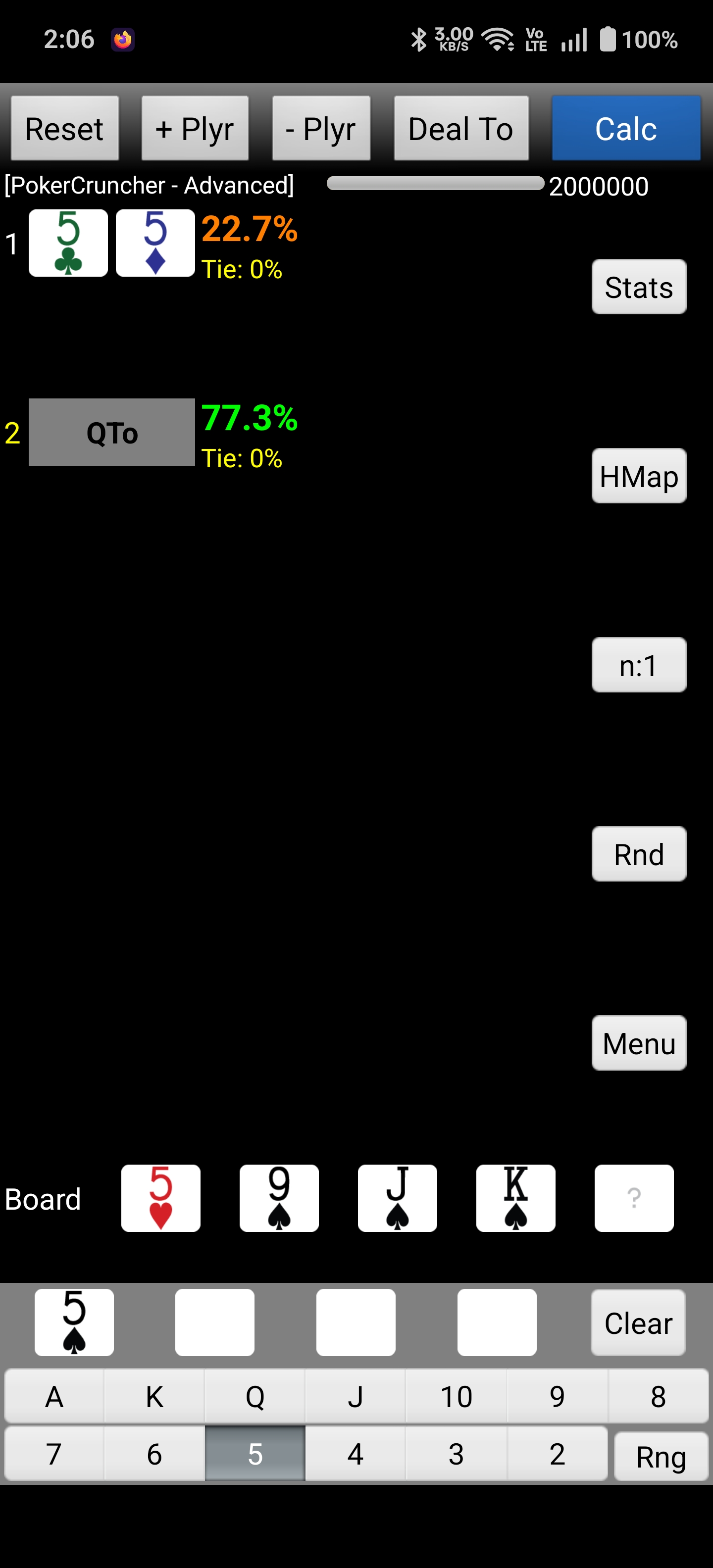
With the 5s:
[image]y83VrTX.jpg[/im
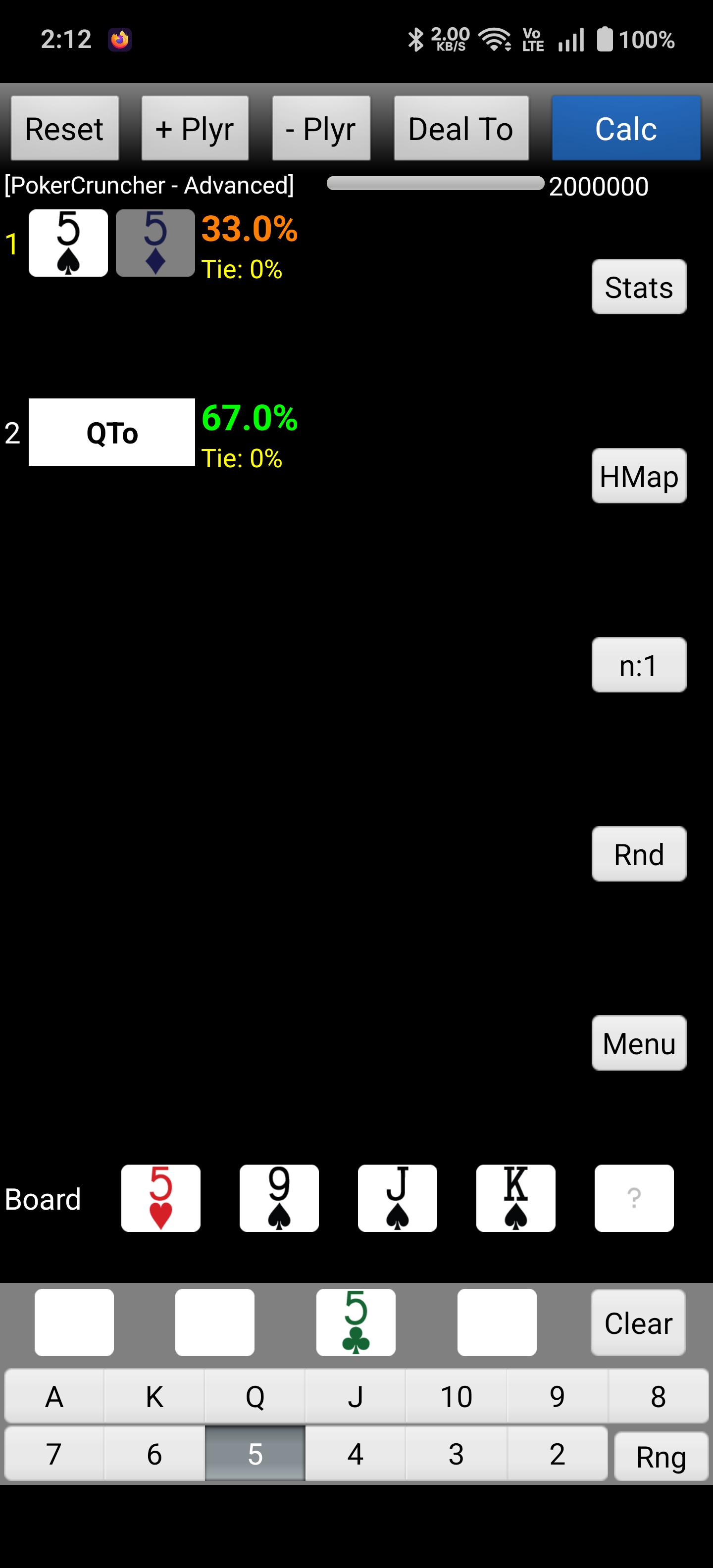
..]
Preflop is fine in this spot. You just have to raise the flop after a big bet and call on this draw-heavy board. Picking up the pot then and there is not a bad result.
When you get it in you're going to do great in the long run. Who knows, maybe they did have a draw and got there on the turn? Even then you may have made a fullhouse on the river.
Don't take people's bluntness personally OP. I was called a dunning Kruger champ the other day, so I may just be a fish on an eight year heater. Even if that's true, who cares? It's a stupid card game. Lol.
If "raised pots don't go 4-ways or more much" then you're not going multiway enough of the time to make setmining profitable. And those flat/folds have to be factored into your overall profitability, and they'll be decimated the more often you do that (and there was a decent chance of that happening here).
Gimo,wemighthavetoagreetodisagreehereG
I really don't agree with your emphasis on multi-wayness. Sure it's nice to have, but it's just one variable in the implied odds function. Other factors like stack sizes and villain's post-flop aggression are important considerations too.
In a single-raise pot, against one opponent, in a minstakes game where players generally overvalue hands and payoff.....my baseline implied odds target for set mining would be 20 to 1. If villain's stack is at or over 20x the raise size, then I'm setmining. If there's a raise and callers before me, then I can lower the target. Multi-way means I'm more likely to get paid off, so I don't need villains to be so deep. In a 3 or 4 way pot, I can set mine in shallower spots where stacks are 18x 15x or even 12x the raise size. In the OP, the villains all have well over 30x the raise size. We are more than sufficiently deep to set mine against any number of opponents.
With regard to your second statement, the cost of the flat/folds is likely negligible. Suppose Villain raises to 5x and we call intending to fold to a 3-bet. How often do 3bets happen behind us? In minstakes games, I'd say the likelihood of a 3-bet - with only BTN and blinds left to act - is probably less than 10%, surely less than 20%. But let's say it's actually 20%. So 1 in 5 times we fold. That means we'll pay 25BB's for every 4 flops we see. So our cost basis is 6.25BB's. Just use that to evaluate your implied odds. Look for stacks to be 20x that amount, or 125BB's. In the OP hand, we are much deeper than that.
In this case here, if it goes HU (i.e. the super aggro guy or the solid guy behind us don't 3bet, of which there is a decent possibility) we end up against "the best player in the game / strong pro". Whether he has 30x the raise or 50x or 1000x is pretty irrelevant, as the IO are a mirage against this opponent (as he'll be able to limit his losses to about as small as possible in the worst case scenarios). Unless, what, you think the best player in the game is going to lol stack off with an overpair (which he'll only have some of the time) 100% of the time in an SPR 16 pot?
GcluelesssetminingnoobG
Unless, what, you think the best player in the game is going to lol stack off with an overpair (which he'll only have some of the time) 100% of the time in an SPR 16 pot?
If that's what I expected, then I would target implied odds of 8 to 1 since that's how often I make a set.
I target a deeper stack (20 to 1) to account for the times I don't get paid off.
And in reality, it's not like the only two outcomes are "get it all" or "fold and lose". Sometimes we'll get value, but for less than full stacks. Villains can c-bet and barrell. they can value bet worse. They can call with draws. There are lots of ways to win money in poker.
Unless, what, you think the best player in the game is going to lol stack off with an overpair (which he'll only have some of the time) 100% of the time in an SPR 16 pot?
If that's what I expected, then I would target implied odds of 8 to 1 since that's how often I make a set.I target a deeper stack (20 to 1) to account for the times I don't get paid off.And in reality, it's no
GG's overall point is valid though. We make money by playing more pots with the players who are worse than us. If we perceive our opponent to be better than us, we have to rely on position and our cards if we hope to profit. We can't hope to profit by outplaying them.
GG's overall point is valid though. We make money by playing more pots with the players who are worse than us. If we perceive our opponent to be better than us, we have to rely on position and our cards if we hope to profit. We can't hope to profit by outplaying them.
Sure, but we're talking about sets. They almost play themselves.
Plus, I kinda think if someone is savvy enough to make their way on to a poker forum, then they shouldn't be intimidated by anyone at a 1/3 table.
The "best player in the game" (who it sounds like we're scared of) just cold called a bet and raise on J95 with action behind. And we're supposed to be avoiding hands with him?
If we perceive our opponent to be better than us, we have to rely on position and our cards if we hope to profit. We can't hope to profit by outplaying them.
A good player isnt going to pay us off when he's out of position either. Any time we're involved with a good player just presume your edge to be zero and take your coolers like a man. Probably the first time I've ever agreed with GG and we should just fold pre, but whatever we got there and one of us is paying some maney.
IMO, a lot of your posts (such as taking aggressive actions) seem to revolve around winning the pot, when all we really care about is winning money (there's a difference).I've long ago concluded that small pairs are likely not profitable for me in most spots. In an effort to control potential tilt, if the first card I look at in EP is <= 6, I actually don't look at the seco
For the second paragraph here, we can be friends… I will listen more to what you say
Clarifying the 1st paragraph:
As a tight player, when I do enter a pot, I feel the need to fight for it. I will give up, but not easily. I find that most of the time aggressive action is winning the pots and the money.
—————
Also, the game I play is not scared of good players, just trying to describe them. Sometimes I do well against better players and really don’t often see terrible fish anyway.
I like adjusting to the players, figuring them out, finding exploits
I’m starting to realize that I do gravitate towards making tight folds at times and other times barreling like a maniac. Balance?
This hand isn't played as badly as it looks. Would probably gii on a safe turn, which is most of the time. Not shoving flop was a mistake and not calling turn maybe a slight mistake. Played too cautiously, but you did avoid probably getting stacked when the flush hit.
Grunch:
PRE - seems fine to set-mine with 55 from MP. I'd think CO and BTN are pretty capped when they both over-call.
FLOP - I'd think this board is fairly likely to get stabbed at least some of the time. Second to act, I might check and see what CO and BTN want to do, especially if our read is that CO is very aggro.
As played, I'd think CO would 3B pre with JJ, so the only hand I'd be worried about him having is 99. But I'd think 99 would 3B at some frequency pre, or just smooth-call your flop bet at some frequency.
The bigger concern is UTG. He may have been checking range, or checking because he flopped top set and has the board crushed. He could have 99 or JJ.
Then again, if I was UTG with JJ or 99, and saw this action...yeah, I think I'd 3B. I'd be giving you and CO a range of TP, top 2P, and a bunch of draws. You bet 2/3 pot, and CO raised 3X. You and CO seem to like your hands.
So, I dunno. UTG may just have an over-pair or a draw. If CO has 99, he's just getting our money. I think I'd jam here.
For the second paragraph here, we can be friends… I will listen more to what you say Clarifying the 1st paragraph:As a tight player, when I do enter a pot, I feel the need to fight for it. I will give up, but not easily. I find that most of the time aggressive action is winning the pots and the money.—————Also, the game I play is not scared of good players, just trying to descr
Ugh. Had a reply typed up and lost it. Briefly then...
Agree with everyone else who says jam flop. Embarrassed I wasn't more adamant about it in my post above.
There's a disconnect between saying you fight for pots, and seeing that you basically went into a defensive shell once you got raised. I suspect you tend to be aggro until you meet resistance, then you mostly shut down when you don't have the nuts.
Your posts here and in other threads speak to a "not going broke with the second best hand" mentality. It's fine to protect our stack when opponents likely have us beat, but you don't appear to be ranging opponents effectively enough to know when you're beat and when you have the effective nuts rather than the true nuts.
You may be watching your opponents, looking for exploits, but you don't seem to be carrying the logical threads forward into each hand. It seems like you give opponents broad labels like LAG and Pro, but you miss the opportunities to actually use the available exploits.
Like, here, UTG sees you put in a chunky bet, and the LAG raises. Then he tank-calls. If we think he's the best player in the game, does it seem more likely he's slow-playing a monster or he's making an implied odds call? Good players don't tend to slow play strong hands on wet boards when multiple opponents show interest.
Also, LAG over-calls pre from the CO, instead of 3B'ing to push the BTN and blinds out and iso your dead money. Does it seem more likely he has 99, or just a good draw on the flop, and sees the opportunity to get this heads up and IP once the PFR checks and you stab at it?
Observing our opponents to build reads should inform our ranging of them and result in exploit opportunities. You're not ranging, so you're not finding the exploits.
From your comments I likely messed this up.
Hero calls
(420) 5h9sJs (Ks)
UTG check, Hero check, CO jams 365,
UTG tanks and folds
Hero?
Hero folds…Bottom set, no spade, block nothingCan’t find any bluffs, but lots of value with straights and flushes.My hand looks strong, but my line was weak and the population massively underbluffs in this situation. How can a reg not have it shoving into the best player in the game on a wet board.I made a disciplined fold, but it felt awful mucking a set face down and not seei
This is what I'm talking about.
You actually don't look that strong once you flat call the flop. UTG doesn't look that strong when he tank-calls.
CO is LAG. Maybe he got there, but he could make this play with 2P, at some frequency, once action checks to him. He may believe UTG or you would jam flop or turn with a made hand, so you're both pretty capped.
Having seen UTG tank-fold, what do you think he had? Maybe AK? AJ? TT? Could you have deduced that he was pretty capped after he check-flat-called the flop?
You think CO always has it here. Could you have put him on a draw when he raises your flop stab? Is it possible he could take this line with J9 or KJ? What about AsJx?
Could you have discounted the likelihood that either opponent has a higher set on the flop? I think you could, if you were connecting the dots between your reads and the action.
Plus, I kinda think if someone is savvy enough to make their way on to a poker forum, then they shouldn't be intimidated by anyone at a 1/3 table.
It has nothing to do with being scared, it has to do with estimating our IO, and a large part of that is who we are up against. It should be fairly self evident that our IO are a lot better against the biggest whale in the room versus the best player in the room. All I can do is go on OP's read, but assuming he can put at least most opponents into a somewhat appropriate position on the whale thru solid player spectrum, then our IO don't exactly look awesum in this spot. Not to mention the chances of us not being squeezed thanks to the two opponents behind us (again, nothing to do with being "scared" but rather simply an honest evaluation of how often we're going to see a cheap flop here).
GcluelesshonestevaluationnoobG
it has to do with estimating our IO, and a large part of that is who we are up against. It should be fairly self evident that our IO are a lot better against the biggest whale in the room versus the best player in the room.
Everyone agrees with that. But I would ask you to take the next step and quantify what you're saying.
First, what do you think are appropriate implied odds to target when set mining against the described villain. I suggested my default setting is around 20 to 1. Do you agree with that? In the OP, we're over 30 to 1. Is that enough?
Next, I'd say we can quantify the cost of folding to a 3-bet behind us. I already gave an example where I suggested that we might get 3-bet off our hand as much as 20% of the time. Against a 5x raise we would be paying 25BB's for every four flops. So 6.25BB's each. We can then evaluate our implied odds using 6.25 as our cost basis. So, we're still looking at over 25 to 1 IO against just one opponent. Is that enough, in your opinion?
How deep do we have to be to set mine against a 5x raise by described villain, and what % of the time do you expect to get 3-bet behind you? These are necessary questions if we're making an "honest evaluation"
Against anyone accurately described as "the best player in the game / solid pro" we're *never * deep enough to setmine, that's my point. The IO are an illusion against this player, so we need to either go very multiway (therefore getting our immediate odds almost to our necessary IO where a single postflop bet will make us profitable) or we need a mark in the hand.
Take this example. It's slightly different due to being OOP, and let's not get too nitpicky with money already put in / 3bet option / chances of stealing postflop UI / etc., and just concentrate on purely setmining to illustrate the point. Folded to the Button, who raises to $20. We're in the BB with 55. Do we have enough to setmine if Button we're $100 effective? Clearly not. What about $400? Getting closer? What about $600? Ok? Now let's say he has $1000. Heck, let's give him $10,000. No brainer cuz "IO", right? Now let's say the Button is *insert fave NL crusher*. How are we doing then, still think it's a profitable spot? Not to mention small pairs often have a threshold where we would rather not get in stacks with a set against anyone remotely competent, so there comes a point where the stacks grow to a size where RIO become more of an issue than IO; i.e. how are we doing against this guy getting in that $10K against him when we flop a set?
Obviously in this case the UTG player is unlikely to be *insert fave NL crusher*. But he's still being bucketed by OP (I can only assume correctly) as a damn good player. We never have the IO to setmine against him HU, regardless of how big the stacks are / how often we get 3bet behind us.
Conversely, if you told me it was the biggest whale in the game raising preflop and everyone behind us was either a passive non-3betty OMC or a terrible passive fish, ok, I could probably get behind a call then.
GcluelessmiragenoobG

