3-bet pots as preflop IP caller - heuristics for flop raise against c-bets?
Hi guys!
Looking at my solver database right now for 3-bet pots, SB vs BTN (btn opens, sb 3!, btn calls) and I can't make sense of the discrepancies when it comes to raise frequencies  I see a) that the frequencies range from ~10% to ~30% ; b) that the flops that raise a lot are pretty much all rainbow flops, c) that monotone flops don't raise much and d) that low paired board raise more often than high paired board. That's about it, which sucks because of course being meant to raise 30% of the time typically means I'm meant to bluff raise stuff like underpairs and overcards+backdoor a lot more than when I should raise 10% of the time.
Any advice is welcome!
6 Replies
I just drilled these spots a bit more (SB vs X, haven't gone through BB vs X yet) and I'll add that, when facing small c-bet (it doesn't apply to bigger c-bet, which raise a lot less overall anyway), the flops that raise 20%+ are unconnected or lowly connected. Flops with straight possible don't raise much (like, 10%-12% max).
Also, when facing bigger c-bet (geometric), frontdoors typically don't raise. That's where most of my big mistakes were : we're talking like 1 whole bb mistakes when clicking raise with, say, FD, OESD, or GS+BDFD. And on the other side, I don't think I've seen an instance of the EV of raise being significantly higher than the EV of call. So pure calling them might be an OK simplification?
Still welcoming your insights!
Did some more drilling. Heuristics don't seem much different when playing against BB. BB uses big c-bets more than SB though, so overall we're meant to raise a lot less when facing c-bet.
Fundamentally, the 2 main things to figure out seem to be 1) the indifference threshold and 2) the raise frequency. It's hard to bluff raise enough when facing a small c-bet on a disconnected rainbow board, so from a c-bettor's perspective I may assume that those raises would be underbluffed. On the opposite, it's easy to overbluff raise when facing a large c-bet on a connected/wet board because you're not supposed to raise all that much in the first place, and the few raising you should do is counter-intuitive (they're not FD/OESD).
Still welcoming thoughts!
This is a cool thread, and im interested in what you find out. Cant offer anything besides guesswork though, just posting so that you know youre not alone here typing into the void
Hey, I took 3 minutes to solve your spots, and here are a few examples :
(optimuspoker) 3-bet pots, SB vs BTN, vs CB33% / rainbow flop
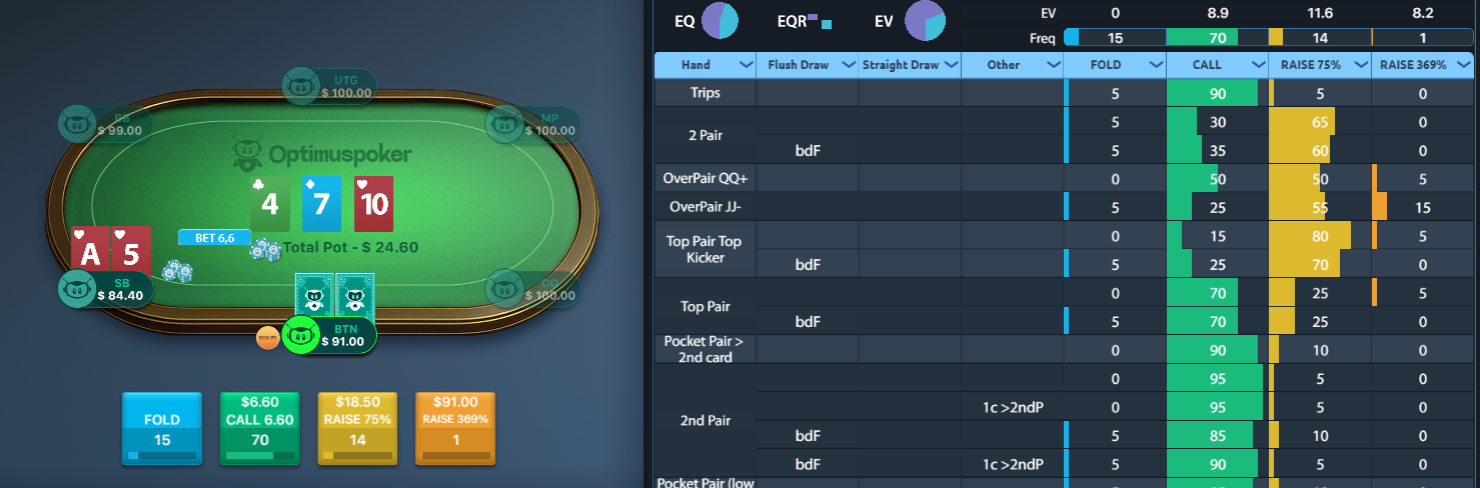
14% flop raise + 1% shove
(optimuspoker) 3-bet pots, SB vs BTN, vs CB33% / monotone flop
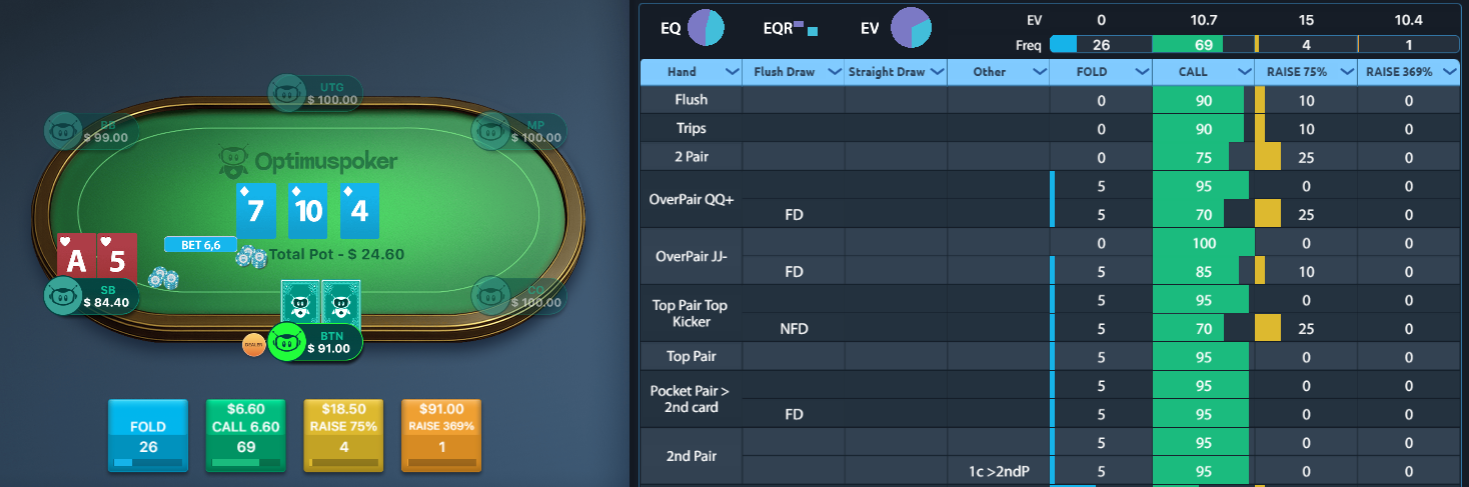
4% flop raise + 1% shove
(optimuspoker) 3-bet pots, SB vs BTN, vs CB33% / low paired board
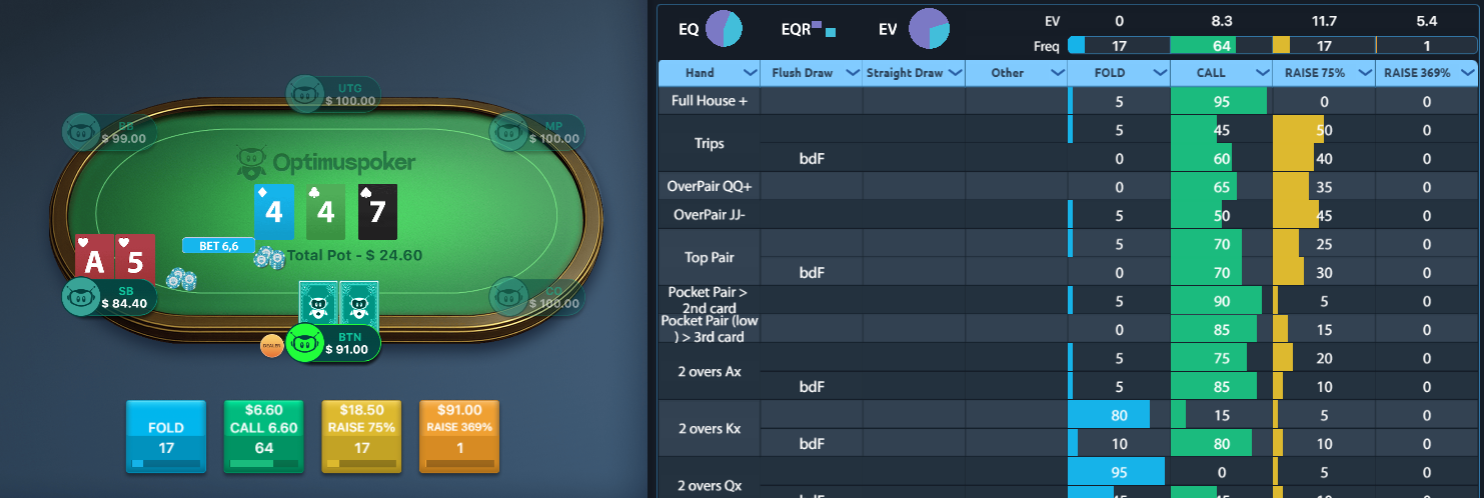
17% flop raise + 1% shove
(optimuspoker) 3-bet pots, SB vs BTN, vs CB33% / high paired board
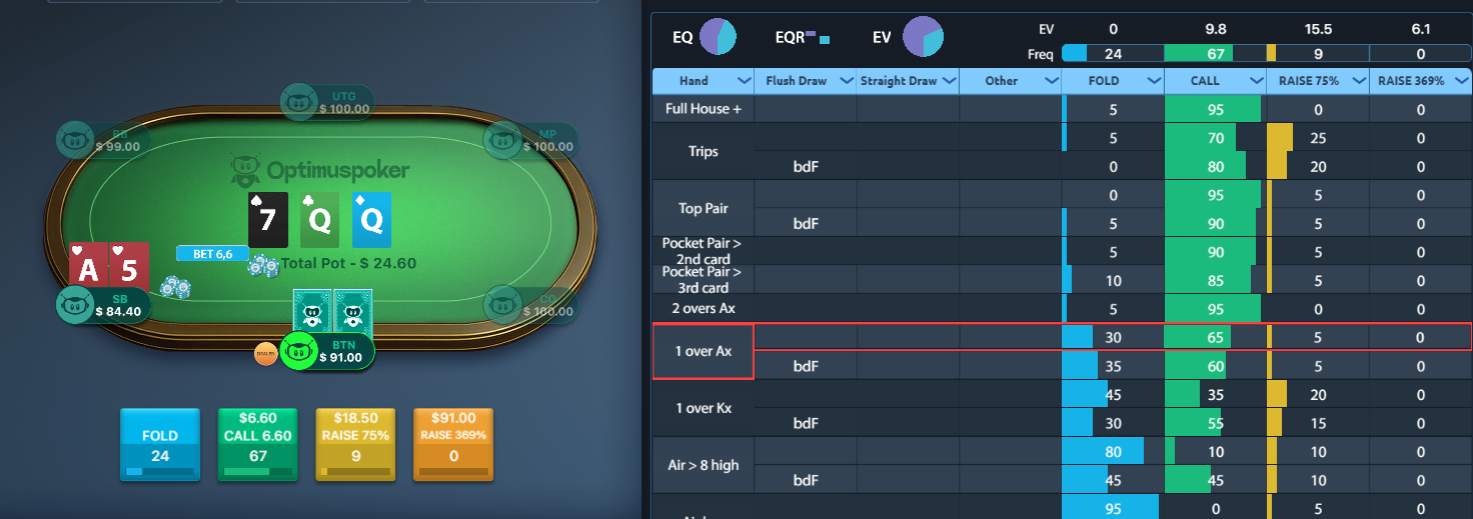
9% flop raise + 0% shove
In all cases, check the circular diagrams above the right table, it explains the range frequencies, then you need to adjust every handclass, as described in each table.
To summarize my work on the matter up to this point, I'd say I now have a protocol (in the form of 2 questions) and 2 heuristics.
Questions :
1) Where is the indifference threshold vs this bet?
2) How often should I raise?
The indifference threshold helps to identify the hand classes used to bluff. For instance, low unconnected flops will have some underpairs as bluffs, whereas 2-broadway flops will typically pure fold them. That's because in the first case they're 0EV or slightly +EV, whereas in the second case they're -EV.
The raise frequency helps to define both the value threshold (the more often we raise, the lower it is) and the raise frequency of bluffs ; because bluffs are mixing in solverland.
Heuristics :
A) Against small c-bets, unconnected rainbow flops are raising very frequently.
B) Against big c-bets, frontdoors are pure calling.
Which means, for the first heuristic, that players are actually very likely to underbluff when they do raise (because draws are lacking and it's tempting NOT to raise underpairs and overcards+backdoor), and for the second heuristic, very likely to overbluff when they do raise (because it's tempting to raise draws).
This is a cool thread, and im interested in what you find out. Cant offer anything besides guesswork though, just posting so that you know youre not alone here typing into the void
Thanks! I'm ok with the guesswork. That's mostly what I do as well 😃
Hey, I took 3 minutes to solve your spots, and here are a few examples : (optimuspoker) 3-bet pots, SB vs BTN, vs CB33% / rainbow flop14% flop raise + 1% shove(optimuspoker) 3-bet pots, SB vs BTN, vs CB33% / monotone flop4% flop raise + 1% shove(optimuspoker) 3-bet pots, SB vs BTN, vs CB33% / low paired board17% flop raise + 1% shove(optimuspoker) 3-bet pots, SB vs BTN, vs CB33
Thanks for sharing your data! It's coherent with with I observed on my own sims, except that the frequencies are much higher, because my raise size is ~33% instead of 75%. Not gonna lie, I thought the typical raise IP in 3-bet pots what much smaller than 3/4 pot  I don't have access to complex/complete flop aggregates though, so you might be right!

