Wasting time aimlessly studying/how to improve the real-time thought process
Hi,
I'm writing this after the rest of the text, I tried to follow an example but I found it really hard to stay coherent, so I ended up abandoning the example and just asking questions at the end, I wouldn't blame you for skipping to them. I sincerely apologise for the mess of a post that this is 😀:
For several months now I have been trying to improve my game, but feel as if I am not getting anywhere despite my best efforts. I have a solver, but I've been mainly using Flopzilla to try and become more aware of ranges. Every day I try and review hands that I've played with the software, but I'm completely unable to implement this study in playing sessions. I think I might be misunderstanding what is possible during the limited time that you have to act. I've included an example below to try and illustrate my problems:
NL Hold’em $0.05/$0.10 – 5 Players
Stacks:
UTG ($9.49)
CO ($3.37)
BTN ($13.50)
SB ($3.50)
BB ($8.62)
Preflop: ($0.15)
UTG is dealt Q♠ Q♦
UTG calls $0.15
CO folds
BTN folds
SB raises to $0.25
BB calls $0.15
UTG calls $0.10
SB folds
Pot: $0.55
Flop: ($0.55) 9♥ 9♣ 5♣
BB checks
UTG bets $0.19
BB calls $0.19
Pot: $0.93
Turn: ($0.93) J♦
BB checks
UTG bets $0.70
BB raises to $2.45
UTG calls $1.75
Pot: $5.83
River: ($5.83) 8♣
BB bets $2.05
UTG calls $2.05
Showdown:
BB shows K♠9♠
UTG shows Q♠Q♦
BB wins $9.93
To start with, I am aware that I misplayed this, but I will go into the details now:
PREFLOP:
Hero's range:
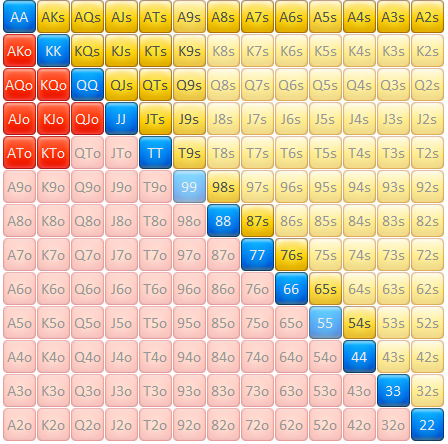
I think this is fairly standard, more SCs and fewer suited Kx than solved, but same proportion of range.
Villain's range:
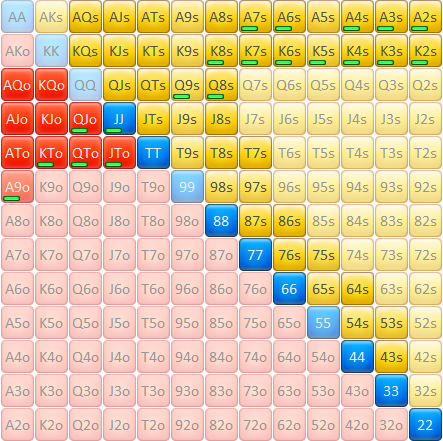
Could have more suited hands, and might not 3bet suited Ax, Kx, Qx as much, but my best guess.
FLOP:
I have no idea whether I should be betting here with QQ, and I also have no idea what the thought process should be. I guess I start by trying to make sense of his range.
"In terms of nutted hands, I know Villain has more 9x. Maybe slightly more boats, but a very small part of his range. For his continuing range, flush draws, some gutshots, pocket pairs (TT, 88-66, maybe 44-22) and then maybe overcards with a club."
Now, during the hand I had no idea what proportion of Villain's flop range that that continuing range makes up, but I guess that's the point of Flopzilla study, so that I will know this next time. Fine. But even with a perfect picture of Villain's range, I have no idea which hands that I should be betting here. My actually hand, QQ, is ahead most of the time, but if I bet and get reraised, it's an uncomfortable spot and I probably end up having to fold at some point during the hand. So I'm inclined to just check, but then I just end up not value betting thinly enough. Clearly I need to improve my thought process, but don't know how to determine whether betting is good or not here. I guess I can see what a solver does?
The solver here offers this solution:
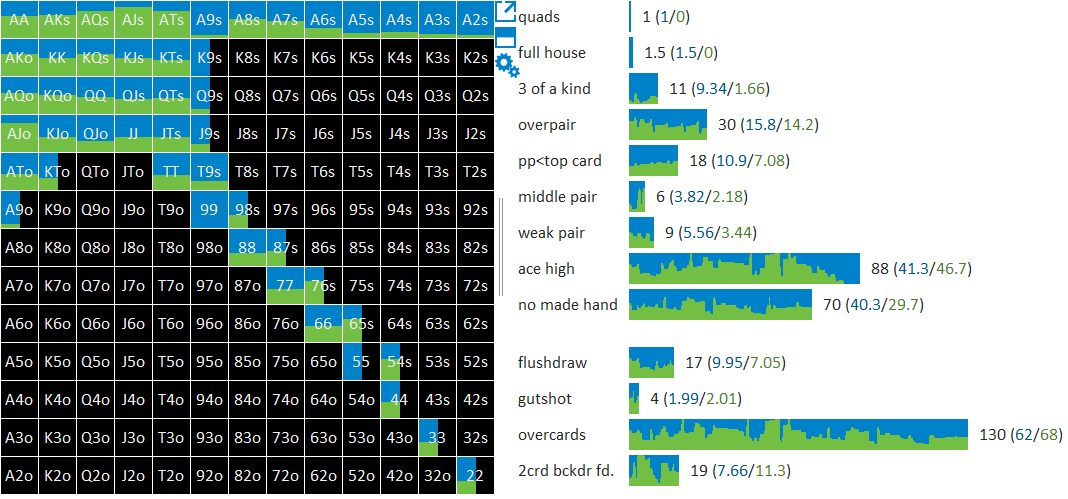
Ok, so the solver is betting QQ and other overpairs some of the time here. But what do I actually take from this? To start with, I appreciate that this strategy is not something to aspire to replicate, and that you have to understand the 'why' behind its actions. And that this is an equilibrium strategy that will not represent any actual human player. So I can try to node lock what I think Villain would actually do. But the truth is, I don't know whether they are reraising trips here, whether they are bluffing JT 1 club hands, bluffing underpairs with a club, whether they're bluffing at all even! So I can get reasonably close to estimating a general continuing range, but whether he calls or raises certain hands and the effect that that has on future ranges is just overwhelming with all the possible scenarios, and I end up getting nowhere, hence this post.
I hope this doesn't come across as a low effort post, I'm just really struggling to put into words what I'm actually confused with. I guess it's that I don't understand how this off-the-table study actually helps in general play. I can't visualise the ranges during the hand very well, especially when playing multiple tables. These are some questions that I think answers to would help me:
1) When it's my turn to act after Villain has bet, should I be thinking about his range or my range, or do I need to be thinking about both? If both, should I be thinking about one more than the other? Is it different when Hero is choosing whether to bet or not, and with what sizing?
2) This is a bit abstract, but how do you keep track or ranges? Do you visualise the starting grid of hands, kind of like in chess where the Grandmasters are picturing the board in their mind? I have next to no visualising ability, partially due to chronic illness causing fatigue, so I struggle to do this. Or listing combos? That's what I've been trying to do, but particularly when there's wide ranges (flop, SRP) you can't list all of the possible combos, and it's hard to tell which categories of hands (top pair, straight draws etc.) are in what proportion. It also takes me too long, given you only get a maximum of about 20-30 seconds, and normally a lot less than this.
3) This stems from question 2, when Villain bets and Hero is deciding whether to call or not, how do you estimate how high up Hero is in his range? Even in Flopzilla with unlimited time, it takes a lot of work. I know that MDF is not always applicable, but for simplicity, if Villain bets 2/3 pot, then I think Villain has to defend 60%? How on earth can you estimate what 60% of your range is? Even with perfect visualisation of the range, I would struggle to order categories to find the cutoff point. In the posted hand, I struggled to identify whether there were more flush draws or trips, let alone saying that there's around 10% trips, 20% flush draws, 40% air, etc.
4) This comes from my rambling in the 995 hand; how does Hero decide whether to bet or check a certain hand at the table? I don't understand the purpose of betting QQ here, if Villain check/raises then it's so tough.
I have a lot more uncertainty but I think these questions would be at least a start, if anyone is able to help me?
Thank you,
C
4 Replies
Step away from GTO, it's only meant as a general guide. Focus on evaluating the strengths of your opponent, are they calling a lot before the flop? Or raising constantly? What do they do post flop? Do they get aggressive? Or passive? Things like this give you hints on what intentions they have, and are exploitable.
Is this with a straddle? I don't understand why you didn't 3 bet or raise to start.
I think you want to start looking into heuristic studies. Run it once has as a lot of videos on this. Heuristics is more like a checklist guide on how to handle flops, players, and betting amounts and situations. Its far more important for "in the moment" analysis. GTO is a fall back check to see if you played a hand right or if you want to do a deep dive into a scenario.
I am not a good player, so grain of salt as always.
I dont get whats up with this preflop action, so i'll assume its just a srp for simplicity. If you had a chance to 3bet, you should have.
I have no idea whether I should be betting here with QQ, and I also have no idea what the thought process should be.
Am i still ahead more than half the time when i bet X sizing and get called? Do i have showdown value (if we just check it down, do i win some of the time)? Does opponent fold better hands often enough if i bet X sizing?
Basically, is you hand good for value or bad enough to bluff (bluffing returns more than winning X% at showdown)? If it is, you bet, if not, you check. I think you can start with this simple one and build from there.
Now, during the hand I had no idea what proportion of Villain's flop range that that continuing range makes up, but I guess that's the point of Flopzilla study, so that I will know this next time. Fine. But even with a perfect picture of Villain's range, I have no idea which hands that I should be betting here. My actually hand, QQ, is ahead most of the time, but if I bet an
If you have a perfect picture of villain's range, you know how much equity your hand has after a bet. If its above 50% (maybe 55% IP), you can value bet. You will never have that, but you could guesstimate based on your experience and study of theory.
"What if he has the nuts" is not a helpful process - nuts are a very small part of the range, at least at that point.
I guess I can see what a solver does?
Ok, so the solver is betting QQ and other overpairs some of the time here. But what do I actually take from this?
That QQ is ok to bet or x in theory - but your study shouldnt stop there (just checking "did i play alright" is useless and often harmful). What other hands do you bet, and what do you have to check? What range does the opponent call in theory? Is it what you thought (i bet its much wider than what you described - 5x, good overs, good backdoor draws should probably call)? If its actually what you think it is, do you have enough equity with QQ? How does QQ play if we x? What if the opponent doesnt bluff garbage on later streets? etc etc
Nodelocking is time consuming and the results are very dependent on the quality of your lock - how well you guess your opponent's strategy, which you cant really know. You can start by applying basic principles - if villain's range is just good made hands and draws, it has more equity against your QQ than the solver thinks. If villain never bluffs, we can fold more, etc etc.
I don't know whether they are reraising trips here, whether they are bluffing JT 1 club hands, bluffing underpairs with a club, whether they're bluffing at all even!
What would you do, ie what do you think is the best? Do you know something about that specific opponent that would skew it, eg they are very tight?
1) When it's my turn to act after Villain has bet, should I be thinking about his range or my range, or do I need to be thinking about both? If both, should I be thinking about one more than the other? Is it different when Hero is choosing whether to bet or not, and with what sizing?2) This is a bit abstract, but how do you keep track or ranges? Do you visualise the start
1. Both, but also your hand. Value betting is about equity.
2. Thinking of hand categories i think is best - A high, low pockets, bottom pair, top pair, trips etc
3. You dont need to be exact - how many worse/better hands do you have? Also, its not necessary to always follow MDF even in theory
4. You get called by a lot of worse hands in theory. If villain only calls trips+ and good draws, you dont need to bet.
GL

4B pre.
I understand you're asking for postflop feedback after already stating you misplayed preflop, but it is important to prioritize your studying time, which to a certain extent you allude to in the title. Studying a postflop node in which you've clearly misplayed preflop in a situation that should have a pure frequency is not particularly useful.
Your "solver" output is also not helpful... Not only does it not look converged based on the output you've supplied, but you've given yourself full frequency of even AA—not to mention it's going 3-way to the flop. This shows you utilized it in a very cursory way and are likely not understanding how to utilize the software at a basic level.

