My journey from a beginner to an advanced player
Hi guys,
I'm starting this thread to document my progress as a new backgammon player. I will post analysis, questions, an
Position 1
Although not in great danger, you would hate to see 3-3, 1-1 or 3-1. And you're already behind in the race + his bar point is still open, so no immediate need to split the back men. Also, since his 2-pt and 3-pt are already made and not his 4-pt and 5-pt, he'll be incentivized to blitz rather than to prime. By keeping the ace point, you deny a potential blitz.
Position 2
Even if you get hit, it's not the end of the world, you still have a better board than him. And putting a 3rd checker on the 3-pt doesn't look good, as it can only help for the ace point. Plus, on the 21/36 rolls you DON'T get hit, you'll have good chances to close the bar point.
Position 1- not too much to add to what uberkuber posted. Both you and your opponent are in positions where you each very much want to make important points still, but you lack builders to do so naturally. Splitting gives your opponent a target to shoot at whole slotting an important point and making it more likely that he will be able to make that point. Bringing down two gives you more ammunition (a checker on the 9 point is an especially powerful builder in general since it targets all the points you will need to complete a prime - 3 through 8 - and is sufficiently far away from the opponentÂ’s back men to make it relatively unlikely that it will be hit.) That gives you a distinct advantage in the position since he has essentially no builder.
Position 2 - this one is a frustrating one for beginners. You are absolutely correct; all the rules of thumb that you learn tell you that you should play safe here. The key to this one though is looking bigger picture. Think about how black will try to give himself his best chance of winning this game. He will try to escape the back men, build his front position, and wait for you to be squeezed off your bar point anchor and leave a winning shot. How do we prevent that from happening? Trap his back men behind our prime, of course! If we can do so, then any shot he gets when we break anchor wonÂ’t be a winning one. My first preference when I looked at the position was that we want to slot the six point, which pointed to 11/6, but the problem with that was what to do with the 6. Since thereÂ’s no good 6, we slot the 7 with 13/7 instead.
If you havenÂ’t yet encountered the idea yet of a pay now vs pay later position, this is not exactly one, but has some of the features of it. A pay now vs pay later is a position where you have to decide whether itÂ’s best to voluntarily leave a shot now or play safe. Arguments for voluntarily leaving a shot are typically either that the shot you leave now is likely the last one you will leave, but the safe play will likely lead to more shots later in the game or that your opponents position now is weaker but will improve meaning that a shot left now is less damaging than one that gets hit later. In this position, we would rather get hit now (even a couple times) than get hit coming off our anchor when black has a closed board.
Thanks for the comments! The first position is now a bit more clear to me. I'm often confused about when it is good to split back checkers and when I should just stay back.
I understand the reasoning behind the best play in the second position, but I'm wondering if most players would hesitate to leave 3 blots. I think I almost immediately ruled out that option because it just seems too risky. I'm not sure how to assess whether the benefits outweigh the risks, so I automatically opt for the safe play in these types of mid/late game situations.
I haven't updated in a while as I've been busy with other things. However, I have still been playing backgammon quite a lot, but I haven't been as focused as before. I was very motivated in the first couple of months of this journey, but now a bit of fatigue has set in and my progress has stalled, even taken a few steps back as you can see in the graph below:
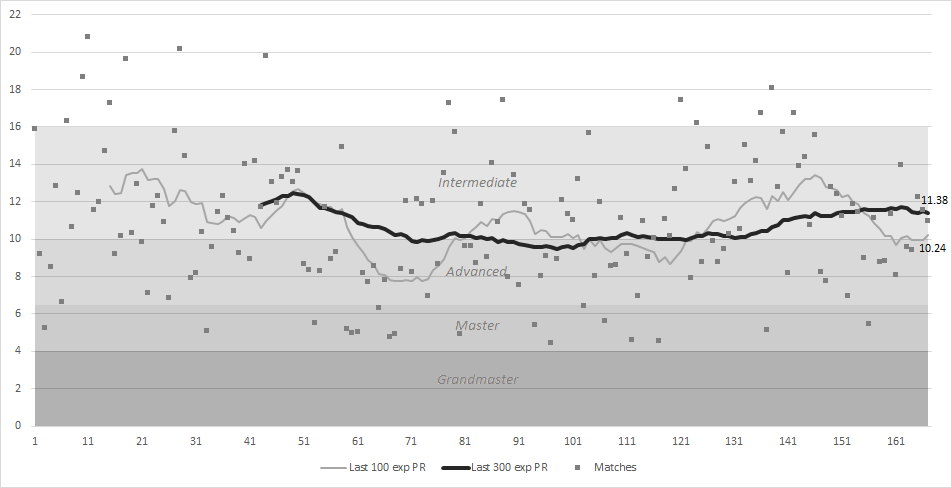
A lot of the recent high PR matches are simply due to poor focus and just playing for fun. When I'm focused and think before every move, I believe I still play under 10 PR on average. Nevertheless, I think the easy part of improving is pretty much done and unless I start studying the game more seriously, this is probably the level I will remain at.
The original goal I set was to get average PR < 10, and after achieving that I kind of lost focus. I need a clear goal and I want to get better at cube play, so I will try to get cube play PR (long-term average) under 10 by the end of this year.
A couple of positions from recent matches:
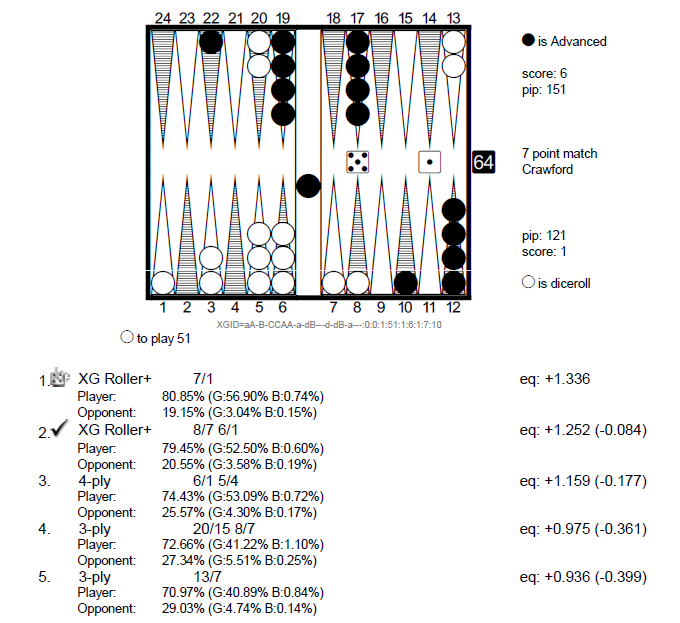
Making the 1-point is obvious, but what to do with the ace is not. I made the 7-point, which is a blunder. I don't really understand why.
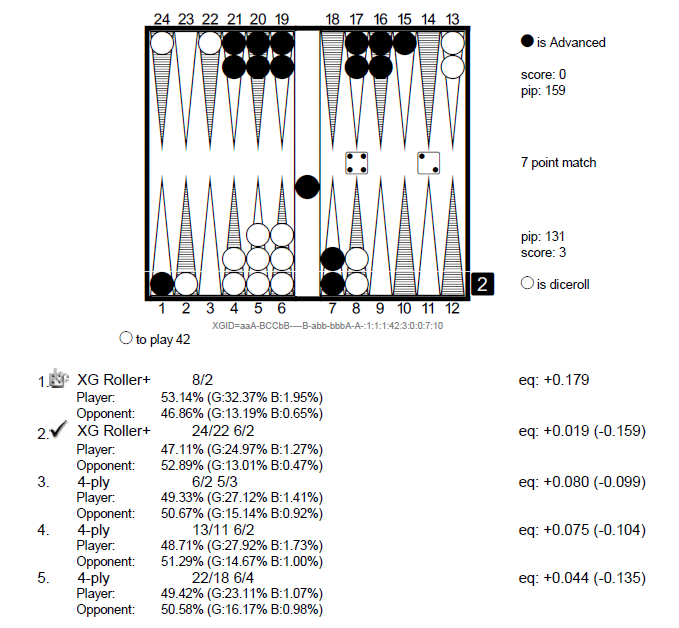
Here, making the 2-point is mandatory, and it seemed obvious to me to make the 22-point anchor, but it is a huge blunder. Can you guys explain why?
Position 1 is all about builders for your 2 and 4 points. Your play leaves you only checkers on the 5 and 7 points aimed at those points (you’d break your 7 to make one of them). Playing 7/1 leaves checkers on the 5,6 and 8 points targeting them.
Position 2 - I probably would have anchored too, but look at sixes. If you anchor the only six you can play is 8/2, which stacks an unwanted spare on a point where you don’t want it and possibly leaves a blot (after 65 or 61) on your side of the board. Failing to anchor gives you a six to play without burying a checker. Leaving the blot on the 8 isn’t as dangerous as it seems - he only hits with 31, 11 or 53

