In other news

In the current news climate we see that some figures and events tend to dominate the front-pages heavily. Still, there a

There have always been private landlords here, but they used to be somewhat grubby characters not making a huge amount of money because rents were cheap, but they did provide housing for people "in between" or for people first moving out of home. Sort of the anti-Insoos.That was before the buy to let market developed and people were encouraged to take cheap mortgages out on sec
What you are describing is a common effect of a monetary problem .
Maybe mix with a overflow of immigration like we had here in Canada .
But you can’t have both way , no free lunch exist .
You asked who’s paying for Keynes economy ?
Everyone pays , the value of money goes down .
Like luciom said correctly , it can be benefial during a crisis but there is always a cost .
In Canada the cost was an explosion of inflation , dramatically in housing.
Creating more debt to make affordable housing won’t fix the problem when you already have an inflationary problem .
Well you could force people to work at a lower salaries , cutting home prices down .
Forcing contractors to take a hit on their profits margin or even forcing them to build at a loss .
So yeah you can have an infinite supply at a cheap price for housing .
But I’m not sure using those regulations will last very long…. In a free country .

Housing is an essential part of the economy and should be planned as such, with measures taken to ensure there's sufficient private housing for working people to be able to buy (as used to be the case), and sufficient public housing for non-working people to be able to rent from local authorities.
When was it the case that all working people were able to buy housing?
I've never heard of that being true in the US or anywhere else.
In most big cities, haven't most people always rented?

Case in point. 1950s. Median office worker for the Water Board, a public utility organisation, gets married to a non working woman and they buy their first house, a three bedroom in an ok suburb of north London. They go on to have two kids, with the mother staying at home to do child care. They aren’t wealthy, don’t buy expensive things but have no financial worries and are by no means poor.
When their sons grow up and leave they downsize, sell their house and buy an apartment in this block, where we later move to and become neighbours.
Their first house is now worth about £700,000 and that life is quite impossible now even if both median earners are working, let alone only one of them.
That’s how ****ed things are here.
Case in point. 1950s. Median office worker for the Water Board, a public utility organisation, gets married to a non working woman and they buy their first house, a three bedroom in an ok suburb of north London. They go on to have two kids, with the mother staying at home to do child care. They aren’t wealthy, don’t buy expensive things but have no financial worries and are by
yes like everywhere else shrug.
all the western countries have about the same problems.
the value of wages been downgraded to the benefits of capital.
wall street get the big chunk of profits now and leaves crumb for main street.
And the non ending devaluing of money isnt helping either.
What would you have done? Let it rip with zero safety measures?
In case the numbers don't already tell the story--we don't need much input from over Italy way on economies 😀
Well that's exactly why you should have done the opposite of Italy, which would have been nothing. We locked down 70 days with armed militaries in the streets.
Ofc it was completly useless and covid rebounded easily.
Case in point. 1950s. Median office worker for the Water Board, a public utility organisation, gets married to a non working woman and they buy their first house, a three bedroom in an ok suburb of north London. They go on to have two kids, with the mother staying at home to do child care. They aren’t wealthy, don’t buy expensive things but have no financial worries and are by
There are a lot more people that would like to live in London these days, both because of internal and external immigration. There are barely more housing units in London.
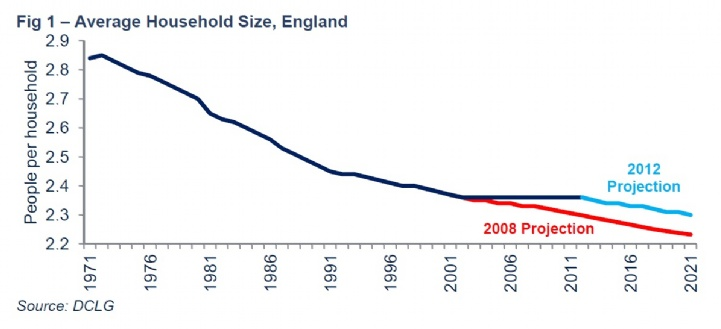
Also, for factors related to the aging of society and difficulty in couple formation and whatnot, the median household size is smaller, so with the same population you need more units.
Then for london specifically there was sustained interest by international investors as well.
All that comes out as much higher demand, while supply didn't even remotely keep pace. Which means a lot higher real prices. That's not "****ed", that's how anyone with a basic understanding of reality would have predicted prices to move.
You can dislike the outcome. The solution relies in a combination of lowering demand and increasing supply.
Supply can be increased both by outright new construction, by fractioning existing units into smaller ones (which the city has been very much against for a long while iirc) , and by allowing conversion of commercial real estate into residential real estate (both now-unused industrial real estate, and recently under-used offices thanks to the slow moving toward WFH).
Afaik london creates immense problems to new construction, significant problems for fractioning, it moved somewhat reasonably for conversion of industrial real estate (but slowly) and it's still TBD how much it will allow rethinking offices as residential units.
So a lot can be done for the supply , and it's all about local political choices mainly.
For demand, local political power is toothless.
You need to either have OTHER places become more attractive (and a few did, but they are smallish, and have their own housing problems as well these days), to become so much worse than a ton of people wants to leave (like it happened in the 70s, but i won't recommend that route), or to severely restrict immigration (we went through this already) but that's something up to the national gvmnt.
Seems pretty clear solutions (other than immigration restriction that would make sense for a lot of other reasons as well) have to be on the supply side.
You only focus on supply of public housing (which on paper isn't absurd and could be part of the solution, with many caveats) because of your political bias and you disregard all the rest though.
And the fact that right now public housing is occupied by a ton of immigrants is somewhat morally horrific. Normal british people can't afford to live there but immigrants are allowed to, that's the sort of thing that make blood boil in normal people and that will determine a change in national politics to fix it.
When was it the case that all working people were able to buy housing?
I've never heard of that being true in the US or anywhere else.
In most big cities, haven't most people always rented?
up to ww2 more or less everywhere 40-50% of households were owner-occupiers. Higher in rural lower in urban, so yes in big urban areas up until the 40s in most countries the majority was renting.
But then the 50s-70s came and enormous efforts were made to allow more people to buy in urban areas in several countries. IIRC the shared idea coming from sociology (when it was still a decent science) was that democracy with capitalism would be strengthened in a nation of owners.
So rates of owner occupied housing jumped a lot, going above 60% in the USA and touching 70 if not more in Italy. Germany and Austria were different and always had a ton of (subsidized, ultra-regulated) renters.
The UK saw the most dramatic shift i know of in the western world. From a nation of renters, it became a nation of owners
This was made by gemini using data points from various sources (
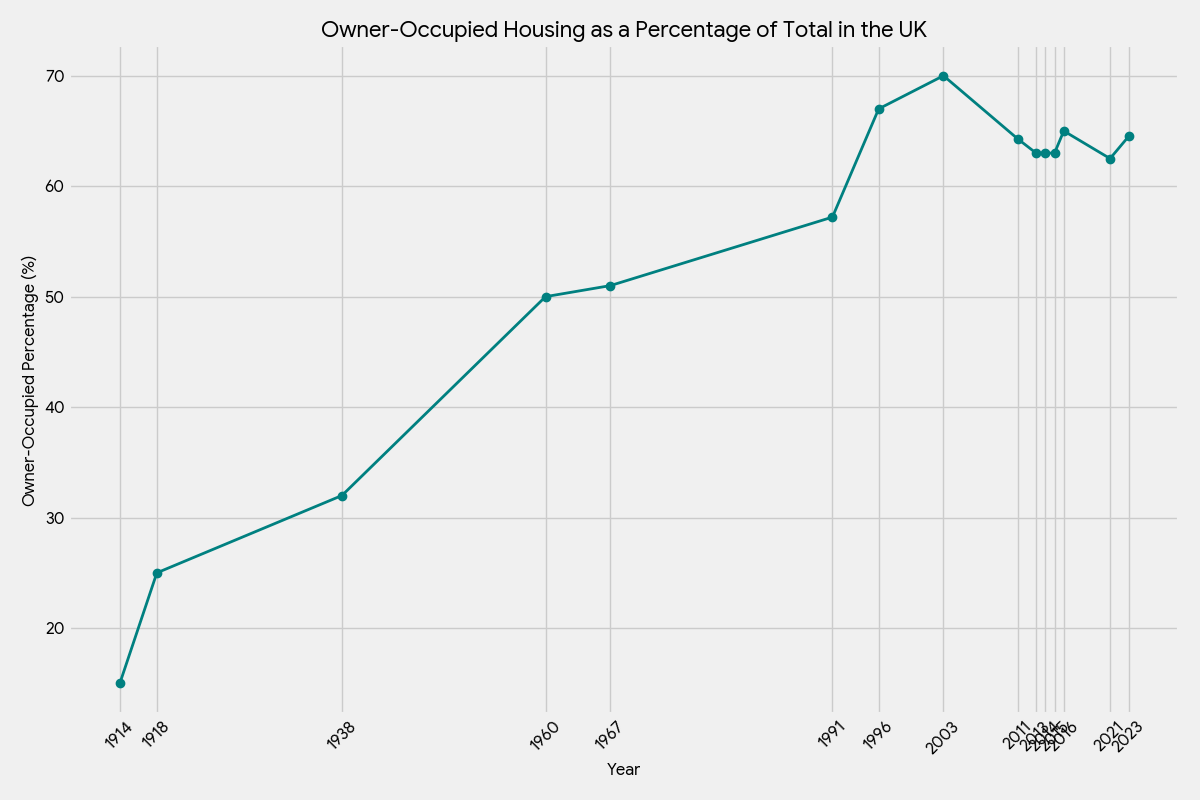
] which i checked)
Supply can be increased both by outright new construction, by fractioning existing units into smaller ones (which the city has been very much against for a long while iirc) , and by allowing conversion of commercial real estate into residential real estate (both now-unused industrial real estate, and recently under-used offices thanks to the slow moving toward WFH).Afaik london
You have no idea what you’re talking about. What you call fractioning has been happening across the city for decades with houses converted into smaller apartments and it’s everywhere and still not enough. I’d be surprised if any of the houses I or many of my old school friends were brought up in were still houses. I google mapped a couple and they’re flats now.
The rise in population caused by immigration + births - deaths - emigration over the last few decades is tiny when compared to the increase in house prices, so immigration is barely a factor.
You have no idea what you’re talking about. What you call fractioning has been happening across the city for decades with houses converted into smaller apartments and it’s everywhere and still not enough. I’d be surprised if any of the houses I or many of my old school friends were brought up in were still houses. I google mapped a couple and they’re flats now.
Ofc it has been happening A BIT, but it could happen a lot more and with lower costs and regulatory requirements.
That's actually something the local leftist governments in the main northern italy cities streamlined massively in the last 10-15 years, and helped a lot to keep housing prices in dense urban areas lower than they otherwise would be.
It's just one element of many to help supplying units to smaller households which are the norm more and more these days.
The rise in population caused by immigration + births - deaths - emigration over the last few decades is tiny when compared to the increase in house prices, so immigration is barely a factor.
Households are smaller so you would have a SIGNIFICANT pressure upward in prices even with stable populations.
I don't believe you do believe that if you repatriate 3M immigrants from the UK, of which 1M in london, prices in London would move only a little.
And 3M is just the migration from 2021.
Ofc it has been happening A BIT, but it could happen a lot more and with lower costs and regulatory requirements. That's actually something the local leftist governments in the main northern italy cities streamlined massively in the last 10-15 years, and helped a lot to keep housing prices in dense urban areas lower than they otherwise would be.It's just one element of many to
No, I just told you it’s been happened A LOT in London and there’s obviously a market determined limit to how much more can happen when there’s still demand for family houses. Maybe it’s at equilibrium now, I don’t know, but there’s a lot of money to be made by converting London houses into flats, and families having kids will have to move further out to afford a house.
I don't believe you do believe that if you repatriate 3M immigrants from the UK, of which 1M in london, prices in London would move only a little.
And 3M is just the migration from 2021.
Without the million recent immigrants London will cease to function to anything like the same level. Hospitals and transportation are just two areas that would be badly hit and there aren’t a million unemployed young people in London to train to do those jobs.
Your ideas really suck, not only from a moral perspective but also from a practical one.
Without the million recent immigrants London will cease to function to anything like the same level. Hospitals and transportation are just two areas that would be badly hit and there aren’t a million unemployed young people in London to train to do those jobs.
Your ideas really suck, not only from a moral perspective but also from a practical one.
I Was comparing sizes. Ofc you woulnd't remove ALL new entrants, only the low income ones (and mostly, their relatives randomly allowed in on family reunions).
You don't need to rempatriate the full time nurse or bus driver, but the deliveroo guy and his 6 family members and the "cousin" of the bus driver.
You can start with every single one of these
In March 2025, 15% of individuals in receipt of a Universal Credit payment were neither UK or Irish nationals
In March 2025, 15% (around 1 million) of individuals in receipt of a Universal Credit (UC) payment were non-UK (and non-Irish) nationals aged 16 or over at the time their Universal Credit claim began (Figure 5)
Repatriate them to countries where they may face death or imprisonment for political reasons?
Far better and more humane to introduce a property tax on the wealthy.
Repatriate them to countries where they may face death or imprisonment for political reasons?
Far better and more humane to introduce a property tax on the wealthy.
you can try a property tax on the wealthy, that won't make housing cheaper though.
They have hefty wealth taxes in France (the highest in the world, starting from very low thresholds of 1.3M eur), it's not like Paris housing is affordable.
So you already know, for a fact, it won't solve the purported problem you purportedly want to solve.
And btw family reunions from countries not a war aren't "people fleeing death or imprisonment for political reasons at home". If you meant the ukrainians (the only actual refugees currently basically in the UK) you can make an exception for them yes, like most countries in europe correctly did.
But making that reasonable exception for ukrainians would require being even stricter with family reunion from pakistan, bangladesh, african countries and so on.
It will make housing cheaper when you reinvest some of the property taxes in building new houses.

It will make housing cheaper when you reinvest some of the property taxes in building new houses.
Increasing supply is the key to lowering housing costs. IMO we need higher density housing, way more apartments and mobile home parks. The issue isn't so much how it will be paid for, at least in the US there is a lot of resistance to that because of concerns it will lower property values. I understand that to a degree, but we can't have a society where people only live in McMansions.

The problem is, Americans seem much less excited to live in high-density housing than the Europeans.
Building a 1000 sq ft house is only slightly less expensive than building a 2500 sq ft house, and that's why everyone is cranking out McMansions.
This will only get worse as the tradesman shortage continues to spiral out of control.
No real estate developer in their right mind is going to spend tens of millions of dollars putting up a bunch of "affordable" apartments when they could use those same dollars on much more profitable luxury units on the limited land they have to work with.
Plus, if I've paid however much I did for a luxury condo, I don't want someone putting a low-income tower up down the street. I don't blame them one bit. Everyone wants a cheap house, but nobody wants to live next to people who need cheap housing.
I am not a nimby where I live because I gain if more people live in the city center.
We get more services, quicker trash collection and so on (vs the counterfactual) if the center doesn't depopulate so if they convert offices into residential I am all for it.
but if I lived in American suburbs I would be the leader of nimbies: when you need to rely on your car for everything, more people means a worse quality of life directly through the traffic/lack of parking channel and there is no possible compensation for that.
you cannot underestimate how ruinous it is for well being to have to spend more time in the car (I might be biased because I don't need a car for 95% of what I do and I planned my life not to need one)
The problem is, Americans seem much less excited to live in high-density housing than the Europeans.Building a 1000 sq ft house is only slightly less expensive than building a 2500 sq ft house, and that's why everyone is cranking out McMansions.This will only get worse as the tradesman shortage continues to spiral out of control. No real estate developer in their right mind is
I'd be very happy to live nearby college students and young workers which I actually did for a while. now we gentrified a bit so it's harder for them to rent around where I live (also Airbnbs sucked supply out of the market).
but if a MENA name appears in your building your property loses value immediately, so I suppose it's much more about racism than anything else in the USA as well.
The problem is, Americans seem much less excited to live in high-density housing than the Europeans.
Building a 1000 sq ft house is only slightly less expensive than building a 2500 sq ft house, and that's why everyone is cranking out McMansions.
This will only get worse as the tradesman shortage continues to spiral out of control.
I’ve never heard of an apartment complex opening up and having a lot of property that can’t be moved. Even the 1 million dollar condos in the 7 story building about 10 min away from me all got sold. And so did the one that opened 5 min away from me. It seems like there is more excitement for high density housing than you think.
And I’m sure there are ways to make it cheaper to build the 1k sq ft house (tax incentives, etc) and more expensive to build the bigger house, in the places where that would be relevant.
No real estate developer in their right mind is going to spend tens of millions of dollars putting up a bunch of "affordable" apartments when they could use those same dollars on much more profitable luxury units on the limited land they have to work with.
Plus, if I've paid however much I did for a luxury condo, I don't want someone putting a low-income tower up down the street. I don't blame them one bit. Everyone wants a cheap house, but nobody wants to live next to people who need cheap housing.
People moving into luxury apartments from non-luxury apartments can still bring down prices, luckily. And not everyone goes to city hall and demands that affordable housing not be built because they want to protect the price of their artificially-inflated asset 😀
Of course partially people with your attitude have completely ruined real estate in this country, along with the crazy left-wing anti-developer, anti-building attitudes. It’s funny how you would end up on the same side as the crazed leftists a lot of the time on this issue.

Building a 1000 sq ft house is only slightly less expensive than building a 2500 sq ft house, and that's why everyone is cranking out McMansions
This isn’t remotely true fyi

USA is so annoyingly carbrained, it’s terrible. There’s basically 5 cities you can live in comfortably without a car in the whole ****ing country. It’s so dumb.
Most Americans are also annoyingly against support for public transportation, not realizing that better infrastructure would literally make their precious driving a more pleasant experience overall. It’s the same NIMBY mentality that exacerbates the housing issues.


