My journey from a beginner to an advanced player
Hi guys,
I'm starting this thread to document my progress as a new backgammon player. I will post analysis, questions, and key concepts as I'm learning them, hopefully also inspiring comments from other players. As a side note, I've played poker for a long time and will also participate in poker discussion elsewhere in the forum.
To be fair, I'm not a complete beginner as I first got interested in backgammon about 10 years ago and played a bit with friends and family. I also recall trying out Xtreme Gammon and looking at some optimal moves, but I never got to using the cube or playing proper matches.
I recently got interested in the game again when I was watching a live stream from the world championships in Monaco. To my surprise, a player from my home country (Finland) ended up winning the tournament. I decided to try studying the game a bit more.
What I'll be doing first:
- Watching some tutorials on Youtube
- Perhaps read a book or two
- Get XG and play against the computer a lot, analyzing mistakes.
I will track my PR throughout this journey and post graphs here so that I can tell if I'm making progress. My goal is to reach advanced level (PR < 10 over 100 match points). I'll try to achieve this by the end of 2025.
Here's the final of the BGWC that got me inspired.
It was surprisingly entertaining to watch with commentary and live XG analysis. I think they are trying to give the game a bit more modern feel, which should be attracting new players. It got me interested at least.
I've been going through some beginner material, reviewing the rules and some terminology. In the past, I think I've always just played 1-point matches without cube, and so gammon (2 points) and backgammon (3 points) never really entered the game.
I'm not entirely sure I understand the Crawford rule - does it mean that neither player can use the cube? And does the rule stay in place for the remainder of the match, or just for one game?
Edit: Figured this out, so only for the next game, the trailing player can't use the cube to immediately double - makes sense.
So I've got XG (extremeGammon) installed and been familiarizing myself with the program. There are a lot of settings and information I don't yet understand, but I've been playing against the computer to get used to the program.
I'm taking a quick look at every error or blunder I make as I play (free mode in XG). Some of the mistakes I'm making are easy, "why didn't I realize that" moments. Those should be easy to fix as I become more experienced. Some mistakes I don't really understand - these will be more difficult to fix.
Soon I'm going to start playing competitive matches against the computer. I will analyze every match and will post a graph here to track my PR.
XG has different skill levels for opponents, "beginner" is probably closest to my own level. There is an even lower level opponent named "distracted", but I think that one is too weak.
I watched all the videos in this recent tutorial series from BackgammonGalaxy on Youtube:
Lots of new stuff in there for me.
Some of the new concepts I learned:
- Try to maximize: 1) checker utilization, 2) purity (structure without gaps), 3) flexibility (develop for next moves), 4) freedom (back checkers are not trapped)
- Minimize opponents good rolls or create a duplicate (e.g. opponent can hit a blot but doing so prevents them from completing some other useful move)
- The stronger the opponent's home board or priming potential, the more you prioritize establishing an anchor or running (self-evident but I did not understand the importance of this before)
- The player who has the stronger home board has an advantage in a hitting exchange, and can afford to play more bold
- Priming/contact vs. racing/blitzing depending on which player is ahead in the race
- Fight more aggressively for the key points (e.g. 5-point)
- End-game: in a race, get checkers in a triangle shape (minimize time to get checkers to home board) and fill gaps in bear-off structure
I think focusing on these concepts is already starting to improve my level from beginner to intermediate. A beginner (in my view) is a player who knows the rules and can avoid the most irrational moves, but lacks understanding of key concepts such as those I listed above. Once you learn basic strategy, you kind of automatically become an intermediate level player. Comparing to poker, I feel like I have now learned basics about fundamental concepts such as value-betting, bluffing, semi-bluffing, bet-sizing, pot control etc.
Next, probably going to start reading a book. Any recommendations? Classics are always recommended, but I'm not sure if reading an outdated book (written before modern engine solutions) is best value, so I guess it should be a newer one.
I still almost completely lack cube strategy. Based on practice games with XG, I have an intuitive idea of when to double/take/pass, but very often I miss doubling opportunities.
Hello DiceRoll,
Nice to read you.
I have read many Backgammon books (all the modern and also Paul Magriel's) and I agree with your idea to read moderns.
The three books of Olsen are quite instructive (Badass, pure strategy, cube like a boss). All Michy's also. Dirk Schiemann is very good also.
I also recommend if you want to be serious to consider starting building a database, full of your blunders.
One thing also that really help me was to compare dice distributions.
An example: (safe)


With an excel file i manage to do this.
I have read many Backgammon books (all the modern and also Paul Magriel's) and I agree with your idea to read moderns.
The three books of Olsen are quite instructive (Badass, pure strategy, cube like a boss). All Michy's also. Dirk Schiemann is very good also.
Thank you for the suggestions. I think I will go with Olsen's books first, since I already watched his videos and learned a lot.
And yes, I think I will start building a blunder database at some point. I'm still making some very easy mistakes, but once I have gained a bit more experience, building a database seems like an important thing to do.
I found a nice channel on Youtube with an interesting video on cubing:
Great insight in that video and it illustrates how complicated cube strategy is, something I'm only now beginning to understand.
Over the last few days, I've been playing a lot of competitive matches against XG's intermediate level opponent to get my PR rating, which is essentially a starting point for tracking my progress. I checked the rules on the BMAB website and mimicked a real tournament setting: the matches are 7-point matches with a clock (120 seconds per point). No help on pip count or recognizing errors until the match is over.
For an active rating, BMAB requires over 100 experience points, which equals at least fifteen 7-point matches. I've now reached that amount and below is the result summary:

Overall PR is 12.2, which I'm quite pleased about. It is not yet advanced level (even though XG labels it as such), as the BMAB advanced level (and my goal) is PR < 10.
I'm positively surprised about how good my cube play PR is.
Here is a list of the individual matches. There was quite a bit of variation as some matches involved very difficult situations:
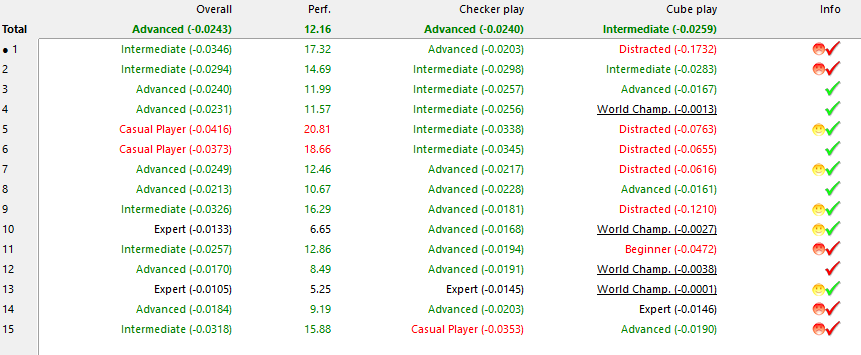
I have to say that I played the matches quite fast without much thinking, basically relying on intuition. This was because I was kind of in a hurry to get fifteen matches done to get a reliable rating, which is now my starting point and I will gradually try to improve from here.
After the matches, I looked at blunders I made. Some common themes I noticed:
- In the early game phase, I don't fight for the 5-point enough. I'm basically scared to leave a blot in my home board.
- I doubled many times too early/weak when I thought I was ahead but the match was actually close to even
- In mid-game phase, I seem to be playing a bit too loose, leaving blots in the middle area of the board
- In mid-game, I missed quite a few doubling opportunities (the opposite of my early game tendency to double too quickly)
- In the end-game phase, I made mistakes in bear-off structure and also not understanding small details in checker positions that affect gammon chances (both my own and the opponent's)
I have a few interesting board positions saved and will be posting them soon.
Some interesting situations from the previous matches where I don't understand the optimal move, one of them below:
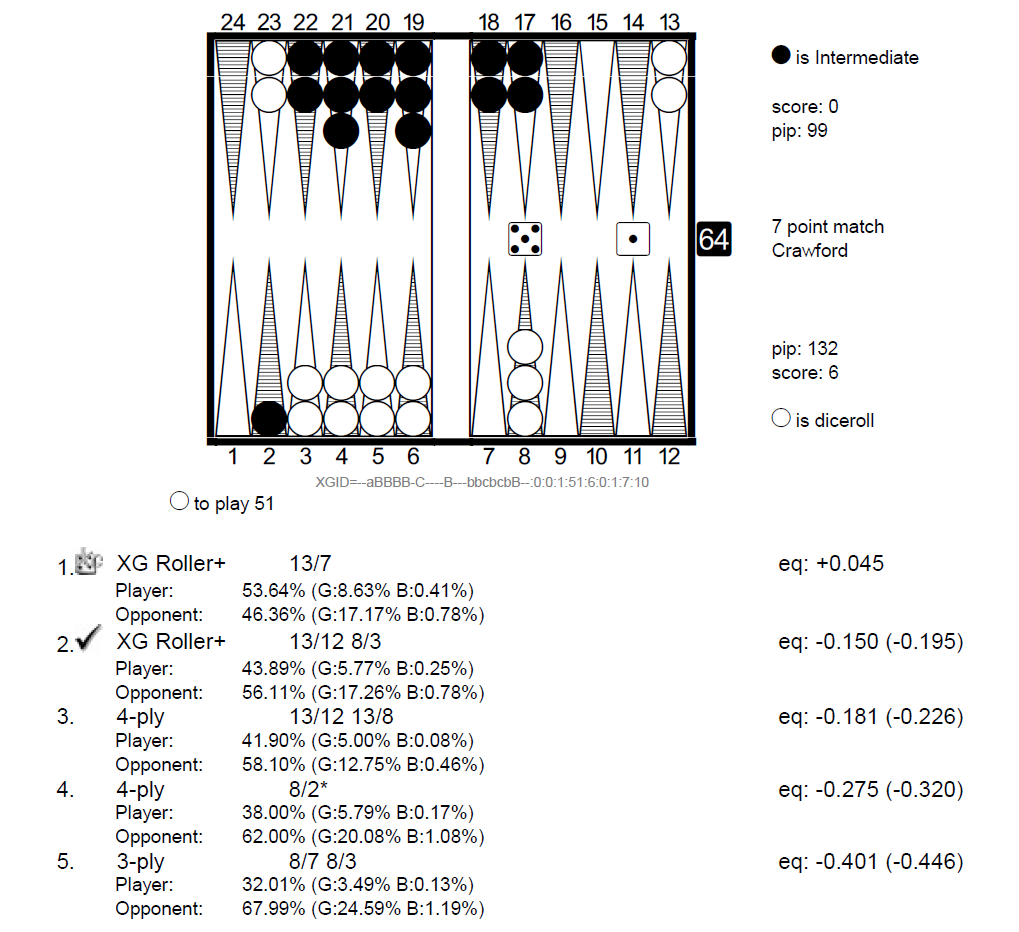
It's Crawford game so gammon wins don't matter for me. It's a huge blunder to move 13/12 8/3 or any other move for that matter, so it seems that we want to get hit here by giving opponent a direct shot (13/7). But why is that?
If the opponent doesn't roll a 5, they are forced to break down their prime, improving my chances to escape. If they do roll a 5 and I don't get hit, I still should have plenty of time before position gets tricky. So why is it crucial to play 13/7?
Here is another one:
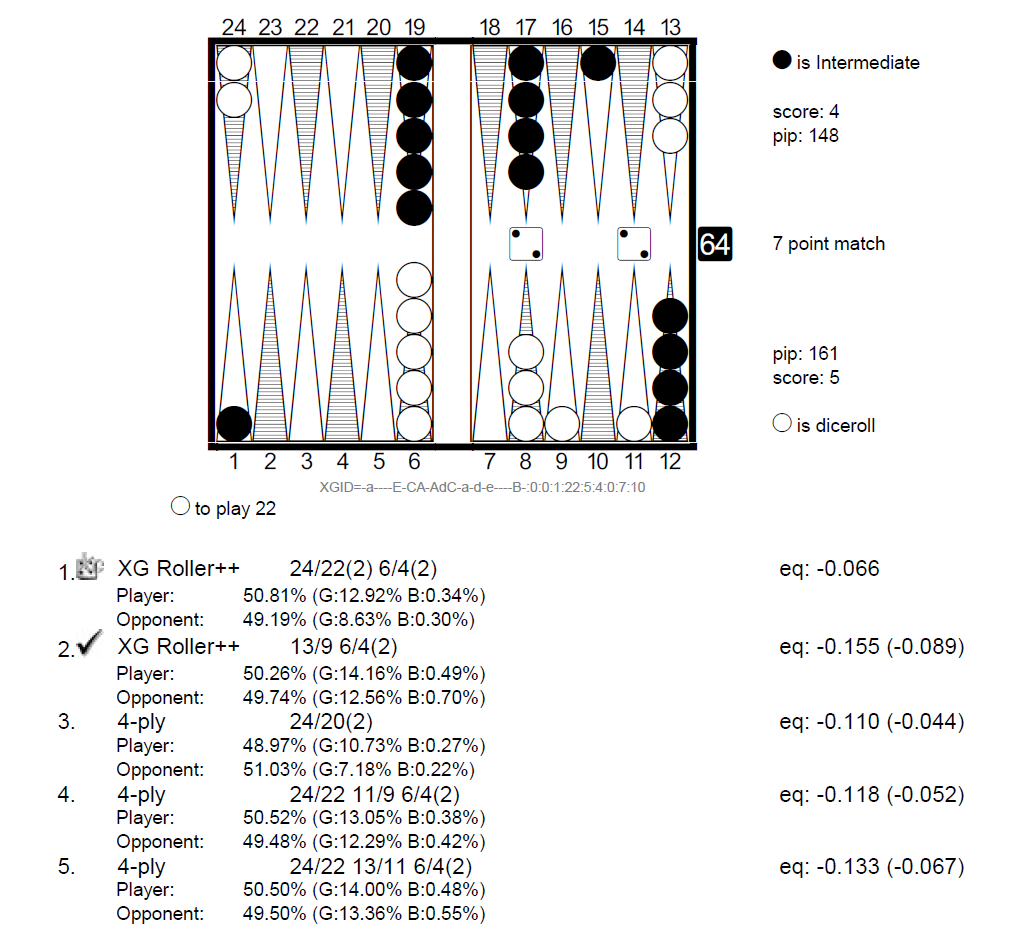
My move 13/9 6/4(2) was a blunder, but why? I understand that with 22, you either make the 4-point or you make the advanced anchor on 20-point. Those make sense. But what is not clear to me is, with the remaining two 2s, why not make the 9-point and either split the back checkers or bring one more down from the 13 like I did? Why is 24/22(2) the best move here? Does the match score affect here, so that your top priority is to avoid getting gammoned?
Some interesting situations from the previous matches where I don't understand the optimal move, one of them below:It's Crawford game so gammon wins don't matter for me. It's a huge blunder to move 13/12 8/3 or any other move for that matter, so it seems that we want to get hit here by giving opponent a direct shot (13/7). But why is that? If the opponent doesn't roll a 5, they
It’s not so much that you want to get hit. It’s more that getting hit isn’t a big deal in this position and making the bar point to trap his last checker is critical.
First of all consider the match situation. You correctly deduced that gammon wins are irrelevant, but you also should realize gammon losses are also (nearly*) irrelevant. ThatÂ’s because black will be able to double at first opportunity in subsequent games if you donÂ’t win this one. After a gammon loss, it needs 5 points, and 6 after a regular loss. Either way thatÂ’s 3 games (barring future gammons) it needs to win to beat you.
Given that, it becomes obvious that getting hit on your bar point is no major deal. As you correctly deduced, your in a world of trouble if he rolls a 5 to escape. If he hits you in the process, no biggie, and that could actually help you. You take away his ability to safely dump checkers onto his ace point during his bearin/bearoff. Best case - he breaks his prime and leaves a shot during bear in. Being hit generates more opportunities.
Finally, what is your plan to win if he fails to escape? Even if he breaks his prime (which is not guaranteed BTW if he does not escape (53, 31, 33, 21 for example) you still have two checkers behind a 5 prime which is a tough position. You need to roll a given number TWICE, whereas he only needs to roll his 5 once to break out. The best thing you could do is take away his escape opportunity by making your bar point. Having that point slotted gives you a couple numbers to do so. (Though 6s might be duplicated if he does break his prime). Hence the correct move is 13/7, little risk for a pretty decent reward.
* I said gammons almost donÂ’t matter because he needs the same number of wins either way. This isnÂ’t quite true. A gammon gains a slight increase in winning chance due to the free drop. He will double at first opportunity. You must take that double if he needs 5 points to win the match; if you donÂ’t he then only needs 4, which is 2 wins. If he needs 6, though, you can drop the double since doing so still leaves him needing 5 points, which is still 3 wins.
Here is another one:My move 13/9 6/4(2) was a blunder, but why? I understand that with 22, you either make the 4-point or you make the advanced anchor on 20-point. Those make sense. But what is not clear to me is, with the remaining two 2s, why not make the 9-point and either split the back checkers or bring one more down from the 13 like I did? Why is 24/22(2) the best move he
A general rule of thumb in the early game is that you should look to accomplish something on both sides of the board when you roll an early double. This case is no exception. You can make an anchor and an important home board point here. That is about as balanced as it gets. Your play doesn’t do anything for your back men. Making the 20 point anchor doesn’t do anything to develop you own board. The correct play is a good balance between these, giving a little of both.
Just as another example of this — suppose your opponent wins the opening roll with 65 and runs a back checker. You respond with 11. It’s tempting to make your 5 point and bar point with 8/7(2) 6/5(2), but it’s not the best move. A better move is 6/5(2) 24/22. Again, the idea is the same - do something on both sides of the board, in this case make an important point and split the runners.
Don’t take this idea too far though. It only applies in the early game. Later, one side or the other will usually need more work, so not balancing is fine. For example, if your opponent has made 4,6,7,8 and 9 points with spares aimed at his open 5 point, then moving 24/20(2) would obviously be correct with a 22. You must make the anchor or risk being primed
A general rule of thumb in the early game is that you should look to accomplish something on both sides of the board when you roll an early double. This case is no exception. You can make an anchor and an important home board point here. That is about as balanced as it gets. Your play doesn’t do anything for your back men. Making the 20 point anchor doesn’t do anything to devel
Thank you for your comments, I very much appreciate them and the thoughtful analysis!
An update on my PR progress. Last week, I played 8 matches against XG's intermediate opponent and the total result (including the previous week's matches) is below:

The overall PR improved last week, bringing the average over entire sample to 11.75. My cube play was worse than in the previous games. Here's the progress chart from XG:
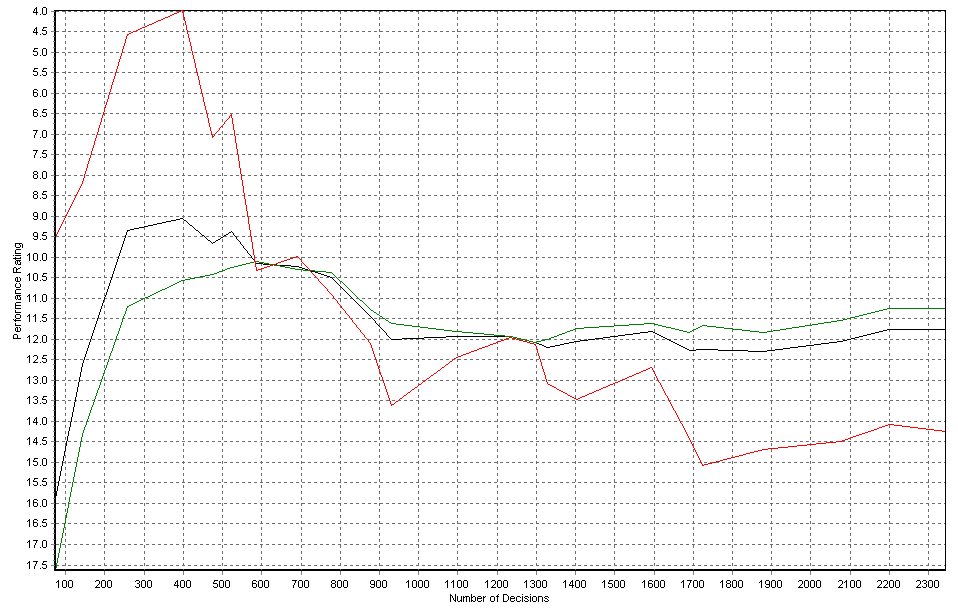
The black line is the overall PR, green is checker play and red is cube play. You can see that cube play has become worse, although the sample size is small. The first few games I played in this series were probably involving easier decisions, hence you see the dip in performance after a good start.
Something I've noticed, it seems to me that XG's intermediate opponent leaves quite a lot of blots that are easy to hit. The correct play against this is almost always to hit, and I find myself playing against the computer with two anchors (a backgame) quite often. These involve some difficult decisions and just one mistake can shoot the PR of a game up. I believe these kinds of games are not that common when playing a human opponent.
It's of course good to practice difficult spots, but for a PR estimate, it's also important that the play style is close to standard. If my observation about the bot's playing style is correct and it is due to random noise added to its decision making, then the obvious solution is to play better opponents that add less noise. XG's advanced level bot is probably closer to my current level anyway, so I'll be playing against it in the future.
I've analyzed blunders in last week's games, and noticed some common themes:
Early/mid-game:
- Still leaving blots mid-board
- Not valuing advanced anchors enough
- Playing too safe especially when should be blitzing, letting opponent escape
- Doubled several times when too weak, although not so early as I did in the past. In the previous week, I missed a lot of doubles mid-game, so it seems I have adjusted (maybe a bit too much)
End-game:
- Blunders in bear-off structure and generally in organizing checkers when opponent is playing a holding game or a back game
- In general, played too safe (especially when opponent's home board has blots)
- Missed several doubling opportunities, the opposite of my mid-game tendency
I think I'm in a phase where I should read more or watch tutorial videos. I've played quite a lot and analyzed games, but I need to understand the game better, especially cube play and end-game concepts.
I donÂ’t know this; Im just guessing from the way you post about cube action. It seems that you may not be fully accounting for all the factors that play into it. The strength of your position is of course important, but the volatility of the position also matters. This is a bit avbstract since zi canÂ’t give you specific positions, but suppose you have two positions. In the current position you win 65% with 10% gammons on both. Should we double? From the strength of the position alone, we would conclude that we should.
However suppose one position is such that after we roll and our opponent rolls, we still will win between 60-70% of the time regardless of the dice rolls (with similar gammons). In the other position, there are some rolls where we will win 95% of the time when they happen and others where we will only win 50%. We should double this second position now since our opponent will take now but will not if we roll our good roll. In the first position we should wait since we still will have a double/take on our next opportunity to double.
If you do look at some videos or books, the concept is called “market losers”. Are there some sequences of your roll plus opponent’s roll that would “lose your market” and make your opponent drop a double if you wait until your next turn. If so, then a double now is probably good. If not, it’s probably better to wait.
ItÂ’s not always quite so clear cut as this. There might be a small probability of losing your market, and how badly you lose it also matters. If, for example rolling 66 would make the position just barely a pass, you probably should wait.
In general, high anchor holding games and pure races have the least volitility. Prime vs prime games and blitzes are usually highly volitile. Those are just guidelines, though.
The other factor in cube play is match score. If you are playing matches rather than cash games, cube play can be insanely complicated by match scores. There are even match scorers where doubling as an underdog is correct. IÂ’d advise you to read up on cube play in matches and get yourself a good match equity table if you havenÂ’t already done so. ItÂ’s a very rich and complicated subject.
I donÂ’t know this; Im just guessing from the way you post about cube action. It seems that you may not be fully accounting for all the factors that play into it. The strength of your position is of course important, but the volatility of the position also matters. This is a bit avbstract since zi canÂ’t give you specific positions, but suppose you have two position
I'm aware of volatility affecting doubling, although only at an intuitive level, meaning that it makes sense to me that in some situations it is important to double right away as the situation could change a lot after the roll. However, I don't really have a clue about how to quantify it and I'm probably misreading many situations because of that.
Apparently, Dirk Schiemann's book is all about cube strategy and it goes into details about volatility among other topics. I want to read it, but not yet as I think it will be a bit too much for my current level/understanding of the game.
I'm also beginning to understand cube play a bit better at different match scores. I made some huge blunders at first when I didn't realize that doubling is completely dependent on what the score is. Just recently, I took the opponent's double post-Crawford when I was only slightly less than 50% to win, which I learned is a mistake 😀
A couple of interesting positions from recent games:
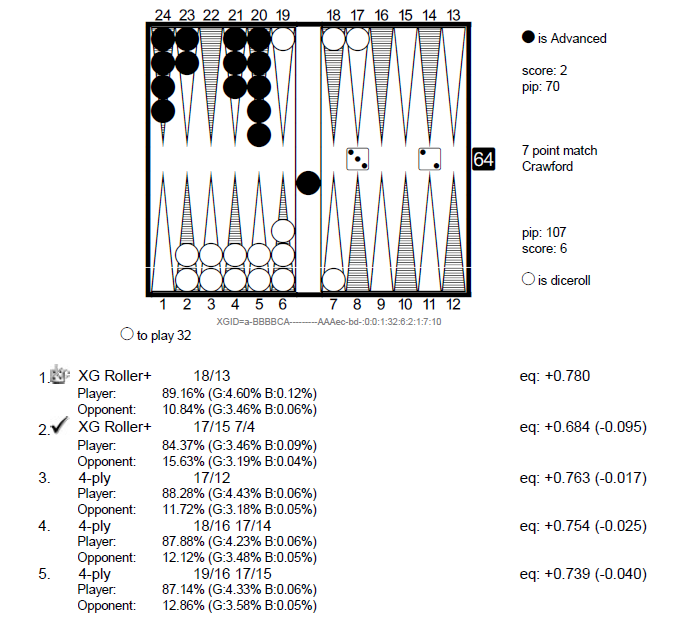
My move 17/15 7/4 was a blunder. It seems that one should not move the checker on the 7-point, but why is that? The chances of the opponent hitting it is 1/18, which is small but why risk it? Is the blot on the 7-point important because we would prefer to make the point, complete the prime, and let him crunch his home board position? I was thinking that I should just blitz the 1-point if he enters, but should we not attempt that at all in this situation?
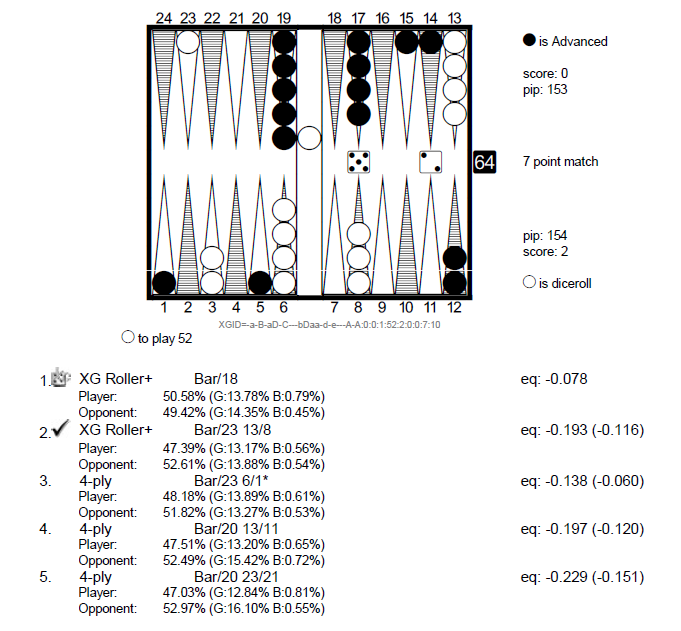
Here I blunder by playing it safe, and I don't understand why it is such a bad play. XG wants to just leave a blot on the 18-point, but the opponent will hit it >90% of times (any 1, 3, 4, 6, double-2), so why should we play this move?
I'm aware of volatility affecting doubling, although only at an intuitive level, meaning that it makes sense to me that in some situations it is important to double right away as the situation could change a lot after the roll. However, I don't really have a clue about how to quantify it and I'm probably misreading many situations because of that. Apparently, Dirk Schiemann's b
Be careful — dropping a double post-Crawford is score dependent. If your opponent needs an even number of points to win the match, then it is correct to drop. If he needs an odd number it is correct to take. The reason should be obvious; each game PC will be worth 2 points. If an opponent needs an even number of points, giving him 1 point will not change the number of games he needs to win — if he needs 6 or 5, he must win 3 games. If he needs 3 or 4 he must win 2 games, etc. Giving an opponent who needs 6 points a point to make it 5 to go doesn’t change anything. If he needs 5 to win (needing 3 wins) and you drop a double he now needs 4 points, which is two wins. Your drop essentially gave up a free win so you should take, even if you somehow only had a 1% chance of winning. Whatever winning chance you have is better than giving him a guaranteed win.
A couple of interesting positions from recent games:My move 17/15 7/4 was a blunder. It seems that one should not move the checker on the 7-point, but why is that? The chances of the opponent hitting it is 1/18, which is small but why risk it? Is the blot on the 7-point important because we would prefer to make the point, complete the prime, and let him crunch his home board po
The first position was an easy one for me. You want to prevent your opponent from escaping his back checker. If he does (and gets past your outfield checkers without being hit), he is way ahead in the race and you have little chance. If he rolls his joker, he is in good shape regardless of whether he hits your blot or not. Getting hit just isn’t all that costly here; plus it gives us an extra man back to try to hit his let checker when he brings it around. When he doesn’t roll the joker, the correct 18/13 leaves you MUCH better off than your move. You now have sixes to close off the prime (unless you throw 66 or 65 in which case you just close your board). Again, containing that back man so you can catch up and go ahead in the race is your top priority. His board is already collapsed so that’s secondary (he can never remake his six point).
The second position was tougher for me (maybe it’s easy for a real world class player rather than an intermediate like me). I confess that I’d have blown it too. I would have looked at something like bar/20 13/11 though. Your safe play is unwarranted at this stage of the game. It does nothing toward either making a high anchor or developing your home board and leaves you inflexible. The bar/18 play has its advantages. It’s true that it is likely that our opponent will roll a number that allows him to hot, but will he want to? Only with some numbers. Fours will likely make the anchor. If he hits loose with ones or sixes he will increase his blot total from four to five or six. Even this early that’s pretty loose. If he doesn’t hit you have a good chance to make an anchor. If he does you have a good chance to return hit and that is advantageous to you since you gain pips with a blot exchange here. Plus, it may not seem like much, but you have a second point made. This favors you in any exchange of hits.
Played a lot of matches this week against XG's advanced level opponent. I've now played a total of 44 competition matches, so it makes sense to include only the more recent ones in the PR calculation:
- Last 300 exp PR: 11.35
- Last 100 exp PR: 10.48
It seems that I'm improving gradually, although it's mainly my checker play. My cube play hasn't really improved. Below is the progress chart from XG (including all the matches):
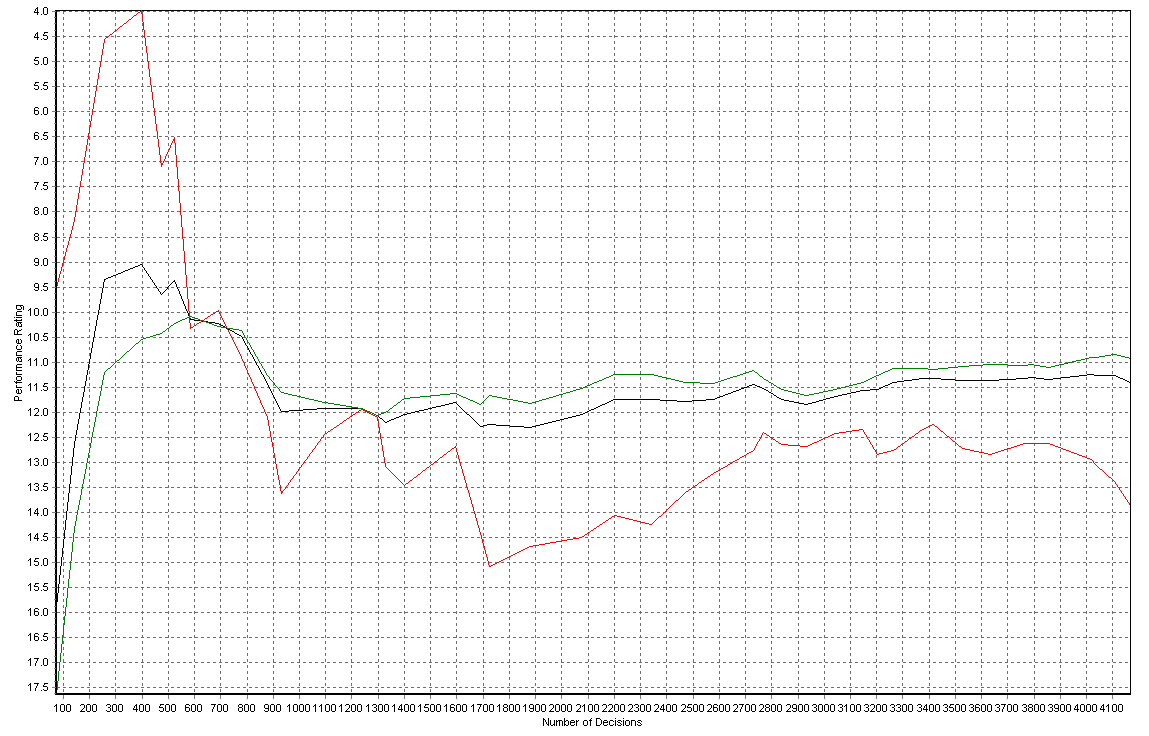
Black is the overall progress, green is checker play, red is cube play.
Analyzing blunders, it seems that it's hard to get rid of some of the habits I have as they keep repeating:
- Gambling too much with the cube, i.e. doubling and taking when not strong enough - this appears to be a clear tendency of mine
- In general, I play too loose mid-field, leaving blots
- I should hit the opponent more aggressively in my home board
Last week I was traveling and didn't have time to play backgammon at all. Below is a position from earlier games that I don't understand:
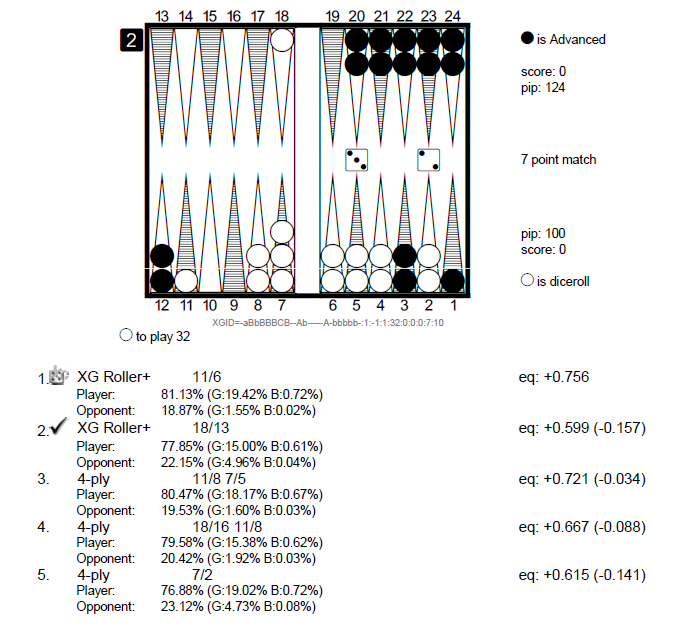
My thinking was, I want to move 18/13 to minimize opponent's chance of hitting. Opponent can hit the blots on the 13-point or the 11-point with any 1, 6-2 and 6-4, which should be 10 combinations in total. XG's preferred move 11/6 leaves just one blot on the 18-point, but it can be hit with any 6, 4-2, 5-1, double 2s, double 3s, so that should be 12 combinations. After this move, I should be more vulnerable to getting hit, which is very bad given the opponent's prime. How can 18/13 be such a blunder here? What am I missing?
After your move 18/13, you're hit on 15/36 rolls:
- Any 1 (11 rolls)
- 6-4 (2 rolls)
- 6-2 (2 rolls)
After 11/6, you're hit on 17/36 rolls:
- Any 6 (11 rolls)
- 5-1 (2 rolls)
- 4-2 (2 rolls)
- 2-2 and 3-3 (2 rolls)
So that's only 2 more rolls. Yes, every roll counts, but what do you gain with 11/6?
- 1 blot secured.
- An extra builder to attack on your 1-pt: now 6-5 can point on your opponent.
- If your opponent rolls small dice such as 4-1, 3-2, 3-1, 2-1, instead of hitting you on your midpoint (13-pt) or moving behind it, he will have to either leave a blot in front of you or start crushing his home board, which is good for you if you get hit later on.
So for sacrificing 2 more rolls, you gain some advantages.
But take this with a grain of salt as I'm no expert.
Looking forward to read what @stremba70 has to say on this position. 😀
After your move 18/13, you're hit on 15/36 rolls:- Any 1 (11 rolls)- 6-4 (2 rolls)- 6-2 (2 rolls)After 11/6, you're hit on 17/36 rolls:- Any 6 (11 rolls)- 5-1 (2 rolls)- 4-2 (2 rolls)- 2-2 and 3-3 (2 rolls)So that's only 2 more rolls. Yes, every roll counts, but what do you gain with 11/6?- 1 blot secured.- An extra builder to attack on your 1-pt: now 6-5 can point on your oppo
Well I’m no expert either but I think you hit on the main points of the position. Cleaning up the blot is good and giving yourself a builder is good too. I think focusing on black’s “prime” is also a mistake. Block doesn’t really have a prime; he has a 5 point board. It’s functionally similar to a prime in that you have to roll a 6 to escape, but with one key difference - you don’t have to move in the meantime when you don’t escape. Since BG is essentially a race we think of this normally as a disadvantage; we are falling behind when we can’t move. But in a position like this timing is more important than the race. You have a timing advantage to begin with and being hit and dancing a few turns only increases that timing advantage.
To put it more concretely: if these positions stay as is, he needs to roll two sixes plus a two and then a third six to escape his back men. If your blot is hit, you need to roll only a six to escape your line back man. If you fail to roll your six your position stays intact. If he fails to roll his first six in the meantime he must move his outfield checkers and eventually will have to break his inner board points destroying his position. Having two blots in the air gives him more time to escape since you’d now need two sixes, but having one checker hit is far from disastrous and might even give you a chance to send more of his checkers back increasing your gammon chances (I didn’t check match score to see if gammons were relevant, so ignore this if they are not).

