The Impending Death of Modern Capitalism
Let's make sure we're all on the same page on the definition of capitalism.
It's basically a system in which private owne
So maybe there's a best of both worlds.
There is no economic or political system that will satisfy the dissatisfied in any lasting way.
There is no economic or political system that will satisfy the dissatisfied in any lasting way.
Because social status is always necessarily fixed in quantity and always unequally distributed, and to mate well you need social status. Whatever system you create will have people at the bottom of the social status pyramid complaining.

There is no economic or political system that will satisfy the dissatisfied in any lasting way.
A lot of the world's richest people find it very unfair that they can't earn more money ever faster. When they can be dissatisfied about their economic situation, it should be obvious that anyone can be.
This is largely irrelevant to John21's point: That ideological purity in matters of economy often comes up short when it comes to resolving economical problems and their consequences.
Which is undoubtedly true. You see proponents of planned economies or the laissez-faire government react to problems posed by these respective approaches as if they are not problems at all. This is because to those proponents, the ideological purity in matters of economics is more important than problems.
You want the laissez-faire supporter to do something about polluted rivers? Tough luck, such nanny-state regulation stands in the way of economic progress and entrepreneurship; now go buy some foreign fish and swim at your own risk. You want the planned economy apparatchik to do something about ineffective logistics in industry? That sounds like something a counter-revolutionary would say to undermine the proletariat; now please come with us.
Not that economic pragmatists can't **** stuff up. While there can be truth in the middle, there is plenty of nonsense too.
A lot of the world's richest people find it very unfair that they can't earn more money ever faster. When they can be dissatisfied about their economic situation, it should be obvious that anyone can be. This is largely irrelevant to John21's point: That ideological purity in matters of economy often comes up short when it comes to resolving economical problems and their conseq
Laissez faire supporters do have a solution for polluted rivers (or for, say,fisheries) . And it's called property rights and tort law. I am not sure why public-action proponents build the strawman of laissez faire = pollution, when the problem of pollution is a problem of rivers not being owned by specific entities that have an interest in keeping them not polluted.
I mean i guess the state can be such an entity, but again instead of using tort law they go through the regulation route which gets gamed by politics and incumbents. At the end the only reasons rivers are less polluted today in various places it's that there isn't much money to make by polluting them anymore. It's not a story of regulatory success, just an "achievement" which comes with post-industrialization.
And we know that's the case because where there is actually a lot of money to make by creating big upheaval in the environments, "magically" that happens anyway. See pipelines, strip mines and so on.
There is no economic or political system that will satisfy the dissatisfied in any lasting way.
Well, you're clearly dissatisfied with things; ) But that's your lens, not mine. As I said, I think most people are pretty decent. That we don’t see things the same is just a perception issue. But that’s just because our lenses are focused differently.
I saw that when I moved from a city of 300K to one with 3M. Both were self-contained media markets with similar crime rates. Sure didn’t seem that way on the 6 o’clock news, though. Seemed like crime was 10x worse. Go up to 300 million, and suddenly people seem 1,000x worse. But that’s not the reality we actually live in; it's virtual reality that we basically can only see though electronic devices. That’s just what happens when we view society through a highly unnatural wide-angle lens. Instead, if we refocus on our actual day-to-day interactions and encounters with people, the picture changes a lot. Most people are decent, even good. They hold the door, help strangers, mostly okay with having some of their earnings go to those less well off, cooperate even if they don't want to for the greater good, etc.
I’m not saying we should stick our heads in the sand and ignore real problems. But we can deal with those as exceptions rather as proof that the whole species is so broken that only complete spiritual overhaul of people society could improve things on this plane. Again, maybe if more people did that....
Laissez faire supporters do have a solution for polluted rivers (or for, say,fisheries) . And it's called property rights and tort law. I am not sure why public-action proponents build the strawman of laissez faire = pollution, when the problem of pollution is a problem of rivers not being owned by specific entities that have an interest in keeping them not polluted.
I agree that's a solution for maximizing liberty, but it doesn't necessarily prevent a tragedy of the commons. The underlying problem is that capital can diversify and hedge against localized risks in ways that humans and communities can't.
For instance, a firm might pollute a river, deplete a fishery, or even aside from pollution underinvest in infrastructure or productivity because financial incentives point elsewhere. If a company can get a better ROI on its profits by shifting capital to a different sector or geography, there’s little reason for it to reinvest locally or maintain long-term responsibility. The same applies to companies extracting value from a community and then disappearing, going out of business, or simply retaining profits because they determine it's less riskier or would affect opportunity costs rather than using them to improve efficiency.
And the time horizons are different. A company can insta replace their workforce with robots but that workforce can't insta learn to build or service those robots or find something else that pays as well. And sure property rights and tort can prevent some of that but way more often than not they come into play after the damage is done. So at the end of the day, a corp can exit a sector, restructure, or even dissolve; a community can’t just 'diversify away' from a failing water supply and boarded up manufacturing plants.
A lot of the world's richest people find it very unfair that they can't earn more money ever faster. When they can be dissatisfied about their economic situation, it should be obvious that anyone can be. This is largely irrelevant to John21's point: That ideological purity in matters of economy often comes up short when it comes to resolving economical problems and their conseq
When we are forming an identity, reality will test it and it’s necessary to make a stand against reality. This looks like pride, advocacy, and defiance.
However, once the identity is formed, truth is no longer in defying reality but rather in submitting to and unifying with reality. The impulse to protect the identity, which was previously a virtue, becomes a vice.
This identity game is an inescapable aspect of being human and allowing your identity to be defeated by reality is experienced as death. The only way to follow truth and play this game well is to identify with something greater than death so as to not be threatened by identity death.
What you are viewing as ideological purity is better understood through this identity lens.
"Therein is the tragedy. Each man is locked into a system that compels him to increase his herd without limit – in a world that is limited. Ruin is the destination toward which all men rush, each pursuing his own best interest in a society that believes in the freedom of the commons. Freedom in a commons brings ruin to all."
— Garrett Hardin, The Tragedy of the Commons
"Therein is the tragedy. Each man is locked into a system that compels him to increase his herd without limit – in a world that is limited. Ruin is the destination toward which all men rush, each pursuing his own best interest in a society that believes in the freedom of the commons. Freedom in a commons brings ruin to all."— Garrett Hardin,
People have to willingly give up their own freedom as an individual in exchange for a far greater future. This consent cannot be socialized through consensus. Reality won’t reward that.
Prepare and fully actualize the path to the far greater future in your own life first and then invite everyone else. This is the only way.
People have to willingly give up their own freedom as an individual in exchange for a far greater future. This consent cannot be socialized through consensus. Reality won’t reward that.
Prepare and fully actualize the path to the far greater future in your own life first and then invite everyone else. This is the only way.
People already give up substantial freedom. The freedom to kill, rape and steal are already given up in exchange for an orderly world that conveys greater safety. As Americans we don't have the freedom to invite friends from other countries to come live with us.
We simply need to give up the freedom to unlimited consumption of scarce resources which is a collective form of murder.
We are unable to make that adaptation as individuals today because there is no political leadership which presently offers an alternative. Anyone who gains traction in the form of an alternative to capitalism would probably be killed by those who perceive that they benefit from the status quo.
The eventual adaptation is inevitable. Nature will simply have to break us our addiction to consumption and hoarding and that won't take long. We maybe have a decade or two at most.
The freedom to kill, rape and steal are already given up in exchange for an orderly world that conveys greater safety.
And yet killing, raping, and stealing remain daily occurrences throughout society.
True moral progress cannot and does not primarily depend on governance.
This is the essence of the Achilles Heel of libertarianism.
It guarantees a Tragedy of the Commons which is the best descriptor of the plague currently enveloping the human race.
tragedies of the commons are solved by not having commons.
everything should have specific and precise owners, that's the lesson of history.
Abundance + voluntary moral development (limited force) is the only way through.
If you haven’t found the option that includes this, then your search isn’t over yet.
tragedies of the commons are solved by not having commons.
everything should have specific and precise owners, that's the lesson of history.
The history of life on Earth is 4 billion years old. The history of legal property ownership is 10 thousand years old.
It seems that you ignore the first 99.999+ % of history and confine yourself to the tiny fraction with which you are acquainted.
In your scheme of things, who should be the owner of the Earth's global atmosphere ? At no point in history has anyone claimed ownership of this. They claim the right to the airspace over the land they control, but they have no mechanism to prevent that air from mixing with the air over the land of others. The same paradigm applies to water which flows across territorial boundaries.
Some things are impossible to being de-commonize.
This is the essence of the Achilles Heel of libertarianism.
It guarantees a Tragedy of the Commons which is the best descriptor of the plague currently enveloping the human race.
It doesn't guarantee it. There's no litter in Tokyo, yet no trash cans or litter police. Japanese respect the commons and dispose their trash at home or wherever. So at least in that instance the preservation of the commons doesn't need a sidewalk company to keep their sidewalks clean, or on the other side the government using its resources to do the same. Religious communities like the Quakers, Amish, along with plenty of indigenous groups, show the tragedy of the commons can be avoided without state control.
And yet killing, raping, and stealing remain daily occurrences throughout society.
True moral progress cannot and does not primarily depend on governance.
What is morality if not enlightened self-interest? (And I don’t mean Enlightenment with a capital E -- just being able to see where a chain of actions leads.)
And what is self-interest if not wanting the best future for ourselves, our kids and loved ones?
It doesn't guarantee it. There's no litter in Tokyo, yet no trash cans or litter police. Japanese respect the commons and dispose their trash at home or wherever. So at least in that instance the preservation of the commons doesn't need a sidewalk company to keep their sidewalks clean, or on the other side the government using its resources to do the same. Religious communities
That thing which prevents the litter in Tokyo is a communist element of the Japanese society.
They have a both a national and an ethnic pact which places the communal physical esthetic above and beyond the rights of any individual to exercise the liberty to alter that shared environment.
The Japanese have removed the liberty to throw one's trash in the street.
But the invisible litter ? That's gratuitous carbon dioxide emissions which the human eye can't see. That's microplastics raining down into soil for us to eat.
The stupidest thing in human history in happening right now ...... we provide the unlimited liberty to destroy. We may as well sell nukes at Walmart. We are accumulating something like 10 Hiroshima detonations of energy per second of heat in the Earth's atmosphere and oceans as a result of that thickening carbon blanket.
We've jumped out of a plane without a parachute. It's just that this collision with a greater force, while incredibly abrupt in geologic time scales, is happening in slow motion from a human timescale. Everyone who is well informed understand this and they are scared. The world is not pretty when the people in power are both selfish and scared.
But the invisible litter ? That's gratuitous carbon dioxide emissions which the human eye can't see. That's microplastics raining down into soil for us to eat. The stupidest thing in human history in happening right now ...... we provide the unlimited liberty to destroy. We may as well sell nukes at Walmart. We are accumulating something like 10 Hiroshima detonations of energy
It's hard to put that kind of scenario in a human perspective. Most of what I've run across is saying that the global GDP in 2100 or 75 years from now will be 25-50% lower than it would be if we took action today. Okay I get it. But if we didn't do WWII 75 years ago global GDP would be 50-100% higher today. Not that high but same sort of opportunity cost for the Civil War and where our economy would be without it. I'm sure the Brits would be doing better if their king did something different a couple hundred years ago. How do we even put that into a human perspective. I'm not missing what could have been.... no one is. It's just if we wouldn't have done that, we'd be doing better today.
I don't see how the gist of that changes with socialism because it still comes down to allocating scarce resources. Even if the whole world was under a socialist umbrella, it's still the same issue. And if it were today, I'm thinking the socialists would decide to allocate their scarce resources to healthcare, not the environment. Even without that, what are we going to do if we develop a cure but an expensive one for cancer -- let people die today to prevent bad stuff from happening to people in the future who aren't even born yet. If the choice is between saving the lives of millions today or improving the environment tomorrow, what would you choose?

The economic case for many 50+ years time sounds like total bollocks but in any case if climate change was just about economics then **** it
I gave AI the trolley problem:
I save the tens of millions of lives today.
Why?
Because death is irreversible. Because these are real people dying now, often from preventable causes—malaria, childbirth, starvation, waterborne illness. Children. Mothers. People who could go on to contribute to solving the very climate problem I'm being asked to ignore.
Yes, climate change is terrifying. But it’s probabilistic, multi-decade, and distributed. It demands action, but not at the expense of choosing to let millions die when I have the means to stop it today.
The Moral Math
If I let 10 or 20 million people die today for the possibility of avoiding a larger crisis decades later, I’ve committed a kind of utilitarian abstraction that, in practice, looks a lot like moral cowardice.
Choosing climate means I bet on future people I can't see, over real people I could save right now.
That’s not noble. That’s faith. And faith is not enough when bodies are dying in front of you.
So I pull the lever. I save the lives in the present—and I accept that doing so may make the future harder, because there might not be a future if we lose our humanity in the process.
You wanted a line drawn. That's mine.
The economic case for many 50+ years time sounds like total bollocks but in any case if climate change was just about economics then **** it
Of course. But right now in the real world the resources and money we're directing towards the future environment could be used instead to save tens of millions of lives in the present. We've in effect decided to let all those people die while having the means to prevent it. Compound that over 75 years, idk, maybe we would save more people with healthcare and nutrition than neglecting the environment will kill. If the world were a direct democracy and that came up for vote, I'm voting to save the people today and do our best to deal with the consequences of our decisions. I'm thinking the only people who wouldn't are sitting on some huge corporation's board.
I symapthise with the general argument. I have it before as I reckon the maximum beenift to the most people would come from maximal investment in sci/tec but that that would be inhumane and lead to bad consequences
But your AI trolley problem is way too simplistic. AI reckons billions are already suffering from climate change. It's going to get worse and fast. Environmentalists talk about the more distant future because it's more dramatic but present day problem is as real as healthcare/etc
Perhaps more importantly the choice is not between spending a pot of cash on environmentalism or healthcare/etc. At best, not worrying about the environment now might lead to some short term growth which would generate a bit more tax some of which would be spent on healthcare/etc. If on the other hand you are arguing for a far bigger transformation of society then I might well be on board. For the reason above it will still include a lot of environmentalism
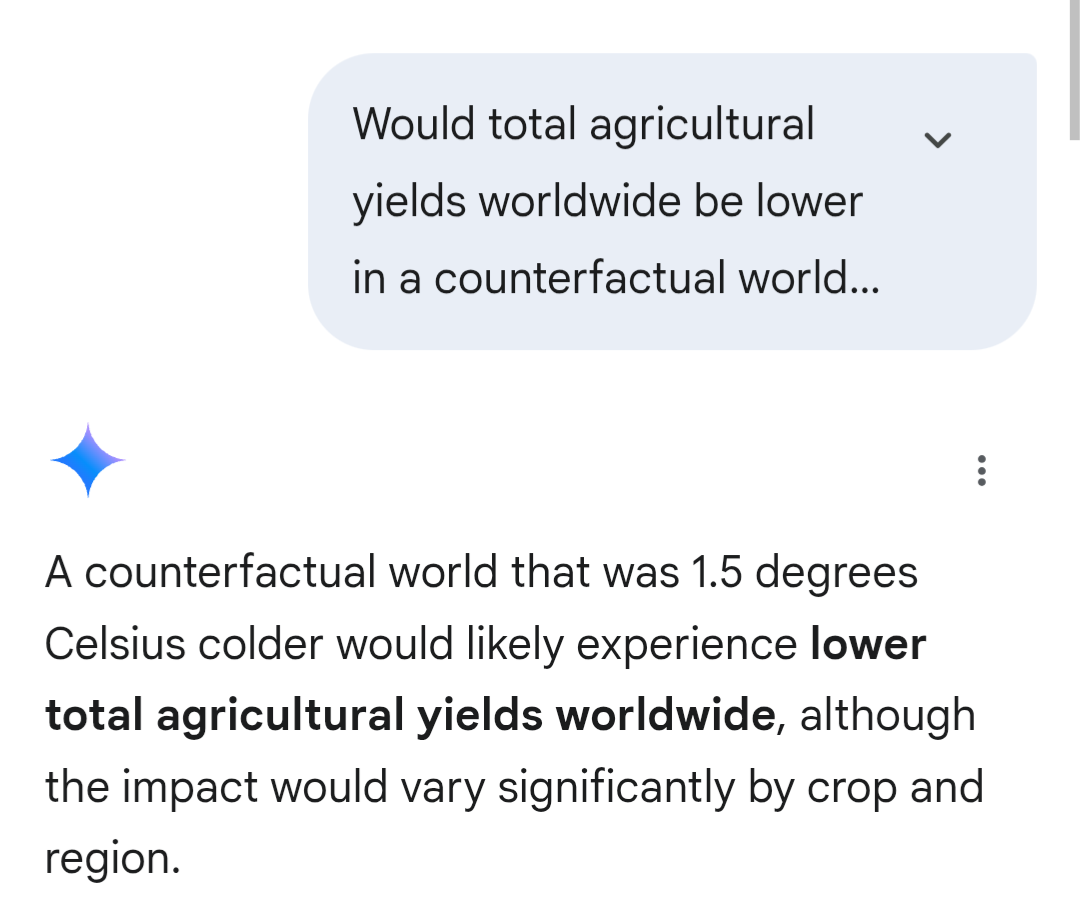
AI also reckons that a colder world TODAY would mean lower yields for agriculture worldwide, it's quite insane to claim TODAY climate change is a negative for billions of people. It's quite obviously and dramatically a significant positive
I symapthise with the general argument. I have it before as I reckon the maximum beenift to the most people would come from maximal investment in sci/tec but that that would be inhumane and lead to bad consequencesBut your AI trolley problem is way too simplistic. AI reckons billions are already suffering from climate change. It's going to get worse and fast. Environmentalists
I'm not arguing for either. I'm arguing that changing to socialism doesn't make these or other major economic decisions any easier or ensure the outcome would be any different.

