Does playing a less exploitative strategy guarantee an edge heads up?

Bob and Joe play a heads-up rakeless cash game. Bob plays a strategy with a Nash Distance of 1%, and Joe plays a strateg

i pick d, but i think its entirely possible, but not very probable, that joes strategy exploits bobs strategy. this is the extreme point, where joe is the favorite despite a nash distance deficiency.
very unlikely, but possible.
The blackpill experiment answers this post.
1) If players are only making unbiased mixing mistakes, not pure mistakes, then neither player has the advantage. Exploitability does not correlate with edge.
2) If we allow for pure mistakes, then I believe (but have not yet proved) that exploitability WILL correlate with edge.
Evidence of claim #1:
We'll start with a GTO solution solved to high accuracy:
- OOP EV = 1.84
- IP EV = 3.20
- Rake EV = 0.06
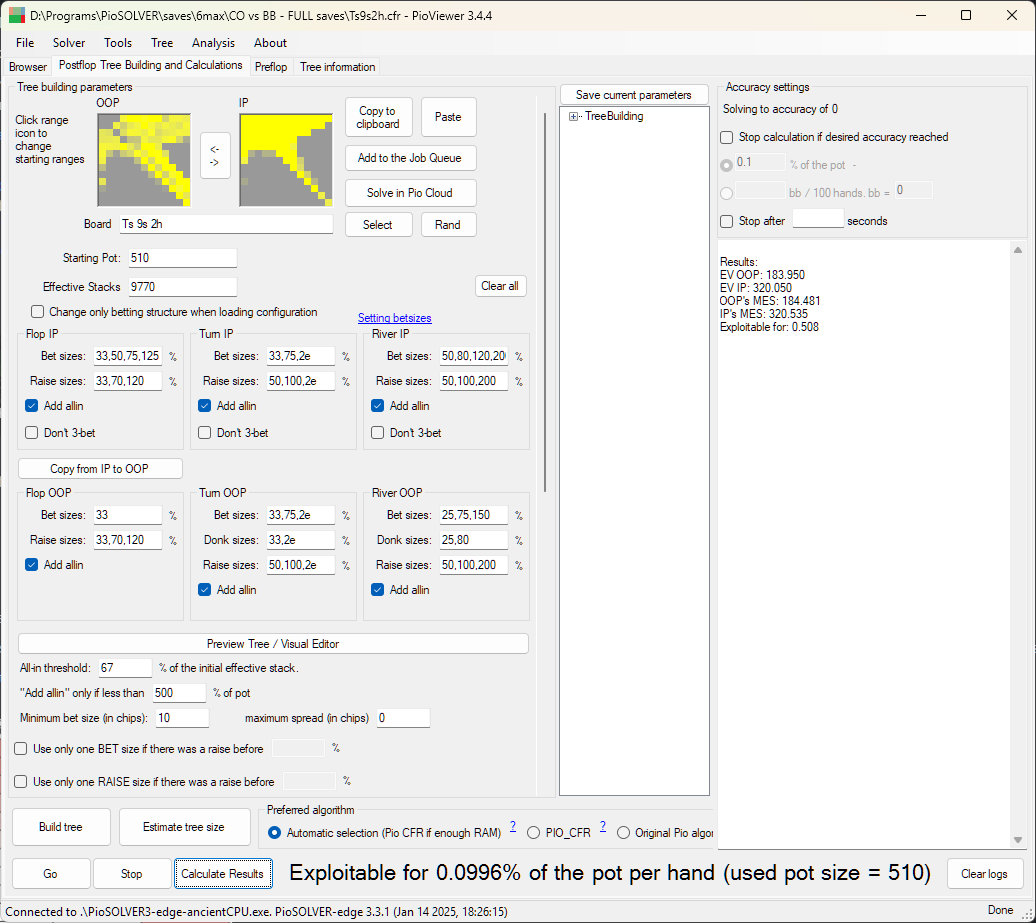
Now I'll round one player's strategy to 1/2 intervals on all streets from flop to river (0%. 50%, 100%), and the other's strategy to 1/4 intervals (0%, 25%, 50%, 75%, 100%), then recalculate EVs of the new matchup.
The idea here is that both players are making mixing mistakes, but one is clearly more exploitable than the other. So will the less exploitable one have the edge?
Results:
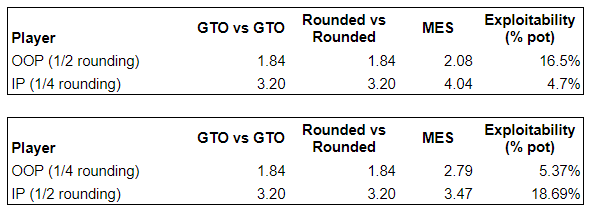
Despite the fact that the 1/2-rounded player is ~3x more exploitable than the 1/4-rounded player, the EVs do not change.
So I think we can safely say that when both players are making unbiased mixing mistakes, there's no correlation between exploitability and edge.
This is true but I would argue that in terms of "èxplonitability" it is really only mixed decisions that matter. In addition pure mistakes are relatively hard to make and at least for a solver they would be the first to be basically non existent. If 2 solutions were solved up to 1% and 5% ( or .1% and .5% ) then basically no pure mistakes would occur.Otherwise this question red
Sorry to be the bearer of bad news, SchrodingersBluff.

