Theoretical question about UTG range at table with a large number of players
Let me preface this by saying that I realize that this has no practical significance. If you aren’t interested in purely theoretical discussions, please skip this thread.
With five board cards and three burn cards, it would be theoretically possible to deal a 22 player NLHE game. I know that a UTG range in a 9 player full ring game is certainly tighter than a UTG range at a 6-max table, so I’d assume that a UTG range at this theoretical 22-player table would be even tighter still, but how much tighter? I’d assume that we aren’t folding AA and likely not KK either, but beyond that, what’s our range? Do we fold TT? JJ? How about non-paired hands? Are we playing AKo? AQo?
Not sure any of the solvers are equipped for this one, but I’d welcome any bout from solvers as well as input from the humans reading this.
5 Replies

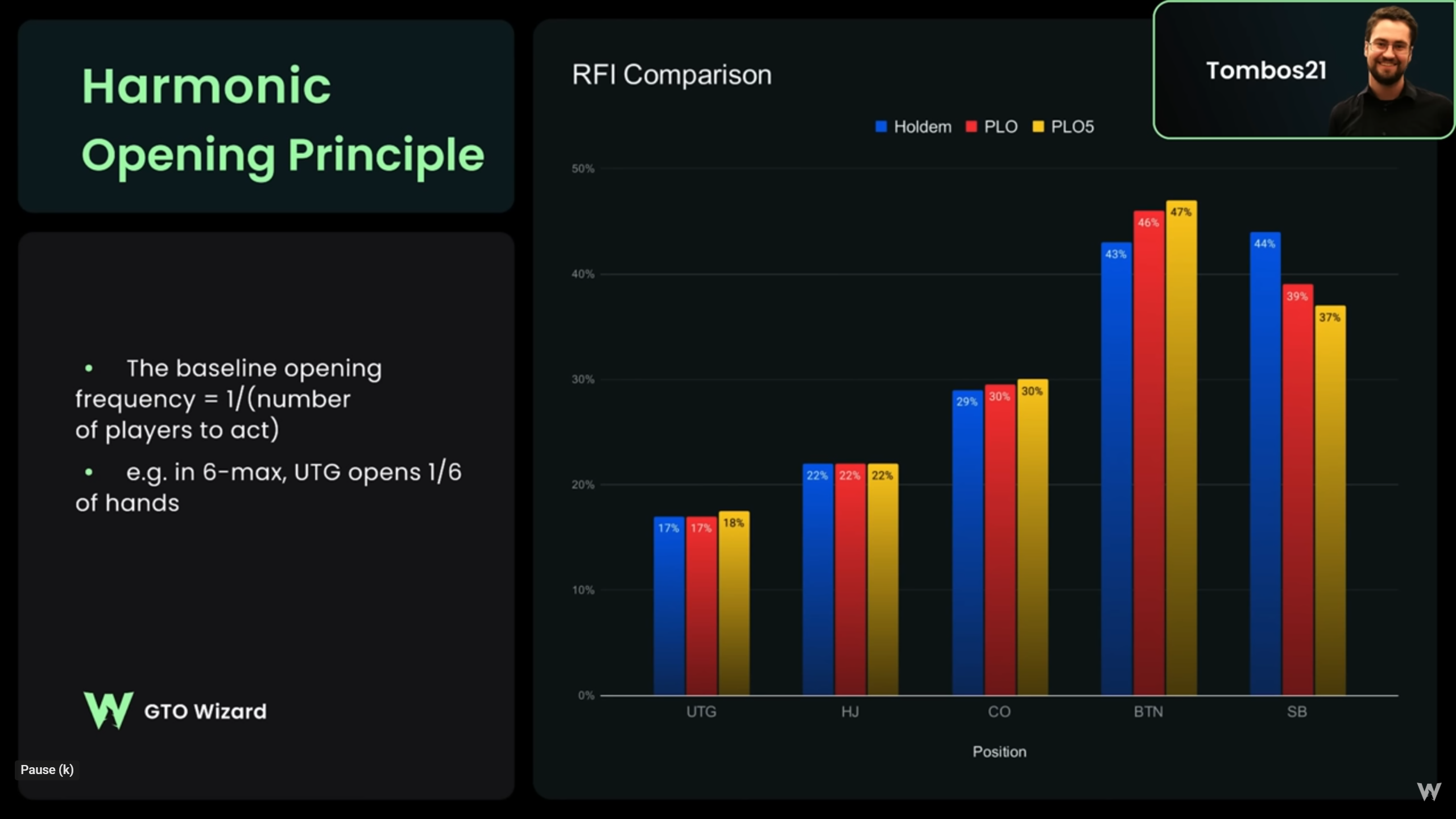
Looking at opening ranges for 9-max it seems that we can approximate the opening range as 1/n, where n is the number players left in the hand.
GTO% (100bb, NL50 rake structurre):
* UTG (9 players left): 11.5% (1/9 = 11.1%)
* UTG+1 (8 players left): 12.9% (1/8 = 12.5%)
* UTG+2 (7 players left): 14.7% (1/7 = 14.3%)
* LJ (6 players left): 17.6% (1/6 = 16.7%)
* HJ (5 players left): 21.6% (1/5 = 20%)
* CO (4 players left): 28.9% (1/4 = 25%)
* BTN (3 players left): 42% (1/3 = 33.%)
* SB (2 players left): 43% (1/2 = 50%)
We can see that when you are far away from the button, the approximation seems quite accurate, but when you get closer to the button the raise% increases significantly above the approximation, presumably because of increased positional advantage. And in the SB it drops below the approximation, probably because of positional disadvantage.
So given this approximation my guess would be: 1/22 = 4.5%
AQo would be a snap fold.

In a 22-max game, UTG would probably open 1/22 hands ≈ 4.5% of hands.
There's this heuristic I call the "harmonic opening principle" where early positions tends to open about 1/N hands, where N is the number of players still in the hand. It's a pattern that persists across form...
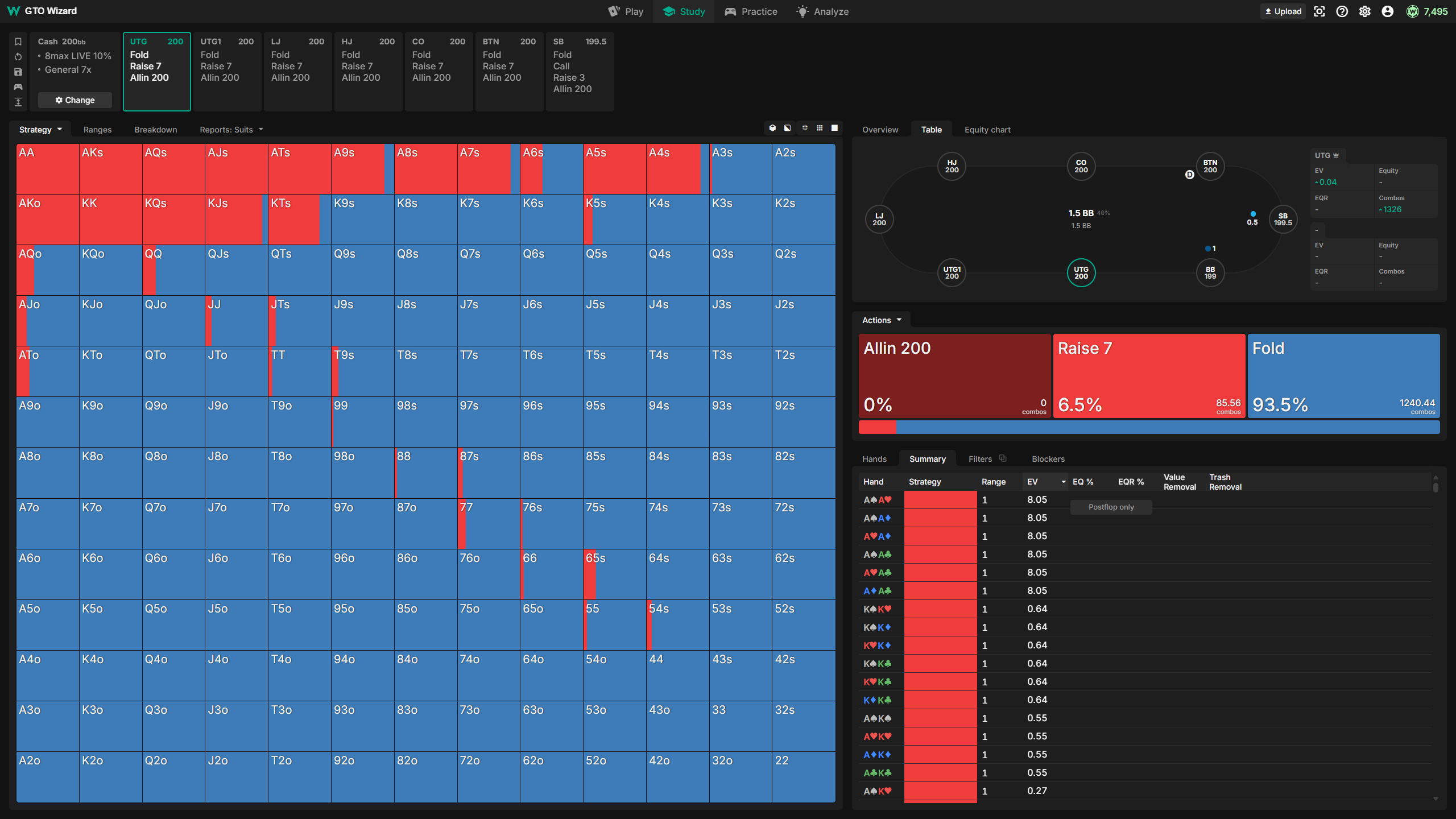
Blockers become paramount with half the deck dealt out in front of you. I think UTG would open AA and hands that block AA. Maybe something a bit tighter than this:
Looking at opening ranges for 9-max it seems that we can approximate the opening range as 1/n, where n is the number players left in the hand.GTO% (100bb, NL50 rake structurre):* UTG (9 players left): 11.5% (1/9 = 11.1%)* UTG+1 (8 players left): 12.9% (1/8 = 12.5%)* UTG+2 (7 players left): 14.7% (1/7 = 14.3%)* LJ (6 players left): 17.6% (1/6 = 16.7%)* HJ (5 players left): 21.6%
Oh snap, Zamadhi also noticed that 1/n trend!
I didn't consciously remember your video, but I guess it must have lingered somewhere in my subconscious 😃
Thanks for the replies. I didnÂ’t realize this was something that was already so easily quantified. Going off the chart Tomboa posted, then, a 4.5% range is just about 60 combos. (60/1326=4.52%) Based on that chart the range would be something like KK+, AKo, A8s+, KJs+, A5s. That (assuming I counted right) gives seven Axs and two Kxs combos for a total of 36. AKo is 12 combos. AA and KK also account for 12 giving 60 total.
I based this mainly on taking the combos that the solver plays most frequently as opens in the posted chart and simplifying just a bit. I wouldnÂ’t be at all surprised or quibble if someone wanted to argue for a bit of modification to that range.
Interestingly that range is a bit off from what my intuitive idea would have been. I would not have expected QQ to be a fold. I’m not surprised that lower than QQ is though. I also am not surprised that AQo is a fold. It does include more suited aces than I’d have thought, but it makes sense in terms of balancing the range. KQs and KJs are a bit of a surprise to me. Again, though it makes sense.

