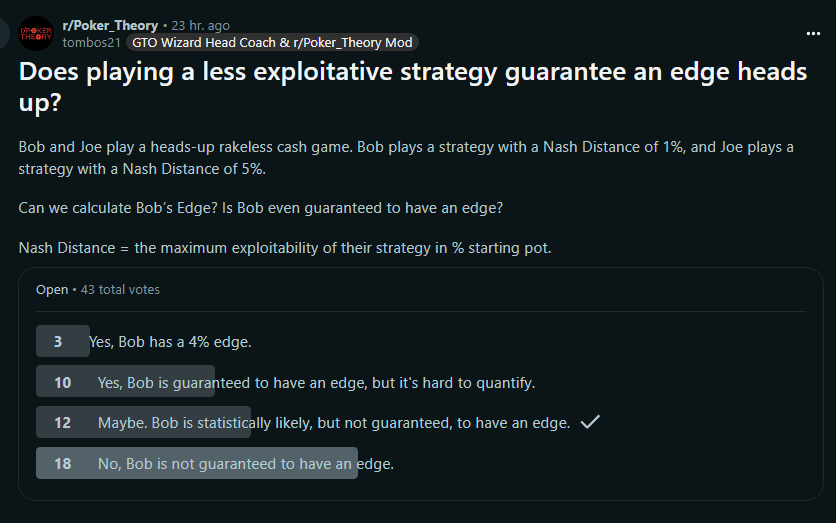
Does playing a less exploitative strategy guarantee an edge heads up?

Bob and Joe play a heads-up rakeless cash game. Bob plays a strategy with a Nash Distance of 1%, and Joe plays a strategy with a Nash Distance of 5%.
Can we calculate Bob’s Edge? Is Bob even guaranteed to have an edge?
Nash Distance = the maximum exploitability of their strategy in % starting pot.

You can calculate Bob's edge if and only if both strategies are known in their entirety. You cannot know Bob's edge just based on the nash distance % for both players.
I would also say Bob is not necessarily guaranteed to have an edge when the nash distance of Bob (ND_Bob) is < the nash distance of Joe (ND_Joe). I would, however, assume that at some difference between ND_bob and ND_joe it may be such that Bob is guaranteed to have an edge. It would be really difficult to calculate that I think, though, as there are basically infinite strategies and just because one is not far off from ND as a whole does not necessarily mean it has an edge against another with a greater ND.
For example, you could take the nash equilibrium as it is and take the same strategy but just do pure actions with all mixed hands. It's possible that the other strategy has a ND quite high, but both strategies against each other would still be breakeven if neither player is adjusting.

There can definitely be cases where a more exploitable strategy has an edge.
Like if we play the nuts or air river toy game.
Joe bets 1x pot. He's supposed to have 33.3% bluffs, but he bluffs 40%.
MDF for Bob is 50%, but he folds 51%.
Joe is way more exploitable, but he's the one who gains EV.

It seems that you were triggered by the infinite monkeys thread.
I'm not an expert in this stuff but logically it seems that the correct answer would be maybe, the third choice?
A player with an exploitabilty of 1 % would have a strategy with an exploitability of between 0 and 1%. A player with an exploitability of 5% would have a strategy with an exploitability between 0 and 5%. So statistically the first player is more likely but not guaranteed to have a statistical edge in any given situation?
This is assuming both players calculated a static "best strategy" and repeated it continuously.
By random chance the second player's strategy COULD just happen to be more accurate even though the range is wider?
Or are you going to argue that both strategies will eventually converge on 0% exploitability and thus neither player will have an edge?
I would argue that's playing semantics because the more accurate player would on average have an edge in a limited (real world) sample.
I still take infinite monkeys' best strategy every time.
Spoiler
I like this quiz because it reveals a common misconception about GTO strategies: just because you play a less exploitable strategy doesn't automatically mean you have the edge.
Options A & B are easily disproven. Zamadhi provided a clear example of how Joe (the more exploitable player) could be exploiting Bob. And Brokenstars makes an interesting point about turning GTO strategy into a pure strategy that peforms the same against GTO despite becoming highly exploitable. So I think we can safely rule out options A and B.
Option D (no guaranteed edge) is probably too pessimistic.
My take: Option C is (probably) correct: Bob is likely, but not guaranteed, to have an edge.
I think C is the correct take because of entropy: There are more ways to play poorly than to play well. Given two randomly selected strategies, it's statistically likely (though not certain) that the less exploitable one has an advantage. As you grow the gametree and allow error in all directions for both players, it becomes more and more unlikely that the less accurate strategy happens to exploit the more accurate one.
It's often easier to understand a concept if you take it to the extreme: Imagine a HU match between GTO Wizard AI (~0.1% ND) vs a RandomBot that selects its entire fixed strategy in advance via dice rolls. It's theoretically possible that RandomBot perfectly exploits GTO Wizard, but the probability of this happening is astronomically small. It's easy to see that the less exploitable strategy is more likely to have an edge.
Caveat: Why only "probably" C?
Spoiler
You need a well-defined sampling method before claiming that Bob's strategy is "statistically likely" to have the edge. As a counterexample, imagine ob's strategy involves frequent hero-calling and Joe samples exclusively from typical microstakes grinder strategies (underbluffing). In this case Joe might have the edge. Therefore, before confidently selecting option C, you need a clearly defined and unbiased method of generating strategies.
For instance, you might start with a GTO strategy and introduce random noise until reaching the desired Nash Distance. Or you could use RandomBot to generate arbitrary strategies over and over again until you get one with the required Nash Distance (although this might take longer than the heat death of the universe).
...
A player with an exploitabilty of 1 % would have a strategy with an exploitability of between 0 and 1%. A player with an exploitability of 5% would have a strategy with an exploitability between 0 and 5%. So statistically the first player is more likely but not guaranteed to have a statistical edge in any given situation?...
No, a 5% Nash Distance doesn't mean you have a strategy with an exploitability somewhere between 0-5%, it means your chosen strategy has a maximum exploitability of exactly 5%.

In nuts/air scenario they seem to be equally likely to have an edge.
Bettor can either over bluff or under bluff in such way that he is exploitable by 1% and the other guy can either over call or over fold in such a way that he is exploitable by maximum of 4%.
So there are 4 options (OB,OC)(OB,UC)(UB,OC)(UB,UC)
OB-over bluff, UB-under bluff
OC-over call, UB-under call
In 2 of 4 options bettor have an edge in 2/4 caller.
Maybe if you allow bettor to XC and XF and caller to bet with bluff catchers, it changes things. Then you will have more strategy pairs, for example OOP can bet balanced and XC some nuts, or maybe IP calls GTO freqy and bets some catchers, if you pairs that with OOP never checking no one has an edge.
No, a 5% Nash Distance doesn't mean you have a strategy with an exploitability somewhere between 0-5%, it means your chosen strategy has a maximum exploitability of exactly 5%.
Interesting. I did not know that. So when you set up a solve the strategy is exploitable to exactly the degree of the target dEV that you run it to?
I suppose that makes sense, as the solver is effectively continuously attempting to exploit a strategy and then refining that strategy over and over to shrink the dEV. So what you're saying is that number is equivalent to the degree to which the solver was able to exploit the strategy on the most accurate iteration?
I'm curious what you think about the second part of my post? About the potential of any edge to converge towards 0?
The player that is exploitable to 5% could be exploitable in either direction. For example in a given spot they could be either over folding slightly or over calling slightly. It seems that the more accurate solution would be (close to?) just as likely to lose EV as to gain EV with their more accurate strategy. At least when we're talking about frequencies of mixed strategies.
If the less accurate solution is over folding slightly the more accurate player would gain EV with their bluffs, but wouldn't that be offset by a corresponding gain with their "value" hands?
So it would seem to me that when the more accurate player effectively "passively exploits" a mistake in one direction the gain would be (at least partially) offset by a loss in another node?
A similar example would be rock paper scissors. A solver could randomize a GTO strategy of throwing each 1/3 of the time, but they would still only break even against a player that always throws rock.
I suppose in poker the more accurate solution would passively gain some sort of EV, but it's not obvious to me how that could be proven mathematically.
I suppose someone could create a bot with a massive database of solves to 5% dEV and have it play trillions and trillions of hands against another bot with a better 1% database, then measure the results until they approach a statistically significant number that could "prove" an edge.
Anyway don't feel obligated to respond to all that. Lol.
BTW tombos, I recently saw a YouTube video you created and it was outstanding! I knew you wrote blog posts for GTOWizard but wasn't aware that you are also creating videos. Anyway when I have some free time I'm going to look for more of your videos, as I learned a lot from it.
Edit: While I was typing my wordy response Haizemberg expressed the same idea i was trying to get across a lot more succinctly. Still interested if the more accurate strategy is actually gaining any EV in the long run.
In nuts/air scenario they seem to be equally likely to have an edge. Bettor can either over bluff or under bluff in such way that he is exploitable by 1% and the other guy can either over call or over fold in such a way that he is exploitable by maximum of 4%.So there are 4 options (OB,OC)(OB,UC)(UB,OC)(UB,UC)OB-over bluff, UB-under bluffOC-over call, UB-under callIn 2 of 4 opt
That's a good point. However, I think it's just an artifact of this being a super simple toy game where players only have one way to change their strategy. Real poker gives you many degrees of freedom: How value-heavy are your lines? How much money are you putting in? What criteria are you using for choosing the top x% of your range? How polarized is your strategy? What blocker effects are you prioritizing? There are countless ways to deviate from GTO.
Add just a little bit of complexity and the space of losing strategies explodes while the set of near-unexploitable strategies stays razor-thin. There are many ways to lose at poker, only a few ways to win.
...
BTW tombos, I recently saw a YouTube video you created and it was outstanding! I knew you wrote blog posts for GTOWizard but wasn't aware that you are also creating videos. Anyway when I have some free time I'm going to look for more of your videos, as I learned a lot from it.
Thanks, glad you liked my video! I’m the head coach at GTO Wizard now. I always enjoy creating content.
...
I suppose that makes sense, as the solver is effectively continuously attempting to exploit a strategy and then refining that strategy over and over to shrink the dEV. So what you're saying is that number is equivalent to the degree to which the solver was able to exploit the strategy on the most accurate iteration?
Err not quite. In a solver, you enter some Nash Distance (dEV) and it solves in a discrete, iterative, chaotic manner, stopping once it reaches any strategy at or below your threshold. You can type in 0.3% and it might end at 0.28%. Here’s a typical chart of Nash Distance over time, notice how Pio’s Nash Distance jumps around as it tries different strategies. Also, Nash Distance is not measuring the "most accurate iteration", it's measuring the exploitability of the strategy at the time of measurement.


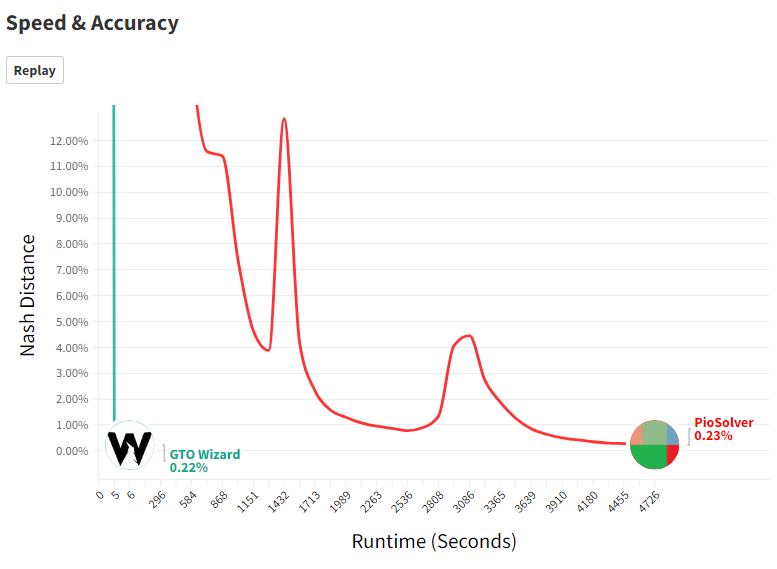
Regardless this doesn’t matter. For the sake of this thought experiment, I’m saying the stopping point is exactly at 1% and 5% Nash Distance.
I'm curious what you think about the second part of my post? About the potential of any edge to converge towards 0?
The player that is exploitable to 5% could be exploitable in either direction. For example in a given spot they could be either over folding slightly or over calling slightly. It seems that the more accurate solution would be (close to?) just as likely to lose EV as to gain EV with their more accurate strategy. At least when we're talking about frequencies of mixed strategies.
If the less accurate solution is over folding slightly the more accurate player would gain EV with their bluffs, but wouldn't that be offset by a corresponding gain with their "value" hands?
So it would seem to me that when the more accurate player effectively "passively exploits" a mistake in one direction the gain would be (at least partially) offset by a loss in another node?
Again I think this is just a side effect of ultra-simplified toy games where you can only adjust in one way. Each player has one knob (degree of freedom); one player can adjust how often they call while the other can adjust how often they bluff. But real poker has dozens of "knobs", degrees of freedom. And this makes it far more likely that the less exploitable strategy wins.
A similar example would be rock paper scissors. A solver could randomize a GTO strategy of throwing each 1/3 of the time, but they would still only break even against a player that always throws rock.
I suppose in poker the more accurate solution would passively gain some sort of EV, but it's not obvious to me how that could be proven mathematically.
Rock paper scissors is an interesting counterexample. In RPS, if we genreate two random strategies, the less exploitable strategy doesn't have any statistical advantage against the other. But I think RPS might be a bad analogy because it's impossible to make a "
" against a GTO RPS strategy. In poker it's possible to make moves that lose EV against a fixed Nash Equilibrium strategy. In poker you have dominated strategies that strictly lose EV. You don't have that in RPS.
I think C is the correct take because of entropy: There are more ways to play poorly than to play well. Given two randomly selected strategies, it's statistically likely (though not certain) that the less exploitable one has an advantage. As you grow the gametree and allow error in all directions for both players, it becomes more and more unlikely that the less accurate strateg
I'm no expert on entropy, but I think Veritasium made a good video about it.
Especially the part between 11:00 to 15:00.

Don't worry about the heat death of the universe: I'm working on it.
EDIT: congrats on the new role tombos, well deserved!
That's a good point. However, I think it's just an artifact of this being a super simple toy game where players only have one way to change their strategy. Real poker gives you many degrees of freedom: How value-heavy are your lines? How much money are you putting in? What criteria are you using for choosing the top x% of your range? How polarized is your strategy? What blocker
Its obvious that there are less strategies within nash distance 1%< then there are within 5%<. I don't know if that means that number of strategies at exactly 5% from nash is higher then at distance 1%.
If you make strategy like this: 80% of the time play perfect nash 20% of the time play Joe 5% strategy. I think (not really sure?) that strategy will be 1% from nash. That would make set of 1% strategies bigger or equal to the set of 4%.
Its obvious that there are less strategies within nash distance 1%< then there are within 5%<. I don't know if that means that number of strategies at exactly 5% from nash is higher then at distance 1%.
I don't know if the Rubik's Cube translates to poker... but in the Rubik's Cube, the number of possible states that are n steps away from being fully solved increases as n increases.
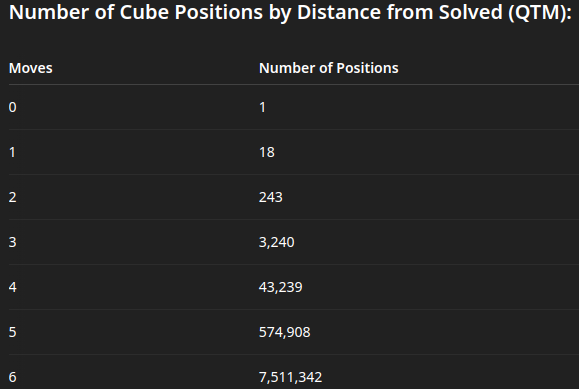
Similar to what Veritasium showed in the video with the energy packets in the metal bars.
Its obvious that there are less strategies within nash distance 1%< then there are within 5%<. I don't know if that means that number of strategies at exactly 5% from nash is higher then at distance 1%.If you make strategy like this: 80% of the time play perfect nash 20% of the time play Joe 5% strategy. I think (not really sure?) that strategy will be 1% from nash. That would
It took me a while to understand what you were saying. But I think I get it now. And it's a clever argument.
Let's imagine that we have some perfectly unexploitable Nash Equilibrium strategy (NE). Now draw a circle around it representing the space of all possible strategies within 1% and 5% nash distance:
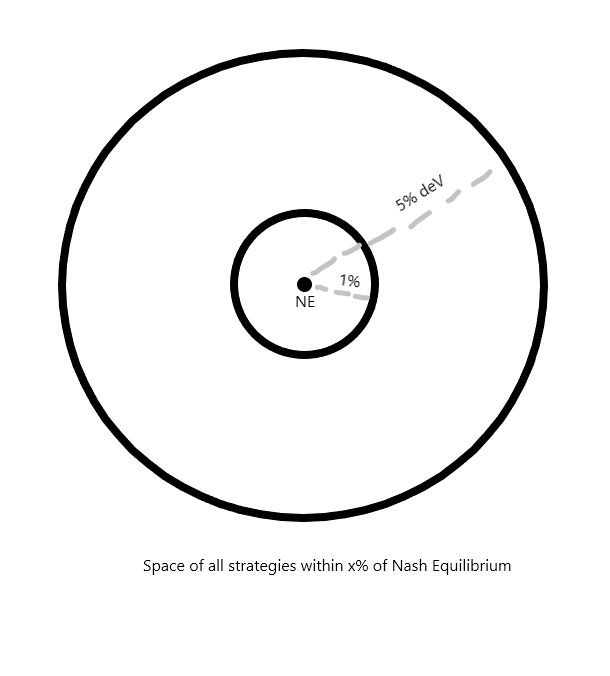
Intuitively, the 5% shell looks bigger. Now in reality there are many dimensions or ways to deviate from GTO, so the space is a multi-dimensional hypersphere lol. But anyway let's keep it simple with a circle.
What Haizemberg93 is saying (I believe, correct me if I'm wrong), is this:
1) We can construct a 1% dEV strategy using some linear combination of perfect NE and the outer circle (Joe's 5% strategy). << This part I agree with.
2) So every 5 % point maps to one 1 % point with a 1-to-1 correspondence. << This part I agree with.
3) Since there's a 1-to-1 mapping, maybe the shells are actually the same "size?" << This part I disagree with.
The 1% shell and 5% shell have the same cardinality, but not the same density.
You can map every even integer to every integer in a 1-to-1 correspondence in the same way, so they have the same cardinality. But the set of all integers is obviously twice as dense. Similar story here. The set of all exactly 5% dEV strategies is much much denser than the set of all exactly 1% dEV strategies.
Ok why does this matter?
What I'm saying is that if we were to take the set of all exactly 1% dEV strategies and the set of all exactly 5% dEV strategies, and randomly choose a strategy in a smooth unbiased way, you would be a astronomically more likely to choose a 5% strategy.
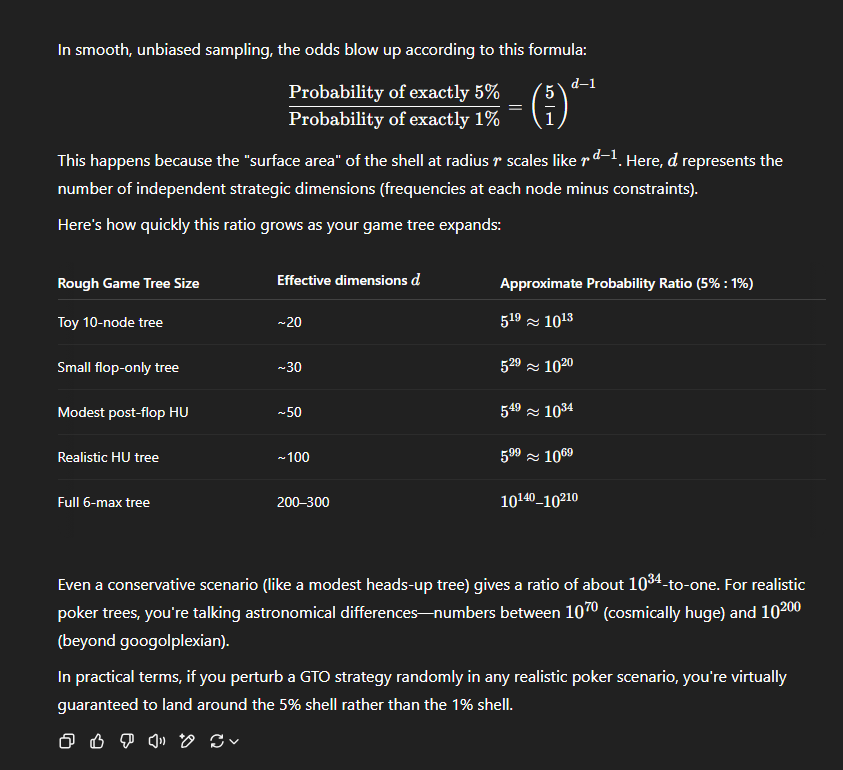
I'm no expert on entropy, but I think Veritasium made a good video about it.Especially the part between 11:00 to 15:00.
Love this video
This question already enters the domain of highly abstract and exotic mathematics. I think that for answering your initial question, it's not even that important whether there are more 5% or 1% strategies. To know who has the edge more often, you would need to pair up all the 1% strategies with all the 5% ones and count how often Bob has the advantage, and how often Joe does.
This, of course, isn’t easy 😃 As for the previous discussion—without going into details I honestly don’t know enough about—Nash distance is not the same as Euclidean distance, and the equilibrium isn’t at the center of that space, so the image with two curves creates some misleading intuitions in my opinion. I also think there’s no guarantee that these are hypersurfaces wrapped around each other near the equilibrium.
You can convince yourself of this with an example of extremely bad strategies—say, someone open-folds all +EV hands and jams all -EV ones. The number of strategies with such high exploitability isn’t particularly large, so for at least some x%, the idea that 'higher exploitability = more possible strategies' doesn’t hold.
Maybe math forum is better place for this question 😃
Yep that's a fair criticism. I don't think we can prove that it's C or D. It requires pretty advanced mathematics to map out the space of all strategies and how dense each region of that space is, math that frankly goes beyond either of our levels of expertise. And this is why I hedged in post #5 with a caveat.
But even if I can't prove it, I am very strongly convinced C is the correct answer. I would conjecture C is the correct answer for any 2p0s game that has a nash equilibrium, and allows strategies that lose EV against that equilibrium.
So I'm not actually sure this is true. I'm going to use rock, paper scissors as a toy game. Poker is less symmetric and additionally isn't entirely a mixed game however I think the idea should be somewhat transferable. For this rock paper scissors game I will limit strategies to having only integer frequencies. This is I am confident is a reasonable simplification for the problem and this assumption is further motivated by the final solution. To be specific a strategy of 30,30,40 is allowed but 30.5, 30.5, 39 is not. This does mean 1/3, 1/3, 1/3 is not allowed however this is not a particularly relevant point when we talk about strategies a distance from Nash. Playing 1/3,1/3,1/3 cannot possibly be +EV against any other strategy is a good indicator that being closer to equilibrium does not actually increase our chances of winning. We could also make the further argument that deviating epsilon from Nash could not possibly make more than delta vs any other strategy .
I will briefly define what I mean by exploitability just in case it is not the common usage. A strategy of 33, 33, 34 has an exploitability of 1%. If it is 34% rock then optimal exploit is 100% paper which wins .34 and splits .33=.165 , This would yield .505 of the pot which I will define to be 1% exploitability. This ensures that if a player gains 100% of the pot the opponent's strategy was 100% exploitable. Therefore exploitability is defined in terms of percentage of the original pot share that the exploiting player has gained. In this case the player was originally entitled to .5 of the pot but now is entitled to .505 pot corresponding to 1%.
One can in fact convince themselves that 33, 33 ,34 is the only possibly strategy with 1% exploitability. This corresponds to 3 possible combinations however one can assume without loss of generality that rock is player 34%. We can now take a look at 100% exploitable strategies. This is 3 combinations of 100, 0, 0. In the case of 100 rock then Player A (34,33,33) is entitled to .34(50) + (.33)(100)+(.33)(0) = .50. In the case of 100 paper then Player A is entitled to (.34)(0)+(.33)(50)+(.33)(100)=49.5 and in the case of 100 scissors then Player A is entitled to (.34)(100)+(.33)(0)+(.33)(50)=50.5. Hence one can see if each of these strategies is taken 1/3 of the time the players break even despite player A having a much less exploitable strategy. One may take this as a special case and so I have also calculated values for 5% exploitability.
In this case there are 2 possible options for 5% exploitable strategies. 35, 35, 30 with 3 combinations and 36, 33, 31 with 6 combinations. One can again assume Player A plays rock 34% of the time and calculate his EV against each of these 9 strategies. This does indeed give player A 50% pot share.
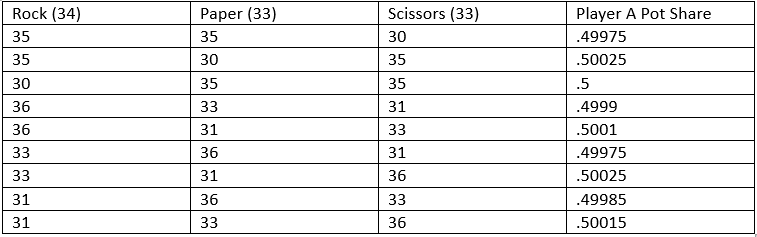
One can see these solutions have a highly symmetric structure. If one strategy gains x EV another strategy will gain -x EV. Poker is of course a less symmetric game than rock paper scissors but I would be surprised if this result no longer holds. Given that the solution to the problem gives rise to a fairly obvious symmetry it is quite clear that 50% pot share will be common to any sort of exploitability ratio even for non integer strategy values.
RPS is not a good analog because you cannot lose EV against a GTO RPS strategy. So playing closer to GTO doesn't carry any statistical edge.
I answered this earlier:
Rock paper scissors is an interesting counterexample. In RPS, if we generate two random strategies, the less exploitable strategy doesn't have any statistical advantage against the other. But I think RPS might be a bad analogy because it's impossible to make a "pure mistake" against a GTO RPS strategy. In poker it's possible to make moves that lose EV against a fixed Nash Equilibrium strategy. In poker you have dominated strategies that strictly lose EV. You don't have that in RPS.
This is true but I would argue that in terms of "èxplonitability" it is really only mixed decisions that matter. In addition pure mistakes are relatively hard to make and at least for a solver they would be the first to be basically non existent. If 2 solutions were solved up to 1% and 5% ( or .1% and .5% ) then basically no pure mistakes would occur.
Otherwise this question reduces to whether there are more pure mistakes for greater exploitable strategies which is either vague or trivial and in my opinion not very interesting
This is true but I would argue that in terms of "èxplonitability" it is really only mixed decisions that matter. In addition pure mistakes are relatively hard to make and at least for a solver they would be the first to be basically non existent. If 2 solutions were solved up to 1% and 5% ( or .1% and .5% ) then basically no pure mistakes would occur.Otherwise this question red
There are pure mistakes left even at high precision. See our latest GTO Wizard QRE implementation for an idea of how to introduce mistakes into the strategy in a controlled way.
https://youtu.be/lsN92LHTNRw?si=XyzYYQIZ...
But you ask a really interesting question. Is the edge you get from playing more precisely in poker only due to capitalizing on more pure mistakes? Do the frequency mistakes essentially cancel out?
If we forced the solver to only make mixing mistakes, would the less exploitable player have the edge (on average)?
There are pure mistakes left even at high precision. See our latest GTO Wizard QRE implementation for an idea of how to introduce mistakes into the strategy in a controlled way.https://youtu.be/lsN92LHTNRw?si=XyzYYQIZ...But you ask a really interesting question. Is the edge you get from playing more precisely in poker only due to capitalizing on more pure mistakes?
This is the "problem" with a GTO strategy. If we're playing a balanced strategy we're not really capitalizing on our opponent's mistakes in either direction.
If they overfold they'll do better against our "value" nodes, if they overcall they'll do better against our bluff nodes. The gains we receive due to their mistakes in one node are, at least to a large extent, cancelled out by losses in another node.
If we know our opponent is making an error in one direction and we respond with a balanced GTO strategy we're losing EV compared to if we were playing an exploitative strategy.
Using a boxing analogy GTO is like using a balanced defensive posture with some controlled jabs. We will be in the best position to prevent our opponent from scoring, and we might even score some points ourselves.
Making an exploitative play is akin to throwing an uppercut. You can do a lot more damage, but you also open yourself up to a well-timed counterpunch.

