President Donald Trump

I assume it's still acceptable to have a Trump thread in a Politics forum?
So this is an obvious lie - basically aimed at
you shouldn't be allowed to order someone to "try", that's a non sense. as yoda said, do, or not, there is no try.you can only order someone to do , or not do, something you are 100% it's in his capacity in a clear objective defined way. you can't order someone to "try to get peace on the middle east" ffs or "find the cure for cancer".would you accept a court to order you to me
You’re not answering the question, and instead proposed an unrelated hypothetical.
I used “try” as a generic term to describe the situation. “Try” is obviously not what the court said.
The district court ordered the government to take certain specific actions and write out what they are doing. They have refused to do so thus far.
The court can’t order a result, it can order an action. To be specific, it cannot find the order was violated just because the guy doesn’t get brought back. But it can find the order was violated if the government refused to take certain actions to further that result.

This is a ridiculous perspective. Courts order parties to use their "best efforts" all the time in situations where it is not entirely clear what is possible and what is not possible. --Plaintiffs moves to compel production of X category of documents.--Defendant: X documents were stored on servers that were damaged by a fire.--Court: Have you done everything you can to retr
Coming soon to a court near you:
--Court: I order you to recover the documents and if you don't produce them I'll deport you to Russia where they'll put you in a gulag. Whining about that being impossible because of some "fire" isn't going to help. We're also going to need a 4 page essay on why Donald Trump is the best President this country has ever had.
It's all been done before, as has this very conversation, and you're still completely wrong.
Go and look at crime statistics in the Victorian era when people were routinely hung. Public hangings weren't even a deterrent because pickpocketting, a hangable offence, was rife at public hangings.
Remove, temporarily or permanently, violent criminals and others take their place.
By Victorian times, from the late 1830s, the death sentence was automatically commuted (often to quite a short prison term) for all capital offences except treason and murder.


except for:
Israeli Prime Minister Benjamin Netanyahu Feb 4
Japan's Ishiba Feb 7
Jordanian King Abdullah II bin al-Hussein Feb 11
Indian Prime Minister Narendra Modi Feb 13
French President Emmanuel Macron Feb 24
British Prime Minister Keir Starmer Feb 27
Ukrainian President Volodymyr Zelenskyy Feb 28
Irish Prime Minister Micheál Martin Mar 12
Lol, you're right, I should have realized that couldn't be correct, but I could have sworn I read that regarding the visit. There must be something special that it was the first of, but obviously not the first foreign leader hosted at the White house.
Correction - he was the first Latin American leader invited

By Victorian times, from the late 1830s, the death sentence was automatically commuted (often to quite a short prison term) for all capital offences except treason and murder.
The "Bloody Code", where even trivial offences were punishable by hanging, didn't end until 1840, three years into Victoria's reign. Although after the 1820s it was discretionary for all crimes except murder and treason, pickpockets were still being hung throughout the 1830s.
Maybe a small hope the U.S. are just in a coma and not dead already .
Harvard decided to stand up to trump it seem ..
I was just coming to say something about this.
The ludicrous demands of Harvard include that the university eliminate DEI programs and ensure "viewpoint diversity" is reflected in its hiring practices.
Did the staff member who wrote this letter even know what "DEI" stands for? In case anyone here didn't know, the D stands for "diversity".
So the Trump regime is demanding that the university eliminate diversity programs, yet ensure diversity in their hiring practices.
And yes, I know what they actually mean by both demands - hire some MAGA professors even if they are less qualified, but don't go hiring or admitting any more negroes.
Still, hypocrite much?
Harvard rejects Trump administration's demands for deep changes


That's exactly what George Conway said a few days ago on Twitter. And that it wasn't far off.
The people of the USA beholden to an insecure, petty, perhaps mad, and deeply stupid tyrant, who is served by idiots and manipulated by the very rich and the very clever.
You poor bastards.
There's no need to rub it in.
And we (RoW) are part of the community of poor bastards now too.

Coming soon to a court near you:
--Court: I order you to recover the documents and if you don't produce them I'll deport you to Russia where they'll put you in a gulag. Whining about that being impossible because of some "fire" isn't going to help. We're also going to need a 4 page essay on why Donald Trump is the best President this country has ever had.
Yep. This is what Trump voters apparently wanted.
Neo-Nazi teen murders his parents, apparently to gain the financial means to assassinate The Orange One, and possibly Vance too.

Very insightful article from Bloomberg today. I normally only quote a few sentences for copyright reasons but this article is so good I'm going to make an exception and post it in its entirety.
Bloomberg: Cheap Consumer Goods Are the American Dream, Actually
Spoiler
In the decades after World War II, as the Americans and Soviets waged a multifront cultural and political fight for the soul of Europe, the US deployed a potent weapon: home appliances. And clothes. And color televisions. And sporting goods. And canned soda.
The US spun up a shock-and-awe campaign to sell the world on the splendor of its affordable, abundant consumer conveniences. It started in Marshall Plan-era West Berlin, where in 1950 the US Department of State built a gleaming trade pavilion packed with thousands of everyday products available to the growing suburban middle class across the Atlantic. For the first exhibition, a model tract home was shipped over from Minneapolis. In later shows, actors depicted nuclear families going about their daily lives through product demonstrations: getting dinner on the table in a jiffy with a microwave, throwing laundry into an electric washer and dryer, sitting down with the kids to watch some TV.
These exhibitions were part of an expansive effort to pitch US-style capitalism to war-weary, communist-sympathetic Europeans. It was one of the most effective propaganda campaigns in American history: Thousands of visitors flooded in to catch a glimpse of a very foreign notion of modern life—first in Berlin, then across West Germany and Italy, and eventually in the USSR itself. At the first Moscow exhibit in 1959, Soviet Premier Nikita Khrushchev erupted in anger at his guide, then-Vice President Richard Nixon, over the display of American decadence. In the years following, Khrushchev tried to fight the propaganda not by opposing consumerism, but by embracing it in state media, promising that comparable Soviet products were already available or soon would be. (They weren’t and wouldn’t be.) The move backfired spectacularly, according to a 2005 article by historian Greg Castillo, validating America’s message about the superiority of capitalism as an economic system in the eyes of regular Soviets. “A runaway inflation of consumer desire ultimately bankrupted the political economy of Soviet-style socialism,” he wrote. Once the people see a dishwasher, they want a dishwasher.
Americans still want dishwashers—and iPhones and new sneakers and closets overflowing with clothes and rainbows of fruit and vegetables at the grocery store. The Marshall Plan’s pitch for “citizen enfranchisement through rising purchasing power,” as Castillo described it, was fine-tuned at home before it was deployed abroad, and it’s still one of the primary animating principles of America’s identity—and its economy. Today household consumer spending constitutes almost 70% of US gross domestic product, the highest proportion for any industrialized nation. Supplying this bounty has required massive development of production capacity around the globe. Although Americans consistently express a preference for American-made goods in surveys, their actual purchasing habits have demonstrated for decades that affordability and abundance trump any ideological preference for domestic manufacturing when it comes time to buy.
For almost a century, leaders from both parties have worked in concert to ensure that the import-fed firehose of consumer convenience continues to gush. Getting in between Americans and their stuff has long been one of the third rails of American politics—for the rare few who’ve tried, even with the best of intentions, the efforts have ended poorly enough to act as a warning to those who would come after them. (President Jimmy Carter, for example, lectured the public on the virtues of thrift. It didn’t go well.)
Team Trump seems not to care. “Access to cheap goods is not the essence of the American dream,” Treasury Secretary Scott Bessent said at the Economic Club of New York in March, dismissing widespread fears (though seemingly confirming them in substance) that the administration’s draconian tariff regime would lead to price hikes and shortages of all manner of imported goods. As a matter of historical fact, Bessent is wrong, though most Americans probably agree with him on some level, if only because the notion isn’t maximally flattering. President Donald Trump campaigned on making consumer goods cheaper—“Starting on Day 1, we will end inflation and make America affordable again, to bring down the prices of all goods,” he told a crowd at a Montana rally in August 2024. If Trump pushes forward on policies that are all but guaranteed to deliver another blow to Americans’ purchasing power, he’ll be daring Americans to reconsider what prosperity actually means—a forced reflection that, at the very least, could come at potentially great cost to his party in next year’s midterm elections. Investors, who don’t have to wait till November 2026 to cast their vote, have already sent financial markets plunging, convinced that Trump’s trade moves will provoke a recession.
Consumerism has always been used toward political ends. When the consumer system emerged in the latter half of the 19th century, the Industrial Revolution had kicked off a broad reordering of society in the US: People began to migrate in droves to cities to take jobs at factories, banks, newspapers and beyond. Regulations on corporate activity loosened, and private companies grew more numerous, larger and more powerful. An extravagantly wealthy class of industrialists emerged, as did a new middle class of office workers.
New classes create new class politics. America’s robber barons, with their habits of buying off politicians and violently breaking strikes, had a worse reputation problem than today’s billionaires. The industrialists, though, had a bargaining chip: affordable consumer goods. Factories could churn out a dazzling array of products at a scale and speed previously unthinkable, and urban office workers, who made more money and had more leisure time than their counterparts in factories, made ideal buyers for these goods. Working in league with the owners of the country’s burgeoning department stores, industrialists pitched consumption to white-collar workers as proof that the wealthy were looking out for the little guy too. “It was in their interest to give the impression that they, not their employees or other workers, were the true populists and that consumption, not production, was the new domain of democracy,” wrote the historian William Leach in his 1993 book Land of Desire: Merchants, Power, and the Rise of a New American Culture.
In return for consumer abundance, many middle-class Americans would take business and political leaders’ word for it when they said that the government was expensive and wasteful and that the social safety net needed to be kept lean to discourage laziness and freeloading. In return, their taxes would be low and, if they worked hard, the power of consumerism would provide the opportunity to buy whatever they wanted or needed—no bureaucrat would choose how to spend their money for them.
As a result, we have things like affordable dishwashers and effective in-home clothes dryers—the kind of stuff that’s still far less common in Europe, where people broadly settled on a more moderate version of this bargain with capitalists—but no guarantee of basic health care or paid sick leave. Trading universal health insurance for a shot at one day renovating your own big, beautiful American kitchen with all the bells and whistles isn’t a deal that everyone born into the US economic system is glad their forebears made, but you can plausibly call it a trade.
What the Trump administration instituted—and later delayed for most trade partners, with the notable exception of China—in April with its so-called Liberation Day tariffs isn’t a trade, it’s a sacrifice, especially given that Republicans in Congress are weighing cuts to the country’s existing social safety net. Washington is withdrawing a century-old deal but offering nothing material to replace it. Even if the tariffs do succeed in eventually luring manufacturing jobs back to America—an outcome that most economists and industrial experts don’t believe will ever materialize—any upside would be many years down the road. In the interim, millions of people will see their household budgets severely squeezed.
There is already a simmering rage among Americans about the affordability of everything from eggs to health care to housing, which seemed to play a not-insignificant role in propelling Trump back into the White House by strengthening his support among lower-income voters. Every indication suggests that cohort in particular is set to see its spending power kneecapped. Beyond that, many economists have warned that the combination of Trump’s trade, immigration and government-spending policies could tip the economy into a recession, leaving millions of Americans vulnerable to losing their jobs.
But the material impact of these changes isn’t the only issue at hand. Americans, perhaps more than any other group of people in the world, imagine themselves through their consumer identity. Like it or not, our purchasing decisions are how we’re taught to construct our sense of self, to communicate our values, to assert our agency. Historically, this has made life easier for political leaders: People who feel most comfortable expressing themselves through consumer choice are less likely to express themselves in other, potentially more troublesome ways. Taking a hammer to those choices may very well inspire some of them to consider other options.
"Freedom House" is an ironically named neoliberal think tank that works directly for the interests of the U.S. ruling class
Freedom House states that its board of trustees is composed of "business and labor leaders, former senior government officials, scholars, writers, and journalists". All board members are current residents of the United States. Past members of the organization's board of directors include Kenneth Adelman, Farooq Kathwari, Azar Nafisi, Mark Palmer, P. J. O'Rourke and Lawrence Lessig, Zbigniew Brzezinski, Jeane Kirkpatrick, Samuel Huntington, Mara Liasson, Otto Reich, Donald Rumsfeld, Whitney North Seymour, Paul Wolfowitz, Steve Forbes and Bayard Rustin.[2]
A murderer's row. I don't mean that in the baseball sense, I mean a literal row of murderers.
In 2006, the Financial Times reported that Freedom House had received funding by the State Department for "clandestine activities" inside Iran. According to the Financial Times, "Some academics, activists and those involved in the growing US business of spreading freedom and democracy are alarmed that such semi-covert activities risk damaging the public and transparent work of other organizations, and will backfire inside Iran."
nothing to see here, just your mom-and-pop NGO receiving money from the feds to participate in "the growing US business of spreading freedom and democracy" in Iran
No way Freedom House could have any interest in depicting various international elections in false ways!
Edit: checking out Freedom House's website. They do a good job of hiding all of the evil cretins who populate their organization. They're also good at pretending to be a pro-human rights advocacy group. I could see some dummy reading this site and being like, "ah, what a sweet collection of altruists, I bet they're running soup kitchens right now!"

Very insightful article from Bloomberg today. I normally only quote a few sentences for copyright reasons but this article is so good I'm going to make an exception and post it in its entirety.
Lmao.
That's exactly what George Conway said a few days ago on Twitter. And that it wasn't far off.
lol
Is George Conway angling for a job as a prison guard? Let's not pretend these Lincoln Project monsters/grifters are any more morally upstanding than the average MAGA person. Conway especially is a piece of **** -- pretending like Trump is Hitler AT THE SAME TIME HE WAS MARRIED TO TRUMP'S VERSION OF JOSEPH GOEBBELS.

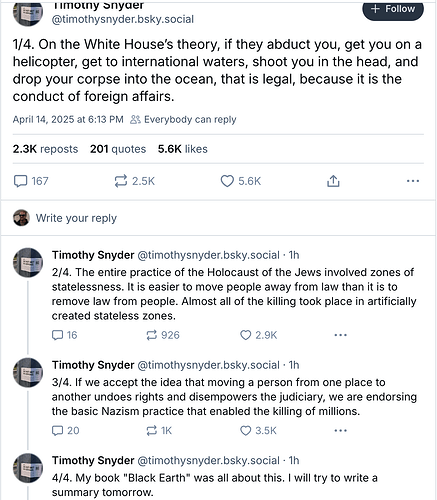
Timothy Snyder is one of the preeminent scholars on fascism and authoritarianism in the US.
Well, he used to teach in the US. He has since fled to take up a position at the University of Vienna in Austria.
Agreed. I need to think a bit more about whether (or how much) I agree with the thesis, but it is definitely interesting.
Sure, George Conway, Rick Wilson, John Weaver (before getting cancelled for multiple attempts of sexual assaults of young men) and the rest may have worked for DECADES to get various Republicans elected (some of whom no less rotten and corrupt than Trump), but look Democrats, this orange fella is just such a unique evil that you need to let us into your party and show you how it's done.
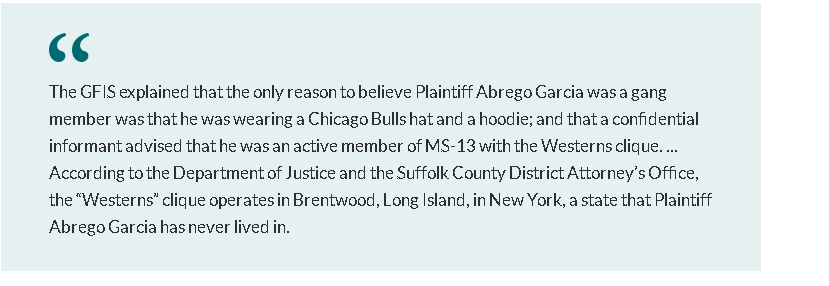
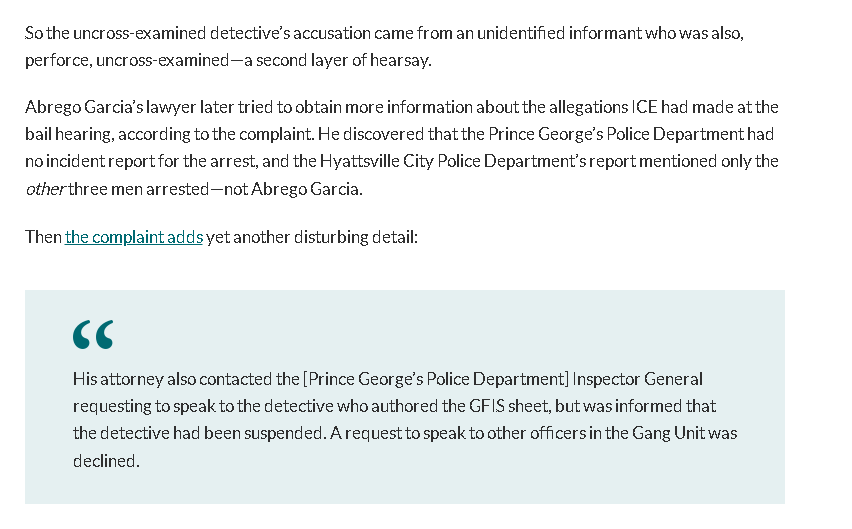
Abrego Garcia and MS-13: What Do We Know...
With all of the blustering from this fascist administration that Abrego Garcia is some MS-13 mastermind human trafficker, the actual evidence to support the allegation is non-existent.
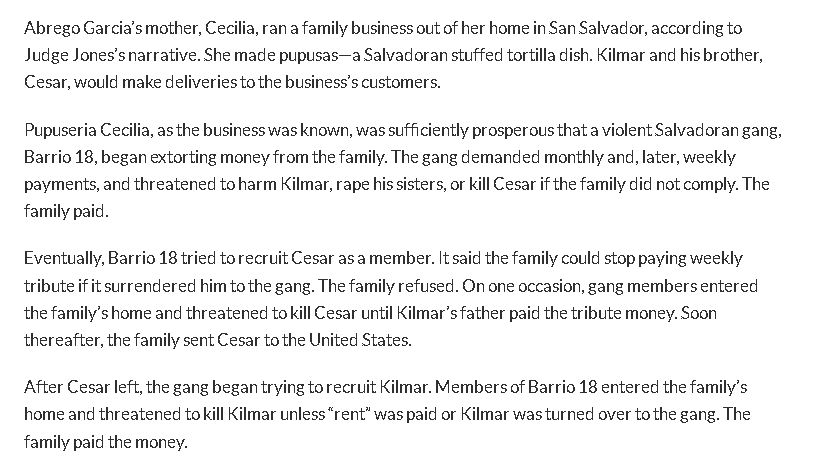
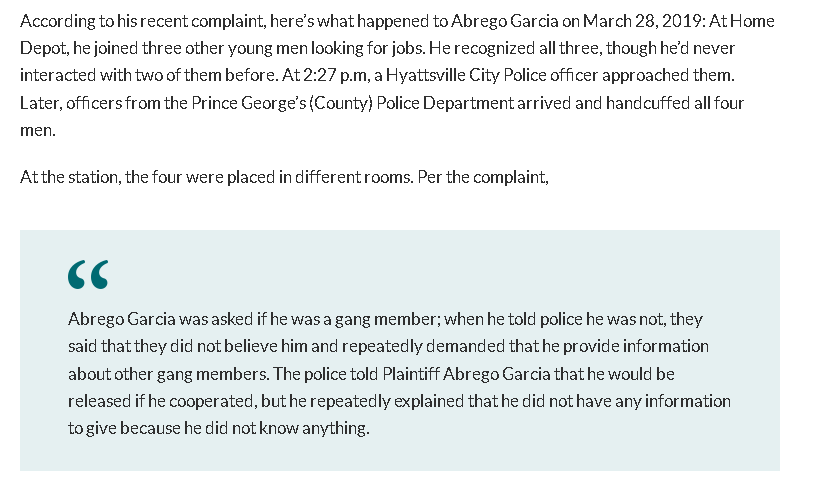
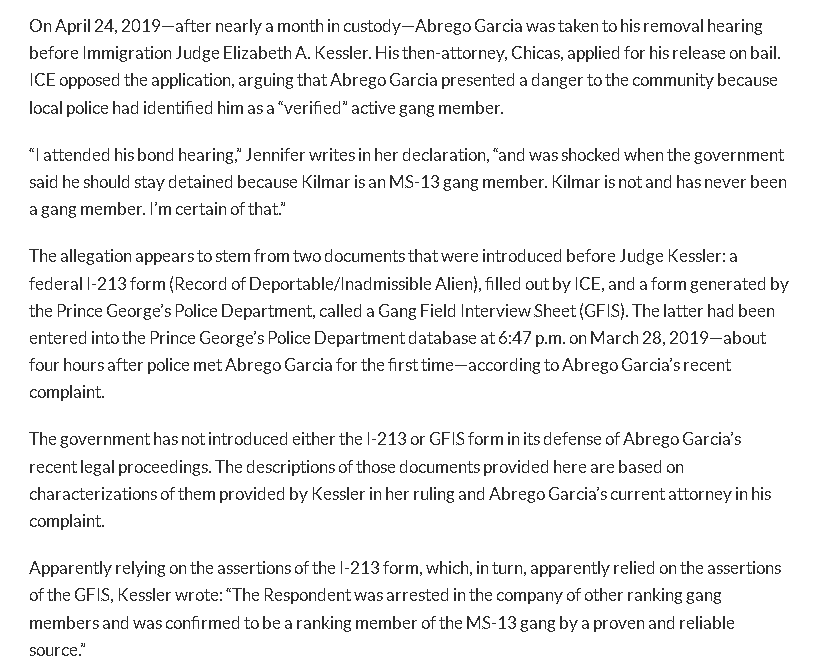

He's brown. That's all that matters.....for now. They'll be coming after anyone they want after it's become obvious they can.


