In other news

In the current news climate we see that some figures and events tend to dominate the front-pages heavily. Still, there a
You can only help someone as far as they are willing to help themselves. In that sense I don’t know what the solution is. Nobody does. People just don’t want to see them or have to think about them which is where “camps” come into play. Ultimately I am not trying to virtue signal. I don’t care about homeless people that much. I just think it’s an interesting dichotomy to suppor
Whatever the preferences, what the solution shouldn't be is to spend 50-100k per homeless person per year without fixing it permanently, which is what california does.
With that amount of money you should be able to buy/build housing

baba must be giddy
https://www.cbpp.org/press/statements/ho...
The House Republican budget passed today calls for massive cuts in health coverage, food assistance, and help paying for college, among some other areas, to pay for huge tax giveaways for wealthy households and businesses. This betrays President Trump’s campaign promises to protect families who struggle financially, as well as his specific pledge to not cut Medicaid, which provides health coverage for 72 million people. While raising costs for families and increasing both poverty and the number of people without health coverage, the budget would swell deficits — all to further Republicans’ expensive and skewed tax agenda.
Both the House and Senate budgets significantly miss the mark on what should be their basic goals: lowering costs, increasing opportunity, and responsibly addressing our nation’s long-term priorities, including reducing future economic risks associated with high deficits. But the enormity of program cuts called for by the House budget stand as a singular threat to the well-being of people in every state, city, and rural community, threatening to take away their health coverage, make health care more expensive, and make it harder to afford food and college.
The Senate should reject the House cuts both now and if Congress ultimately moves ahead with a second budget plan and reconciliation bill this year.
The quick math on the House budget shows a stark equation: the cost of extending tax cuts for households with incomes in the top 1 percent — $1.1 trillion through 2034 — equals roughly the same amount as the proposed potential cuts for health coverage under Medicaid and food assistance under the Supplemental Nutrition Assistance Program (SNAP).
Under what set of values does a budget target those who struggle to pay their bills for severe cuts, while giving an annual tax cut averaging $62,000 for those who make $743,000 or more a year? The tax cut for these wealthy households is greater than the annual family incomes for most of the 72 million people — 1 in 5 people in the U.S. — who have health coverage through Medicaid. And the $62,000 figure doesn’t account for the likelihood that this budget would shower large corporations with more tax breaks, given that it allocates $900 billion more than extending the existing tax cuts would cost.
"The House Republican budget’s path of higher costs for families, more people without health coverage, increased poverty and hardship, and higher debt — all in service to tax cuts for the wealthy and profitable business interests — is the wrong direction for our nation."
The enormous cuts this budget calls for would increase costs, hardship, and poverty for individuals and families across the country. To be clear, the specific proposals that House Republicans have been considering for weeks to make these program cuts are largely not about curbing fraud and abuse, as some claim. For example, proposals to cap federal funding, shift costs to states, or impose harsh work requirements that trip people up with red tape are aimed at cutting health coverage and food assistance for honest people who need help, not reducing fraud.
And the impact of these cuts could be grave: think of a person who loses health coverage through Medicaid and can’t get cancer treatment, an older and frail adult who loses the home-based care they need to stay out of an institution, a young adult who can’t get insulin to control their diabetes, a parent who skips meals so their children can eat, or an older worker who loses their job and has no way to buy groceries. Make no mistake, these cuts would affect people in every state and of all races and ethnicities. At the same time, the impacts would often be especially severe in poorer states with less ability to fill in for federal cuts and among Black, Latino, and Indigenous people and people in rural communities, who have lower incomes and thus are more likely to qualify for food assistance and health coverage.
The House budget would require the Energy and Commerce Committee to cut at least $880 billion; the Agriculture Committee to cut at least $230 billion; the Education and Workforce Committee to cut at least $330 billion; and other committees to also cut programs to reach a cumulative target of at least $1.5 trillion in cuts through 2034. The magnitude of these reductions would force congressional committees to make enormous cuts in Medicaid, SNAP, student loan assistance and other vital sources of support when they develop the “reconciliation” spending and tax bill that follows the budget resolution.
But as massive as these cuts are, they don’t show the full picture of the overall program cuts that the House budget may generate. The committee targets are minimums or “floors” — meaning the committees must cut at least that amount and may cut more. And a provision included by the House Budget Committee during its consideration of the resolution pushes the committees to cut more, by requiring the overall level of program cuts to reach $2 trillion to retain the full $4.5 trillion in tax cuts.
Beyond this budget’s basic effects of taking away health, food, and other vital assistance from people who struggle to afford the basics and making student loans more expensive to partially offset tax cuts for the wealthy, it would have at least three other harmful impacts.
First, the House budget resolution and the proposals House Republicans are considering could result in enormous cost shifts to state, local, territorial, and tribal governments, which are already facing tougher fiscal conditions than in recent years. For example, some of the proposed cuts in Medicaid and SNAP would force states to pick up a much larger share of the programs’ costs or leave people without needed help. In reality, states will not make up for all or even most of the federal cuts, and families will lose health coverage and food assistance.
Second, while this budget aims to extend all of the tax cuts skewed to the top, it fails to call for extending a tax cut that is well targeted to people who need it: the improved premium tax credits under the Affordable Care Act. Failure to extend this tax cut would raise health care premiums for more than 20 million people, including at least 3 million small business owners and self-employed workers.
And third, even with the budget’s huge cuts in assistance, and the suffering those cuts would inflict on individuals and families, it would still increase our nation’s debt because of the enormous cost of its tax cuts. When you strip away this budget’s fuzzy math with its $2.6 trillion macroeconomic gimmick — which is far beyond expert organizations’ estimates (including estimates of conservative organizations) of possible economic effects from extending the tax cuts from President Trump’s first term and enacting potential new tax cuts — the federal debt under the House budget would increase over the next ten years compared to Congressional Budget Office projections of current law.
Even with the budget calling for a $4 trillion increase in the statutory debt limit, we calculate this limit would be reached in November 2026, only 21 months from now, under the policies assumed under this budget.
The House Republican budget’s path of higher costs for families, more people without health coverage, increased poverty and hardship, and higher debt — all in service to tax cuts for the wealthy and profitable business interests — is the wrong direction for our nation. It is also directly at odds with the recent election in which so many people expressed concern about their ability to afford food, housing, health care, and other necessities — and at odds with the promises made to them by President Trump.


I probably agree more often than I disagree with editorials that promote personal liberties and free markets (especially the editorials that focus on the erosion of personal privacy), but what Bezos did today was unconscionable.
Jeff Bezos, the owner of The Washington Post, announced a major shift to the newspaper’s opinion section on Wednesday, saying it would now advocate “personal liberties and free markets” and not publish opposing viewpoints on those topics.
* * *
Mr. Bezos’ decision to curtail the scope of views on The Post’s opinion pages is a major departure from the newspaper’s decades-long approach to commentary and criticism. Under Mr. Shipley and his predecessor, Fred Hiatt, The Post has published a wide variety of views from the left and the right, including liberal stalwarts like David Ignatius and Ruth Marcus and conservative voices like George Will and Charles Krauthammer.
https://www.nytimes.com/2025/02/26/busin...
I can't imagine that the actual editorial decisions will adhere to any reasonable definition of "personal liberty." For example, I suspect that, notwithstanding this new guidance, the Washington Post would publish an editorial in which the author opined that allowing DOGE employees access to a broad array of personal information is a small price to pay in order to achieve a necessary trimming of the federal budget. (In other words, I would not view such an editorial as falling on the side of promoting personal liberty.)
I also think this is very indicative of how the uber-billionaire class now thinks about what it means to own a traditional media or social media outlet. You don't buy those outlets primarily for status. You don't buy them primarily because you think the outlets in and of themselves will be good investments. You buy them primarily because you see them as useful tools for influencing public opinion in the direction that you favor.
What is "unconscionable" in his decision then?
I described what I believe to be the problem.

this guy has never been to democrat run san francisco.
they care greatly for homeless people there.
look at the wonders it's done
Why are all the shelters and soup kitchens ran by Christian organizations if Democrats care so much about the homeless?

Why are all the shelters and soup kitchens ran by Christian organizations if Democrats care so much about the homeless?
evidence for this claim?
Lmao, where I live. We have Catholic Charities, Gospel Mission with 2 locations, and Salvation Army, etc...There's some other non profit ones but the people that run them are also usually Christian. Christians do more for homeless across the country than anyone by far.
Also funny that almost every homeless person says "God bless" when you give them something.
Secular people don't actually want to get their hands dirty. They just like to talk about gov't funded programs.
Lmao, where I live. We have Catholic Charities, Gospel Mission with 2 locations, and Salvation Army, etc...There's some other non profit ones but the people that run them are also usually Christian. Christians do more for homeless across the country than anyone by far.
So your evidence for this claim is your personal anecdote? I'll pass, thanks.
It's literally provable physical evidence. Just google around the country. They're everywhere dumbass.
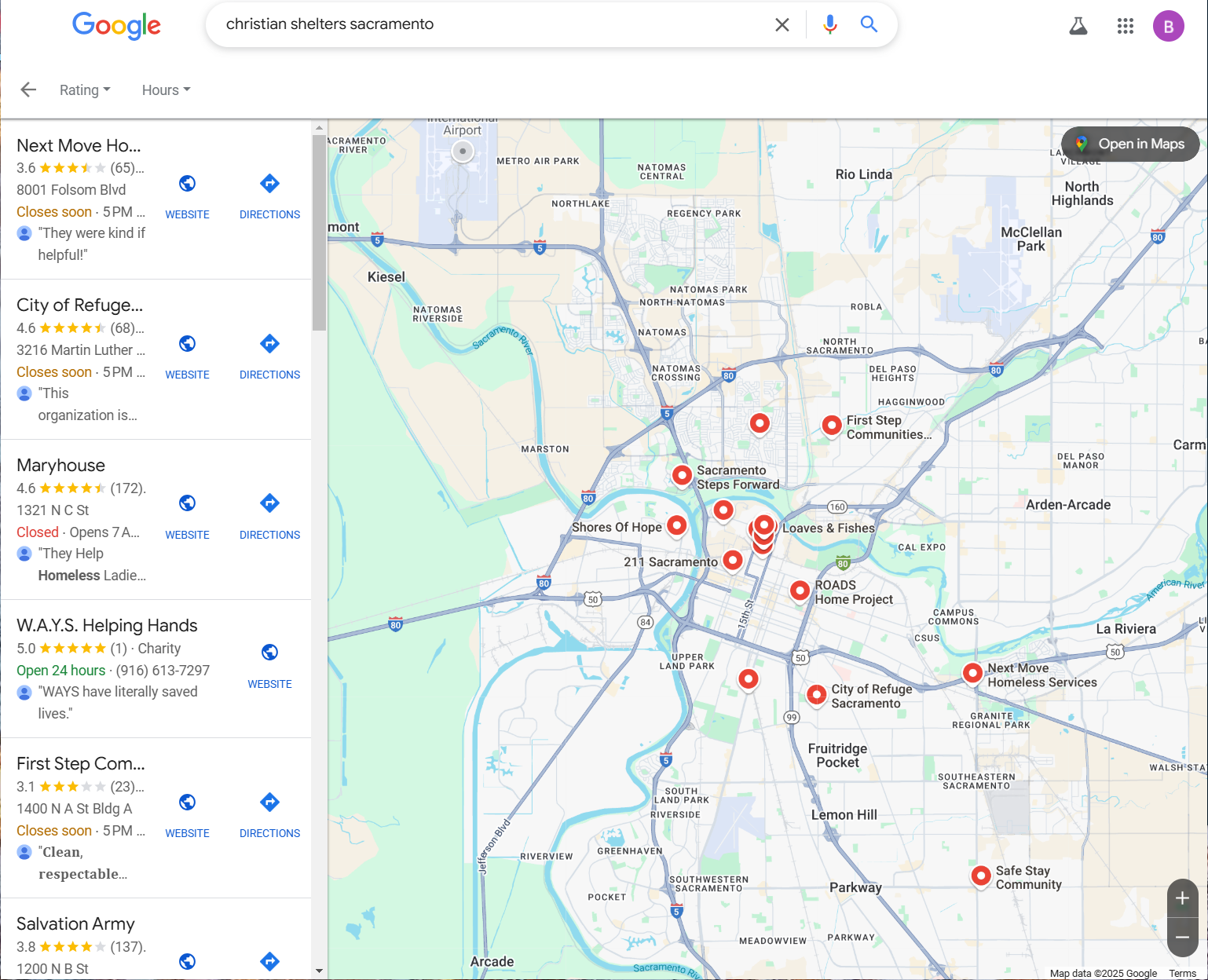
And yet all you provided was your personal anecdote. And, I'm sure much to your dismay, I did google around the country, and found you were not even close with your "all" claim. In fact, barely half were "religious" (not even specifically Christian).

https://www.deseret.com/2017/2/1/2060526...
Oops, huh? df
Are you trying to prove all of the homeless shelters are provided by Christians by showing us that all of the results are Christian when you specifically searched for "christian shelters?"
Really? Is your last name James, by chance?

Hey df. No one is disputing that Christians provide a lot of homeless shelters and what not. I was asking for evidence for your claim that they provide all of them.

Well as a private enterprise there is no moral limit something something to making sure the WP owner's message is delivered without any Marxist pollution. Any breach of the policy and the WP should be able to execute the employee for possibly affecting the PnL.

Garogan out here straw manning by disproving an absolute. Absolutes are the easiest thing to argue against. Simply need to find one thing to the contrary. Kindergarten kids could disprove absolute.
Rather than taking the original statement and agreeing that ya, a good % of homeless shelters are religious based, goes on in typical Garogan fashion and argues with people on the internet as has done for at least the last 16 years of his life.
Sad.

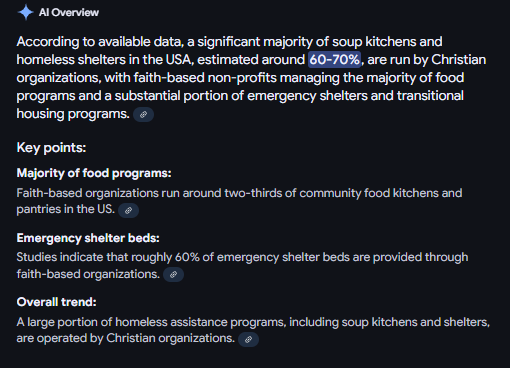
this is pretty well known - churches tend to run like universities where they pile money into investments and then once they feel "secure" start putting it all into charitable projects rather than a new football stadium
a successful church will get about 10% income from all their members as tithes, if they have a robust membership, this is more than enough to pay for their operating expenses so the rest needs to go somewhere
this often how a church will end up owning things like rental units, gas stations, and laundromats is where they park this excess money (and have a way to generate more income and they have the additional motivation of "having this here will provide local services and create jobs")
and then when they really got a good cashflow going they tend to then provide things like homeless shelters and soup kitchens with the excess
i'm very anti-church, but it's absolutely outlandish for you to both not believe they dominate most charitable projects for the homeless and poor and not only that but ridicule the claim in public without bothering to spend 5 secs on google to find out it's true
much like how most environmentalists are shocked to believe that hunters and fisherman (who are majority conservative) donate far to environmental causes than environmentalists themselves do
it's all about skin in the game
churches want new recruits and helping out the poorest in society is a great way to spread the gospel as that food and shelter often comes with bible study
likewise, duck hunters and trout fisherman want to protect those wetlands and mountain streams to ensure their grand children can also shoot ducks and catch salmon
also why most of the liberal elite college graduate wealth of the united states don't give to those causes but instead give to charities that deal with various medical ailments, because no matter how wealthy or educated you are, you'll still have a nephew with leukemia or a father that died of cancer
i'm very anti-church, but it's absolutely outlandish for you to both not believe they dominate most charitable projects for the homeless and poor and not only that but ridicule the claim in public without bothering to spend 5 secs on google to find out it's true
For some reason he chose to argue about ALL. Child's play.
Garogan out here straw manning by disproving an absolute. Absolutes are the easiest thing to argue against. Simply need to find one thing to the contrary. Kindergarten kids could disprove absolute.Rather than taking the original statement and agreeing that ya, a good % of homeless shelters are religious based, goes on in typical Garogan fashion and argues with people on the int
Gregorian logic:
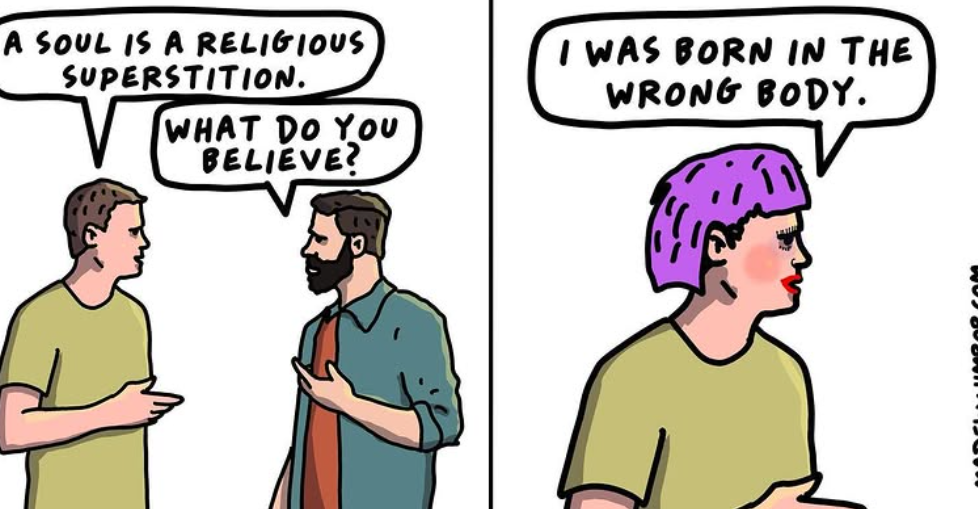
All donks Rick

I probably agree more often than I disagree with editorials that promote personal liberties and free markets (especially the editorials that focus on the erosion of personal privacy), but what Bezos did today was unconscionable.https://www.nytimes.com/2025/02/26/busin...I can't imagine that the actual editorial decisions will adhere to a
Pretending this is about anything other than Bezos trying to block unions is giving him undeserved credit.
So you just don't know what a straw man is. Cool.
He LITERALLY MADE THE ARGUMENT that ALL soup kitchens and shelters were run by Christians, and was USING THE ABSOLUTE to make his point. That is the exact OPPOSITE of a straw man, df.
Why are we distinguishing between Christians and Democrats when Democrats are like 65% Christian?
That actual number is probably closer to 80-85% if you account for burnouts
Like I was raised catholic and I'm closest to pantheistic now but I'd claim non denomination but I'm objectively more Christian than most right wing Christians


