Winrates, bankrolls, and finances

This thread will basically be a containment thread and will stock pile all of the questions and answers about winrates.

It's impossible to track, because the way standard deviation is calculated you can't use hourly averages extrapolated from sessions. In order to do it you'd have to record every single hour played individually. The way the apps calculate it is bogus
If you look into a mirror and say "Mason Malmuth" three times, a malevolent demon will magically appear in this thread to explain to you how wrong you are, and that if you bought the new edition of his book Gambling Theory, and Other Topics you would find the formula for computing standard deviation of winrate from a dataset of sessions of different durations.

This thread has many pages devoted to standard deviation; unfortunately when I look at complicated math formula, my eyes glaze over, so even though Garick explains somewhere how to calculate it, I just can't do so.
I am using two apps to track my winnings. Poker income I think has it wrong I think, because it gives me a standard deviation of 43BB per hour. Rungood says that my standard deviation is 97.6BB per hour.
Yeah I was less interested in the math and more interested in just comparing across multiple data points.
There is a way to calculate the standard deviation weighted for the hour you play in a session which I have calculated in Excel, but I think that underestimates the true variance. Maybe this is because each session is already smoothed out since it lasts multiple hours. Over 184 sessions and 1,158 hours, my hourly has been $86. My weighted standard deviation per hour has been $575.
But I have a spreadsheet where I take an hourly rate and a standard deviation and make a simulation of what a random 1,000 hours would look like if winnings are normally distributed. Maybe it's because my downswing happened when I was playing bigger games more often, but with $86 hourly $575 standard deviation, a 25k foenswing over a random 1,000 hours is extremely uncommon. A more reasonable variance seems to be 1,200. If your win rate is $100/hr and your standard deviation is $1,200, you won't always have a 25k downswing lasting 300-400 hours) over a 1,000 hour period, but it will happen often.
So maybe a good rule of thumb would be to assume your hourly standard deviation is at least 12x your average win rate. But if you are planning to play poker professionally and want to be safe, it doesn't hurt to overestimate the variance in terms of seeing how likely big downswings are and make sure you are prepared for that.
Makes a lot of sense to use Excel for that, I was wanting to avoid getting too much into the math of it but definitely seems like that's the bestway to properly quantify variance with the tools we have at our disposal.
There is a way to calculate the standard deviation weighted for the hour you play in a session which I have calculated in Excel, but I think that underestimates the true variance. Maybe this is because each session is already smoothed out since it lasts multiple hours. Over 184 sessions and 1,158 hours, my hourly has been $86. My weighted standard deviation per hour has been
Yes, I use this method in my Excel sheets to calculate the Std Dev. And you are correct, it tends to understate the Std Dev slightly. This is due to the smoothing effect. Essentially each individual session is view as all having the same variance for each hour of the session. While this is obviously incorrect, it provides a close enough number for me to feel confident in using it to as least ballpark my swings with primedope or another variance calculator.
FWIW... I consistently calculate a much HIGHER std dev for the live full ring games I play than the suggested 60 to 70 bb/hr. I play a LAG style and find I am usually in the 140bb/hr area in std dev.

Currently on a 15 month winstreak at 1/3 NL (and up in the early goings of this month too).
Took a quick look at my records. Not remotely close to my fish-on-a-heater glory years stretch of 23 months, but have easily surpassed my other bests of 11 and 9 months.
Might have something to do with me upping my recreational pokering frequency to ~twice per week (from ~once per week) while playing half the session lengths of before (which is probably good for my shortstack wheelhouse). Or maybe just all luckboxing... noting I kept the streak alive at one point by booking a $3 win for one month (enquire within regarding my coaching rates, ldo).
GpullingashardasIcanonthedoomsdayleverG
Ok, I was just checking my online database and I was looking at my win rate in micro tournaments when effective stacks were above 90BB. My win rate is around 30BB/100 over 48,000 hands which is the equivalent of 9BB per hour in a live poker environment. Then it dawned on my that online MTTs don't have rake which in live poker should be around 8BB/100 or so/ Also whereas micro M
So I just came across this reddit thread which features database analysis of 4 million hands of 5NL:
Microstakes rake is EXTREME. Players invested a total of $45,640 over the course of 4.4M hands. The casino raked 57% of that money. The rake amounts to 11.75BB/100.
- 1. BB won/lost distribution. This graph shows how much money players actually won/lost. 1/3 of players are profitable. 2/3 of players lost money. Less than 8.6% of players won more than a single buy-in. The top 5% of sharks claimed 66% of all money wagered. The vast majority of players are close to break-even. The bottom 1% of players account for 20% of the money wagered. A few whales supply most of the poker ecosystem.
- 2. EV (win rate) distribution. 20% of players are crushing it with a 10+ BB/100 win rate (although that's hard to maintain). Among players with more than 10,000 hands (n=56), the top 10 achieved an average win rate of 13BB/100 +- 6BB. The average EV is -11.7BB/100 (see rake above).
- 3. Calculating mass win rates is tricky. Each player needs a reasonable sample of hands. Unfortunately, filtering out low-volume players introduces bias as the data contains less recreational players. This makes it look like more players are winning. Filtering out high-variance players has a similar effect, excluding wildcards and maniac players from the dataset. It’s a tradeoff between accuracy and bias.
- 4. Visualizing luck: This graph shows how much money players won (BB left scale), compared to their all-in equity adjusted EV(BB/100 right scale). Lots of variance here. Some players were simply much luckier than others.
https://www.reddit.com/r/poker/comments/...
Even if 5NL online is equivalent to 5/10 live or above, this indicates that the 10BB per hour i.e. 33BB/100 numbers quoted as the gold standard is a best case scenario for a tiny minority of all players.
The number of players in this sample is something like 11-13k but the analysis only found 56 players putting serious volume and winning. That's approximately 0.5% of the population.

Currently on a 15 month winstreak at 1/3 NL).
my fish-on-a-heater glory years stretch of 23 months
GpullingashardasIcanonthedoomsdayleverG
Your humility is a model to the best players.
Glad to know your luck finally turned.
It's over 10bb/hour. This year I've not really had a bad losing session, like down 2 buyins or more at the end. Mostly this is from being able to turn around sessions where I hit a cooler top 2 pair into a set or something for a large pot into breakeven or slightly winning/losing sessions. Or from hitting those cooler hands after already being up considerably on the session. But overall I've had a solid number of multiple buyin winning sessions, a good number of double up-triple up sessions, a mixed bag of small winners and small losers, and no big losers so overall the year is pretty positive.
It's over 10bb/hour. This year I've not really had a bad losing session, like down 2 buyins or more at the end. Mostly this is from being able to turn around sessions where I hit a cooler top 2 pair into a set or something for a large pot into breakeven or slightly winning/losing sessions. Or from hitting those cooler hands after already being up considerably on the session.
Very important skill.
Just hit 2500 hours at the $5 level, vast majority at 5/5, a few hundred at 2/5 and 3/5.
That 1000ish hour breakeven stretch was pretty painful, not gonna lie. But I've learned so much in the latter half of this sample that I'm excited to put another 1000 in and see if I can't bring this winrate up from $30/hr to around $50/hr.
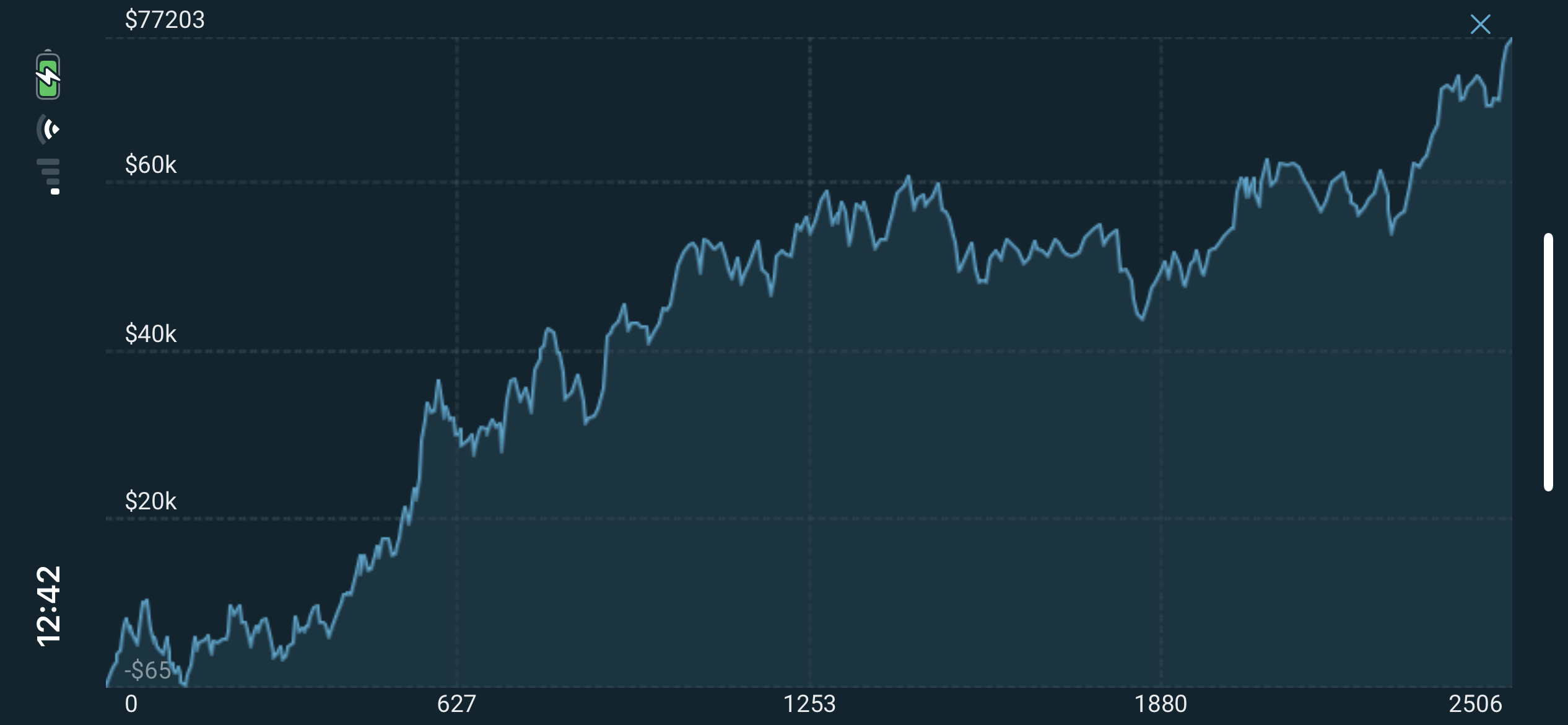
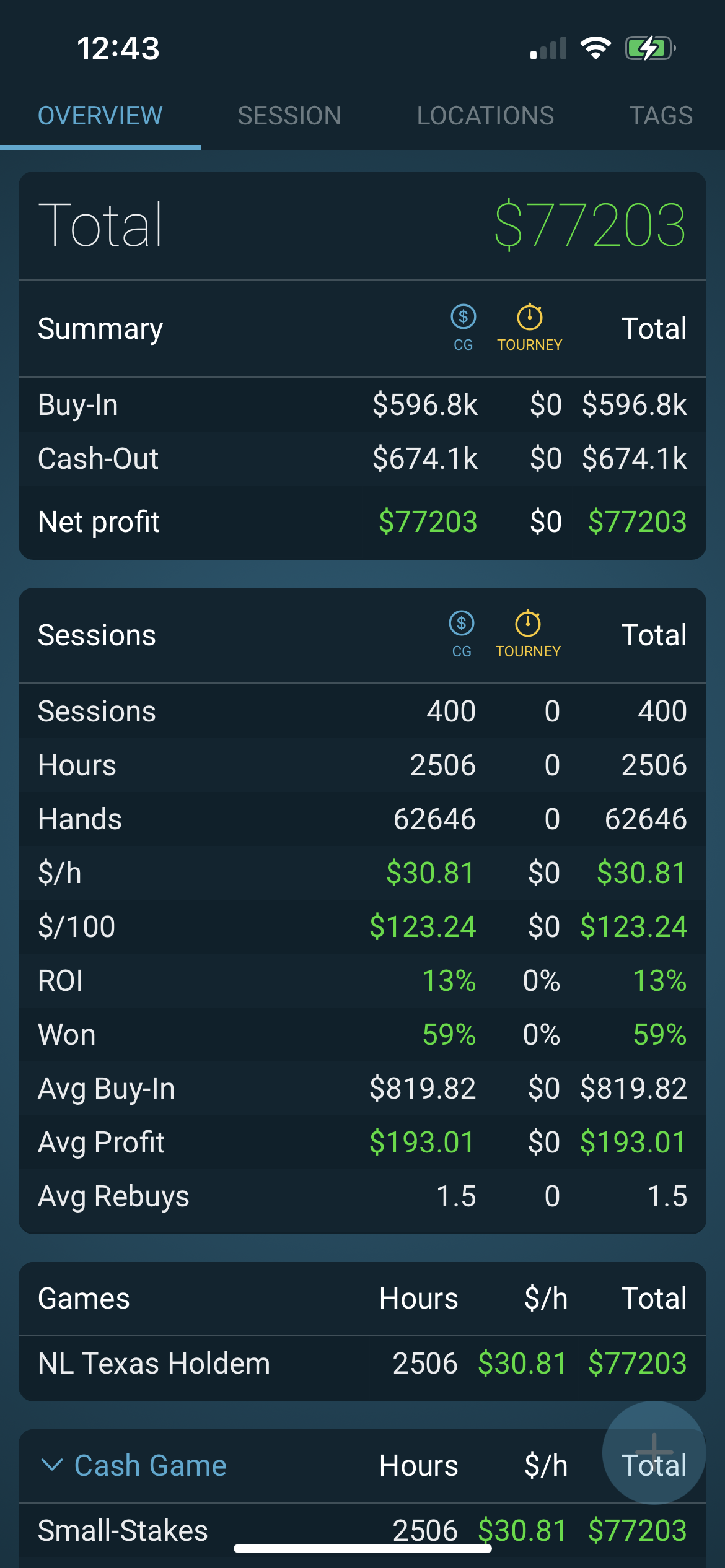
Yeah, that 1000 hour stretch looks brutal. Looks like you were cruising along at about the ~1000 mark shipping about 10 bb/hr and then... WHAM? Congrats on working thru it.
My guess is the long term is a lot tougher to get to than most realize.
Ggoodluck!G

Yeah, that 1000 hour stretch looks brutal. Looks like you were cruising along at about the ~1000 mark shipping about 10 bb/hr and then... WHAM? Congrats on working thru it.
My guess is the long term is a lot tougher to get to than most realize.
Ggoodluck!G
Mmm, I've experienced this kind of stretch at least a few times (I'd say, off-hand, without looking at my spreadsheets). More than once I'd be like, cool 10bb per hour, only to then suffer the old "reversion to the mean." Or maybe "regression to reality" is the better expression, that is, the reality of a dwindling or overstated skill level, inability or unwillingness to improve, changing game conditions, higher rake, etc. Anyway quitebrazen's results are more than respectable imo --- seeking to reach 10bb is smart, too, as complacency in mid-stakes live is the devil in disguise.
6 months of breakeven happens, over a full career of playing you'll probably experience 1 year where you just lose straight even playing well. for me that was like year 4 I lost overall the first six months of the year I went to the WSOP the first week I flopped the nuts and got it all in 11 times in cash games and lost every hand. That was also the end to that year of playing because I had no more bankroll.
The accelerant to getting out of these stretches is usually game selection, but it's possible to also just run completely terrible for a stretch.
Impressed about your results.
What Solver do you use to study and/or how do you study off-the tables?
Mostly GTO Wizard, either presolved for 6 max, 6 max ante + straddle, or GTO Wizard AI. Also some using HRC to solve some preflop spots that are kind of unique: straddle, double straddle, button straddle, large ante which can help to come up with strategies for standup game, and nodelocked spots vs specific ranges that I think deviate a lot from solver.
HRC I use less often and more when I am digging into something specific. I study GTO Wizard every day, mostly with trainer in 6 max straddle + ante because I find that closest to the games I play. I usually don't the trainer and then study individual spots I find interesting. Also study hands I played that I find interesting. I also try to mix in some studying of preflop ranges as different open raise sizing and use the range builder to practice these a few times a week.
I enjoy studying quite a bit and do it kind of compulsively. Probably somewhere between 7-15 hours per week. Mostly on my phone.
I also have a small study group of other professional poker players that play in different areas where we discuss hands/strategy. I try to focus a lot on how people deviate from equilibrium strategies and how to exploit that.
I also have spent a good deal of time this year studying live tells. Elwood's books Reading Poker Tells and Verbal Poker tells have been helpful along with talking to some people who are more seasoned in live tells.
6 months of breakeven happens, over a full career of playing you'll probably experience 1 year where you just lose straight even playing well. for me that was like year 4 I lost overall the first six months of the year I went to the WSOP the first week I flopped the nuts and got it all in 11 times in cash games and lost every hand. That was also the end to that year of playin
Yeah, it is said so often, but you will run worse than thought you would at some point. At least on some emotional level. Like, if you're buying in 5k in at 10/25/50 game, there is a good chance at some point in a 1,000 stretch you will go on a 100k downswing. 50k downswing very likely.
So far I have dealt with a 25k downswing earlier this year and digging out of a 20k downswing currently. Standard buy in is 1k to 2k depending on the blinds. If you are a strong winning player and other strong players believe in you, selling action in bigger games to make them within your bankroll limits may also be an option. At least if the stake you want to play is not always readily available or the bigger games are just too good to pass up.
I basically haven't been playing live since Covid, do you guys think game conditions have changed at all or is live 2/5-10/20 the same as ever?
I basically haven't been playing live since Covid, do you guys think game conditions have changed at all or is live 2/5-10/20 the same as ever?
I'd say the games are pretty healthy but one thing I've noticed is people don't like to play deep and games break early. I played a lot in 2019 and a lot of my winrate then was from being willing to sit very deep and keep the game going into the morning when players start making large mistakes. Before covid a lot more recreational players used to show up after 1AM than now too.

Spoiler
^ I'm currently at 250 hours, 53 sessions, ~7000 hands and break even.
Not sure what if anything this indicates
For the winning players here - what's the longest stretch (in hours) you've gone break even?
I had a close to 300 hour breakeven stretch in the past, wich of course was very rough to play through.
As fas as i understand from discussions on this topic earlier on this forum, other winning players have experienced similar horrible stretches as well. So 250 hours is absolutely not out of the ordinary. Imo if you play enough volume or big volume over many years aka thousands of hours you are likely gonna encounter stretches like this eventually.
Imo you dont know how bad negative variance can be before you experience it for yourself.
Spoiler
^ I'm currently at 250 hours, 53 sessions, ~7000 hands and break even.
Not sure what if anything this indicates
Im currently on a 700 hour be stretch myself with no end in sight, that includes a 20k downswing in tourneys. I think i reached my peak and went on a 20k+ downswing in a month and tried to climb back up from it ever since.
So 250 hours is nothing
Spoiler
^ I'm currently at 250 hours, 53 sessions, ~7000 hands and break even.
Not sure what if anything this indicates
The more you have 1000's+++ of other hours at a decent winrate clip, the less this means.
The less you have 1000's+++ of other hours at a decent winrate clip, the more this means.
ETA: I posted some stats in post#26745, but I've had breakeven stretches of 200 hours / 194 hours / 148 hours (where I went into and then dug myself out of downswings) plus a stretch of 168 hours (where I just flatlined without ever being stuck more than $749, lol). Currently sitting on 6,269 hours of 1/3 NL at $20.98/hour.
Ggoodluck!G

