Winrates, bankrolls, and finances

This thread will basically be a containment thread and will stock pile all of the questions and answers about winrates.
Looked at my 2023 NL cash stats down 1100 dollars after 2 sessions totaling almost 9 hours… the journey to losing player ��
Just hit 1000 hours at 5/5
I'm starting to think it's possible I'm not a losing player at this game
feels good man
(IknowIknowlolsamplesize)
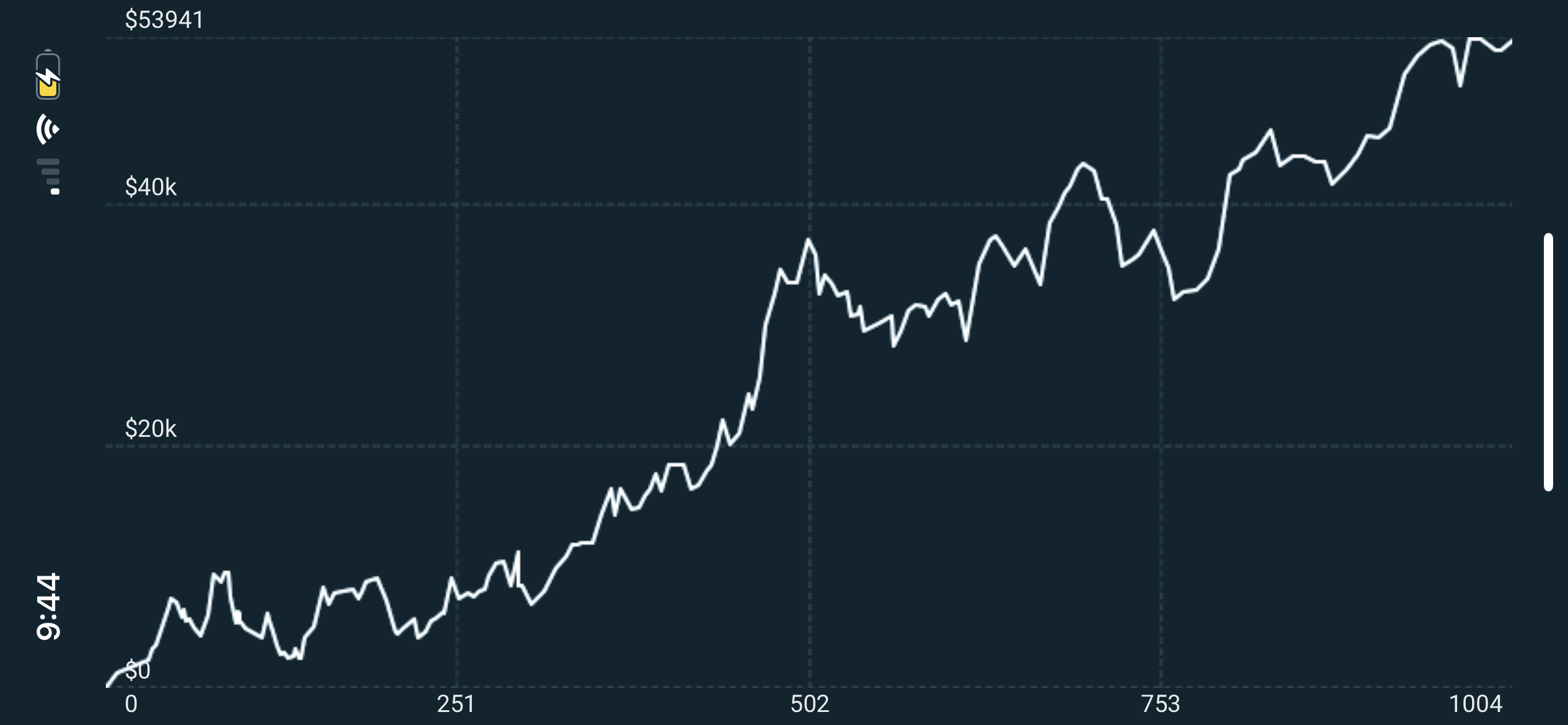
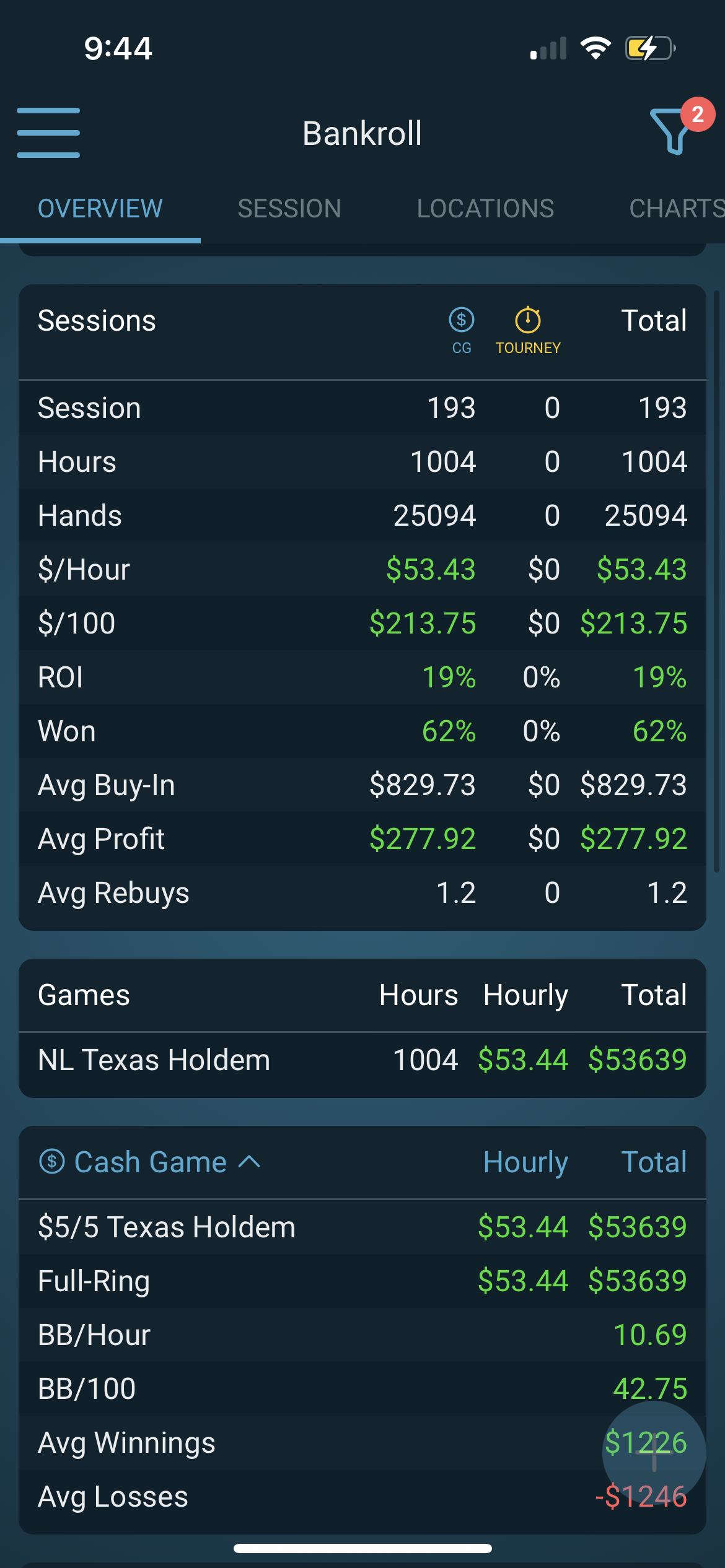

Quick question, what do you think is the best indicator of your true CURRENT winrate?
A. Lets say you play 1000 hours/year
1. The past year (1000 hours)
2. Past 2 years (2000 hours)
3. Past 5 years (5k hours)
4. Your entire poker career no matter how long
B. Same question but for 500 hours/year
Through off felt study/review, if a light bulb(s) has been turned on, and subsequently implemented successfully, I think you can make a solid case for that specific sample of hours.
Closing leaks like call too often, raise/call 3B oop with weaker part of range, better understanding hand configuration are just some improvements that can be made.
Personally, I worked on closing a few during Covid closure and implemented in a good size (> 2k hrs) live sample. I consider this as my hourly, obviously much higher than previous.

Let's say you're a solid winning player at 1/2 over 10,000 hands and want to make a one-time investment into a bankroll to move up in stakes, as high as 10/25 (allegedly the softest game in the cardroom). What is the maximum percent of your life roll you would invest? Let's say you had a $1 million IRA + $300,000 house at retirement. When you retire, how much would you put into a bankroll?
I was half-joking when I told my wife that, when I retire, I'm going to take a chunk from my IRA and invest it into a bankroll. She wasn't pleased. Any help here is also some marital advice.

If I was going to be seriously playing in a good (so probably high variance) 10/25 game regularly I would want at least $250,000.
I would still want to be able to meet all my other expenses from 3% of my investments.
So it really depends on how much your expenses are.
to be seriously playing in a good (so probably high variance) 10/25 game regularly I would want at least $250,000. I would still want to be able to meet all my other expenses from 3% of my investments.
It sadly looks like I'll never play 10/25. Drawing down 3 percent per year seems pretty conservative, the advice a certified financial consultant gives. I was thinking more like 5 percent. I can tolerate variance in retirement funds as in poker. I plan to keep the retirement funds invested in more stocks than bonds, adjusting living expenses as the value of the retirement funds fluctuate.
It sadly looks like I'll never play 10/25. Drawing down 3 percent per year seems pretty conservative, the advice a certified financial consultant gives. I was thinking more like 5 percent. I can tolerate variance in retirement funds as in poker. I plan to keep the retirement funds invested in more stocks than bonds, adjusting living expenses as the value of the retirement fund
You can certainly be more aggressive if you have a high risk tolerance or will have income from other sources.
I for one plan to live much longer than 30 years in retirement and have no plans to eat Alpo so I'd like to save as much as possible.
I would suggest to take out only 25k, play 2-5 and grind your way up the stakes. If you take 250k and go directly to 10/25 you’re most likely the mark at the table and will get crushed.

Let's say you're a solid winning player at 1/2 over 10,000 hands and want to make a one-time investment into a bankroll to move up in stakes, as high as 10/25 (allegedly the softest game in the cardroom). What is the maximum percent of your life roll you would invest? Let's say you had a $1 million IRA + $300,000 house at retirement. When you retire, how much would you put int
It depends your buy in amount. Is the game regularly straddled to 50? I would say 40 buy ins minimum for shot taking. But you don't just start playing 10/25. You play the next stakes below that mostly and take some shots at 10/25, get to know all the 10/25 players, who are the pros, who are the solid regs, who are the recreational players. Get to know their stories. The recreational players are usually independently wealthy or have high incomes. A typical 10/25 game is going to be a mix of pros, recs, and decent recs. The lineups in these games are typically curated so that there aren't too many pros. They will let new blood in, but if they find out you are a crusher they likely won't have you play unless the game is in danger of breaking.
You want to play when there is a good ratio of rec to pro. Sometimes these games can get short handed and it is like 3 recs and a pro and that is the best time to hop in. And for the most part you will play 2/5, 5/10 while you get more comfortable playing 10/25.
If you are seriously thinking about doing this, start making friends in the higher stakes community as an investment for the future. Don't step on toes because you never know who is going to be the one to veto you from being in a game, even if they are seemingly a no one today. And start building your bankroll at 2/5 and 5/10.
If you take 250k and go directly to 10/25 you’re most likely the mark at the table and will get crushed.
I would say that’s an understatement.
Let's say you're a solid winning player at 1/2 over 10,000 hands and want to make a one-time investment into a bankroll to move up in stakes, as high as 10/25 (allegedly the softest game in the cardroom). What is the maximum percent of your life roll you would invest? Let's say you had a $1 million IRA + $300,000 house at retirement. When you retire, how much would you put int
If playing poker for medium-high stakes is important to you, then you should "invest" in a bankroll. More importantly, you should "invest" in poker coaching.
The main problem is that you are not good enough yet to play medium to high stakes. But you are insinuating that you want to play medium to high stakes eventually. So you would need to pay for top notch quality coaching.
You missed his point, which was that he thinks 10/25 is softer than 1/3.
Given that as the context, he just needs a roll.
To be honest, it is actually common that a special highest stake game in the room that runs now and then and is one stake higher than the regular highest stake game in the room will be juicier than the regular highest game in the room that goes all the time.
So if 5/10 runs every day. But 10/25 fires off 1-2 days out of the week..10/25 will tend to be a special lineup built around certain big spots with deep pockets. Some of the 5/10 pros and regs will also be refusing to play that 10/25 game out of bankroll considerations too. So it that special 10/25 game could definitely be juicier and softer than 5/10 in that room.

Ray Zee's old rule was that in general the second largest game in the room was the best one to play.

If playing poker for medium-high stakes is important to you, then you should "invest" in a bankroll. More importantly, you should "invest" in poker coaching.
The main problem is that you are not good enough yet to play medium to high stakes. But you are insinuating that you want to play medium to high stakes eventually. So you would need to pay for top notch quality coaching.
Do you think it's at all realistic for some players to climb up from micros to nosebleeds with no coaching outside of videos, training sites, software, etc? Just left to the internet and their own devices.

Ray Zee's old rule was that in general the second largest game in the room was the best one to play.
FWIW I've seen a few pros say that this 100% used to be true, but is much less reliable now.
Today I played a 5/5/10 that mostly had a 25 double straddle and sometimes had bigger restraddles. It was the biggest game in the room. It was a special lineup with 2 pros (me included), one good reg, and 9 splashy recs (at one point we were 10 handed and the other pro sat out). It was by far the best game in the room. Unfortunately, I was down 4.6k today after 7 hours and am currently on a 25k downswing. I definitely will continue to play these games as the opportunity arises. A little more about this on the blog post:
It sadly looks like I'll never play 10/25. Drawing down 3 percent per year seems pretty conservative, the advice a certified financial consultant gives. I was thinking more like 5 percent. I can tolerate variance in retirement funds as in poker. I plan to keep the retirement funds invested in more stocks than bonds, adjusting living expenses as the value of the retirement fund
Did your wife completely veto your idea to invest in a big bankroll? And is she open to you investing in a 2/5 bankroll? I think you could start playing 2/5 with a 10-15k bankroll if your local 2/5 games don't play that big (20k roll for 2/5 might be needed if the typical 2/5 table tends to play big with large buyins and/or lots of $10 straddling)
Do you think it's at all realistic for some players to climb up from micros to nosebleeds with no coaching outside of videos, training sites, software, etc? Just left to the internet and their own devices.
I don't think it is realistic. Maybe a tiny minority (less than 0.5%) could do it.
What's your definition of "micros?" And what is your definition of "nosebleeds?"
As a part-time player, hard to believe I just logged 5K hrs @ 2/5NL. What a journey ...
Hrs Wins BB/Hr
0-1000.4 $28,448 5.7
to 2007.4 $30,155 6.0
to 3001.2 $34,141 6.9
to 4000.2 $35,529 7.1
to 4999.5 $46,422 9.3
Tried re-formatting, unsuccessful. Hopefully, understandable.

As a part-time player, hard to believe I just logged 5K hrs @ 2/5NL. What a journey ...Hrs Wins BB/Hr0-1000.4 $28,448 5.7to 2007.4 $30,155 6.0to 3001.2
Congrats samo, and nice job of consistently increasing the winrate!
Gwillbepostingmy6Khours@1/3NLin52.5hoursG

You missed his point, which was that he thinks 10/25 is softer than 1/3.
Given that as the context, he just needs a roll.
Not every 10/25 plays like the soft line ups you see on streams. Would be the dream though!
If posters here don't mind comparing notes, I am curious about the current state of live poker winrates across different markets in 2024
What do people think are the realistic average winrates for "good regs" (not crushers who are the apex predators capable of much higher winrates) in their local markets grinding a lot of hours/month? Not inflated by game selecting (obviously primetime hours on weekends would lead to higher than the "average" wintate)
Please include location and stakes.
I'll do my take on LA poker realistic average winrates for "good regs" even though I haven't played anywhere else besides Gardens Casino lately.
5/5: $25-$35/hour
5/10 or 5/5/10: $50-$75/hour
10/20 or Gardens bounty (similar to 10/20): $80-$125/hour
Do you think it's at all realistic for some players to climb up from micros to nosebleeds with no coaching outside of videos, training sites, software, etc? Just left to the internet and their own devices.
Realistic is different than efficient, idk. At some point you are playing big enough stakes/volume it's hard to imagine why you wouldn't get coaching, it takes so little for it to be worth the cost.

