The Box of Chocolates Thread (You never know what you're going to get!)

Welcome to the General Discussion thread. If you have a topic that doesn't warrant its own thread, post it here. Have a

To what extent is our perception of history informed by things like movies, pictures and paintings?

To what extent is our perception of history informed by things like movies, pictures and paintings?
general public - 90%
people like us - 40%
think about every time you have a strong opinion on something and then realize your only knowledge of it is through media - happens to me all the time where i'll be like wait a minute, wtf do i know about this and i'll think and realize i don't
general public - 90%
people like us - 40%
think about every time you have a strong opinion on something and then realize your only knowledge of it is through media - happens to me all the time where i'll be like wait a minute, wtf do i know about this and i'll think and realize i don't
I have a hard time taking historical movies and biopics seriously. "Here's a four minute conversation between George and Martha Washington." *This happened... Just like this.
Where it gets interesting is when we believe or are moved things that didn't happen but still build our views around those perceptions.
think about every time you have a strong opinion on something and then realize your only knowledge of it is through the senses - happens to me all the time where i'll be like wait a minute, wtf do i know about this and i'll think and realize i don't
FYP,
craig

To what extent is our perception of history informed by things like movies, pictures and paintings?
about all of it


I have a hard time taking historical movies and biopics seriously. "Here's a four minute conversation between George and Martha Washington." *This happened... Just like this.
Where it gets interesting is when we believe or are moved things that didn't happen but still build our views around those perceptions.
yes but i think people who will post about this kind of stuff on an obscure poker forum are built different
i love historical films in subjects in which i'm blissfully ignorant, in subjects in which i'm well read it's a constant reminder to myself that "it wasn't out of malice but instead because they thought it would look cool"
and yes, until i take a beat and reconsider things, i often find myself thinking "this isn't how a courtroom trial would work" only to then realize i don't know the first thing about them and never once witnessed one in person... but i have seen a lot of law and order episodes that gives me the feeling that i know how it's done
it's even to the point where when one tries to depict something accurately against the standard perception we have from media precedence it'll get blowback
ie if you made a film about vikings and didn't include the horned helmet or giant axes the audience would probably complain

I have a hard time taking historical movies and biopics seriously. "Here's a four minute conversation between George and Martha Washington." *This happened... Just like this.
Where it gets interesting is when we believe or are moved things that didn't happen but still build our views around those perceptions.
I enjoy them. Like John Adams on HBO was entertaining and I learned some stuff. Much of the conversations between say Jefferson and Adams depicted in the show was taken from actual letters so they would have accurately represented their view, at least at some point in time. They tongue and cheek allude to your point in the miniseries also. John Adams complains about the inaccuracy of Trumbull's famous signing of the Deceleration of Independence painting pointing out that those men were never actually in the same room at one rime with the document.
I enjoy them. Like John Adams on HBO was entertaining and I learned some stuff. Much of the conversations between say Jefferson and Adams depicted in the show was taken from actual letters so they would have accurately represented their view, at least at some point in time. They tongue and cheek allude to your point in the miniseries also. John Adams complains about the ina
I haven't seen that series (Paul Giamatti, right?), but those are some interesting points you mentioned in favor of historical movies/series. I guess I enjoy straight up historical fiction more than biopics or "based on a true story" movies that more or less get viewed as accurate; films like Saving Private Ryan and Titanic that do their best to accurately depict the environment, but the characters and stories are made up, and the artistic vision as it relates to the event is primary. Less to do with facts and more to do with the message and truths found in the story. In that sense, Saving Private Ryan is a more honest movie than Hacksaw Ridge.
saving private ryan is nowhere close to accurate
omaha beach - 50k soldiers landed, 2k casualties (of which 500 died)two waves in totalit was a very soft spot carefully chosen, in order to protect from naval bombardment, most bunkers were over a kilometer inland and did not directly face the beach, spread over lengthy gaps due to inability to cover entire coast otherwise and manned by low quality troopsin between the bunkers
Yeah Paul Giamatti. I would give it a shot even if you normally don't like these type of historical biopics. I find stuff like John Adams that is based on someone like David McCollough's or Lincoln with Doris Kearns Goodwin's work to be worth the time.
I bet. You seem well-versed in history, so I'll take you at your word with all that, but the inaccuracies you mentioned help illustrate what I was trying to say. I don't care so much about the accuracy of this battle or that figure. What I like about historical fiction is that it puts the characters in a general setting and communicates some kind of moral or emotional truth to the viewer without pretending to be a true story.
With Saving Private Ryan, it's kinda interesting. You do have the opening D-Day scene, and Spielberg also may have taken bits and pieces of historical accounts and incorporated them into the movie, but the movie isn't so much about WW2. It's about the characters and how we relate to them and their experiences.
With any historical fiction, the writers should get certain things right, and the more the story relies on those things, the more important it is to get them right, but biographies are never really true. They can't be. That's why I prefer fairy tales, so to speak.
Ironclad is the most accurate realistic historical film ever made (including the background score) and Paul Giammati is the most accurate King John. 

I bet. You seem well-versed in history, so I'll take you at your word with all that, but the inaccuracies you mentioned help illustrate what I was trying to say. I don't care so much about the accuracy of this battle or that figure. What I like about historical fiction is that it puts the characters in a general setting and communicates some kind of moral or emotional truth to
Saving Private Ryan is good on technical details, gets a fair bit of tactics right and doesn't shy away from showing the what WW2-warfare could be like.
It makes mistakes, exaggerates some things and embellishes others, but far less so than most other big WW2-movie productions I can think of. The story is "inspired fiction", which allows for a coherent storyline. While this is done to make the film engaging, it does make it a bit of a soap opera rather than an accurate portrayal. Despite that, I'd say it definitely earns its place as one of the best WW2 movies. Out of the bigger productions, perhaps even the best one.
If you want a film that (at least to me) tells a much more realistic narrative of war, but is still technically brilliant, I recommend "The 317th Platoon".
Saving Private Ryan is good on technical details, gets a fair bit of tactics right and doesn't shy away from showing the what WW2-warfare could be like.
It makes mistakes, exaggerates some things and embellishes others, but far less so than most other big WW2-movie productions I can think of. The story is "inspired fiction", which allows for a coherent storyline.
Except in terms of special effects, Saving Private Ryan is far less realistic than The Longest Day, in which most of the characters represent real people and their actions. A Normandy veteran of long acquaintance told me that the famous opening scene of SPR was 'a bit too intense,' because battle isn't like that -- there's a lot of nothing happening because everyone's lying low, which was certainly the case for hours on the real Omaha Beach. TLD correctly shows that Brig-Gen Cota had to force the pinned-down and terrified Rangers to get on and do their job.
SPR also has SS troops and Tiger tanks on the US front long before that was actually the case (2nd SS and 17th SS didn't confront the Americans till later that June,
and there were no Tiger battalions in Normandy then, and when they arrived they were sent to the British front, perceived by the Germans as the Schwerpunkt -- no GI saw a Tiger till August), and the film also treats us to rocket-firing P-51 'tankbusters,' a rather absurd deus-ex-machina device, because, first, that role was reserved for P-47s ( and there were a couple of airworthy P-47s in England at the time of filming which Spielberg could have used if he gave a damn for anything but sentimental Hollywood schlock) and, second, if you were as close as Tom Hanks to a tank being rocketed by aircraft you'd probably be killed as the unguided rockets splattered all around the target.
It's generally not a very good film, it just looks like one. Halls of Montezuma, despite its various dated dramatic conventions, is probably a more realistic account of a small-patrol action in that war (albeit in the Pacific). And when the rocket-firing fighters appear at the end, they're the right fighters for that place and time, F4U Corsairs. Perhaps only old soldiers care about that kind of thing, but they're more entitled to an opinion than most of us.
generation kill is probably the most accurate telling of modern warfare out there - notably because it's just how it actually happened for an embedded journalist
and that's probably why it never succeeded
it's an amazing show, one of the best in recent history, but never had that big blowout battle where they fix bayonets and charge in to rescue the hostages
nobody really has any idea what is happening - they hear gunfire, is it their own? is it even within range? should they light up that building? maybe it's coming from there?
ok we've been told to move out, guess we'll never know what happened
it also goes deep into why a lot of running jokes in the military are at the expense of 2nd lieutenants who are fresh out of training and thus usually know less than the men they are commanding but also very eager to prove themselves and climb the chain of command - the real villain in the show is their commanding officer and not so much the iraqis who are just trying to live their best lives

Except in terms of special effects, Saving Private Ryan is far less realistic than The Longest Day, in which most of the characters represent real people and their actions. A Normandy veteran of long acquaintance told me that the famous opening scene of SPR was 'a bit too intense,' because battle isn't like that -- there's a lot of nothing happening because everyone's lying low
Sure, I'm aware of all of these. Like I said, there are mistakes, embellishments, and exaggerations.
However, the reality of war movies is that they tend to make a lot of errors, and on average they make a lot more and a lot worse than this, even the ones that chase realism. So, to differentiate it is generally better to rate them comparatively than absolutely. In that regard, Saving Private Ryan does well.
It is true that some older movies often make good use of available equipment and personell.
Hmm. But SPR deliberately makes a couple of much larger errors, purely to serve the sentimental made-up plot. Most obviously, no such mission could ever have been ordered or carried out. Armies do mad things, but they'd never do anything that mad, sending a valuable squad of 2nd Rangers from Omaha over to the Utah area to potter about vaguely looking for some bloke to deliver a message. In the only real case of repatriation from Normandy under the Sullivan rule, as far as I recall, the battalion padre, on receiving the order from the CO, simply walked 200 yards down the lane to the company position, fetched the man from his foxhole and put him in a Jeep to the beach area to await transportation to to England and then home. That's all.
To generate the movie-ish storyline, the script has to pretend that 101st Airborne were all still wandering aimlessly about like lost sheep as late as D+5, which of course they weren't. They were organised and effective, with comms and chain-of-command in place, and that night they took Carentan, with massive artillery and naval-gunfire support, and easily held it next day against a counterattack by the just-arrived 17th SS. The film's climactic action is analogous to the Carentan battle, except that the real thing wasn't a foolish sacrificial small-unit action but a very competent divisional action with corps support, since war is more about logistics than heroics. In the actual circumstances, a repatriation order would have gone from SHAEF down to the battalion padre through the normal channels.
Halls of Montezuma, made for an audience that could actually remember the war, at least shows a Marine patrol doing what patrols really had to do on those terrible islands -- mapping enemy positions and lines-of-fire. There's also a nice flashback to the Richard Widmark character's recent peacetime life as a high-school teacher, because these were just civilians in uniform, a point that SPR nods to but doesn't really respect in its urge to make the characters seem like samurai.
so the basic math of war is very few actually die directly from combat
ie we lost 417k soldiers in WWII but a huge amount died from disease or other things like heart attacks and jeep crashes on base
only 292k of those 417k were killed in action
meanwhile, we had 16 million serving and of those probably 7-10 million saw combat
let's get really conservative and say that most of those who saw combat saw limited action and just take 4 million for the soldiers who saw regular combat
if all those who were killed were of those 4 million, you had about a 1% chance of dying and 30% of those who died did not die in combat
why is this important, because statistically speaking, this means the majority of wwii soldiers never killed anyone because while we fared far better than other countries in this regard, you were still overwhelmingly likely to have survived the war
furthermore, a lot of the kills are going to be concentrated in the hands of a few people who operate bombers, artillery, machine gun emplacements etc
so that drags the overall number of those who could have fought in wwii and killed someone to be very low
so why is this important? because of this
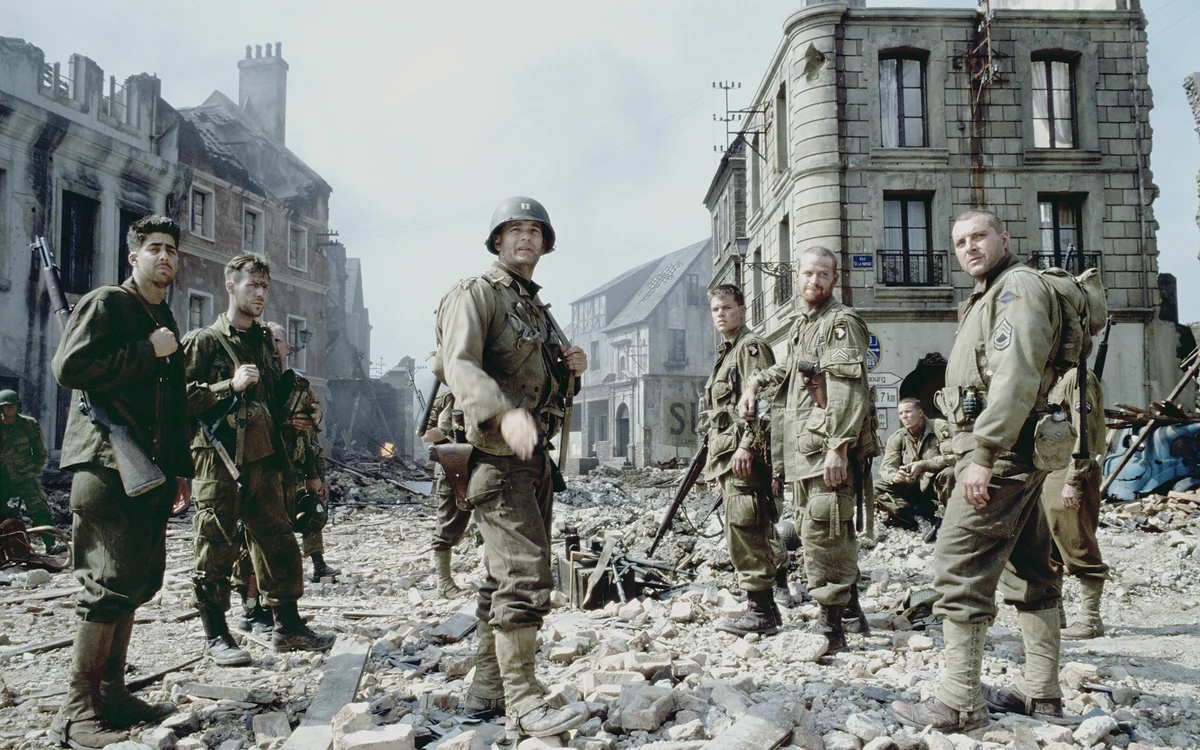
in the process of a few days, this small group of men wipe out hundreds
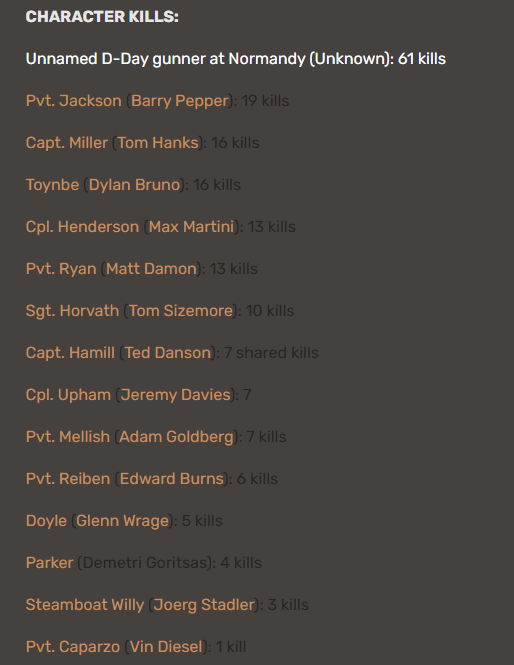
there's 243 on screen kills in that movie
saving private ryan is closer to the avengers than it is to an accurate depiction of wwii

so the basic math of war is very few actually die directly from combat
ie we lost 417k soldiers in WWII but a huge amount died from disease or other things like heart attacks and jeep crashes on base
only 292k of those 417k were killed in action
292/417 is 70%
yes, i think many would be surprised to learn that nearly 1/3 of all us soldier deaths in wwii were not from bullets nor shrapnel but rather things like heat stroke and driving recklessly while on r&r
In Western armies in the Second World War, only a small minority served in combat as such. In a British infantry division of 17,000 in 1944, only 4,500 were in the front-line rifle companies of the division's nine battalions. And most troops didn't even serve in fighting divisions but in the army's huge logistical and administrative 'tail'. But many were still dealing with dangerous equipment and living camped-out, or at least in unfamiliar circumstances, so there was a significant death rate from accidents or illness in that gigantic cohort.
But that's different from the front-line infantry casualty rate, which was daunting. In Normandy, the average British infantry battalion took 100% numerical casualties within six weeks of reaching the front line (and it was no better for the Americans). Not everyone got hit, but most did, and then their replacements got hit, till losses reached and passed 100%. Up to VE-Day, the average battalion took 250% losses. And men wounded in Normandy often returned to action only to be killed in the Rhineland or later.
there's 243 on screen kills in that movie
saving private ryan is closer to the avengers than it is to an accurate depiction of wwii
True, though it's not as bad as that ridiculous Brad Pitt movie Fury. Fury does feature a guest appearance by the British Tank Museum's preserved Tiger, but otherwise it's just daft.
True, though it's not as bad as that ridiculous Brad Pitt movie Fury. Fury does feature a guest appearance by the British Tank Museum's preserved Tiger, but otherwise it's just daft.
Haven't seen it but read that Shia had a tooth pulled and didn't shower for his role.
In Western armies in the Second World War, only a small minority served in combat as such. In a British infantry division of 17,000 in 1944, only 4,500 were in the front-line rifle companies of the division's nine battalions. And most troops didn't even serve in fighting divisions but in the army's huge logistical and administrative 'tail'. But many were still dealing with dang
yet oddly the data disagrees with all of this
it's telling that i'm talking about people who are killed and you go to the much broader term "casualty" which includes people removed from the front lines due to stomach bugs, stds, and toothaches
holding an elementary classroom to your rigorous standards we'd find the same 100%+ casualty rate over the course of a semester - let that sink in and then re-evaluate the nonsense of your "casualty rate" as a manner to depict the rate of survival
instead why don't you focus on the actual rate of survival instead of a logistics term used to figure out how often they need to resupply a unit regularly?
this is exactly how you can paint a picture of units with over 100% casualties because they start with 10 people, an artillery shell lands 20 yards from them where they all get pierced by some minor shrapnel, they are all taken off the line for a week to recover and put back out there and 5 get food poisoning eating moldy rations - not a single man has died, they are all in fighting condition after a few days, yet they have 150% casualty rates which the history channel and doofus's with blogs will highlight not quite understanding what it actually means
history channel tends to take the braveheart approach to retelling where facts shouldn't get in the way of a good story
they often zero in on a specific unit that suffered the most insane kinds of losses and be sure to use the biggest possible number possible (so always use casualty since it includes everything and usually associated with death) and focus in on it giving the impression that is the norm
i also already addressed the fact that the majority of troops are not on the front line but serving in logistics in my prior statement so it's very odd you pretend like that wasn't accounted for - feels like really bad faither posting from you trying to use something i already account for as a gotcha
640k british troops landed in normandy, given the typical 20% front line rifleman breakdown of their military then, we can conservatively estimate 100k (but 125k more reasonable)
17k british troops died in normandy
so about 1 in 10 - nowhere near the "everyone died" yarn you're trying to spin
is 1 in 10 a lot? yes it is, i'm not trying to downplay that, i'm just saying that films like spr are grossly misleading and portray a rate far exceeding that and more in like with your nonsense "everyone died bruh"


