Utility EV: Beyond Chip EV and ICM EV

I read about about the St. Petersburg Paradox and utility functions today and I realized that it will definitely apply to poker in some cases.
The St. Petersburg paradox, invented by Nicolas Bernoulli in 1713, is a paradox involving the game of flipping a coin where the expected payoff of the lottery game is infinite but nevertheless seems to be worth only a very small amount to the participants. The St. Petersburg paradox is a situation where a naïve decision criterion that takes only the expected value into account predicts a course of action that presumably no actual person would be willing to take.
The Game
A casino offers a game of chance for a single player in which a fair coin is tossed at each stage. The initial stake begins at 2 dollars and is doubled every time tails appears. The first time heads appears, the game ends and the player wins whatever is the current stake. Thus the player wins 2 dollars if heads appears on the first toss, 4 dollars if tails appears on the first toss and heads on the second, 8 dollars if tails appears on the first two tosses and heads on the third, and so on.
Mathematically, the player wins 2^(k+1) dollars, where k is the number of consecutive tails tosses.
What would be a fair price to pay the casino for entering the game?
Expected Value
To answer this, one needs to consider what would be the expected payout at each stage:
* 50% of the time, the player wins 2 dollars;
* 25% of the time, the player wins 4 dollars;
* 12.5% of the time, the player wins 8 dollars, and so on.
Assuming the game can continue as long as the coin toss results in tails and, in particular, that the casino has unlimited resources, the expected value is thus:
(1/2)*2 + (1/4)*4 + (1/8)*8... = 1 + 1 + 1... = Infinity
Considering nothing but the expected value of the net change in one's monetary wealth, one should therefore play the game at any price if offered the opportunity.
Yet, Daniel Bernoulli, after describing the game with an initial stake of one ducat, stated, "Although the standard calculation shows that the value of the player's expectation is infinitely great, it has ... to be admitted that any fairly reasonable man would sell his chance, with great pleasure, for twenty ducats."
Solutions
Expected utility theory
The classical resolution of the paradox involved the explicit introduction of a utility function, an expected utility hypothesis, and the presumption of diminishing marginal utility of money.
According to Daniel Bernoulli: "The determination of the value of an item must not be based on the price, but rather on the utility it yields ... There is no doubt that a gain of one thousand ducats is more significant to the pauper than to a rich man though both gain the same amount."
His formula gives an implicit relationship between the gambler's wealth and how much he should be willing to pay. For example, with natural log utility, a millionaire should be willing to pay up to $20.88, a person with $1,000 should pay up to $10.95, a person with $2 should borrow $1.35 and pay up to $3.35.
Before Daniel Bernoulli's 1738 publication, mathematician Gabriel Cramer from Geneva had already in 1728 found parts of this idea, stating that "the mathematicians estimate money in proportion to its quantity, and men of good sense in proportion to the usage that they may make of it."
See also:
Expected utility hypothesis
Von Neumann–Morgenstern utility th...
So how does this apply to poker?
Our first clue is ICM. The goal of most poker players is not winning chips, but winning money.
In cash games, winning chips is the same thing as winning money, but not in tournaments.
The value of chips won or lost in a tournament is not linear: chips lost are worth more than chips won in terms of dollar EV.
So ICM strategies will be different compared to chip EV strategies.
But ICM assumes that the value of dollars is linear, which is not the case in reality.
Yes, just like we can approximate ICM ranges by looking at chip EV ranges when ICM pressure is low, we can also approximate "max utility ranges" by looking at ICM ranges when the utility pressure is low.
But just like it would be a mistake to follow chip EV ranges when ICM pressure is high, it would be a mistake to follow ICM ranges when utility pressure is high.
The real goal is not to maximize chip EV, nor dollar EV, but our utility/happiness (how the money actually impacts our life).
Question: Why do people and businesses pay for insurance even when they know that the expected dollar value of buying insurance is negative?
Because the utility function is not linear. Money/property lost is worth more than money/property gained, especially at the extremes.
Poker example: You somehow wake up with your entire net worth at a nosebleed table and you're all in with KK vs AK and your opponent
asks: "Do you want to run it normally or do you want to guarantee your EV, minus a 1% fee?"
Strictly in terms of dollar EV, you should run it without insurance, but if you take utility into account, you should obviously buy insurance since the negative impact of losing your entire net worth is far greater than the positive impact of doubling it. Similar to how the negative ICM impact of losing all your chips in a tournament is bigger than the positive impact of doubling your stack.
Of course, most regs intuitively already understand this principle when they exercise bankroll management by following something like the kelly criterion rather than putting all their money at the table even in cases where putting ones entire net worth at the table would maximize dollar EV.
That may seem like an unrealistic scenario, so a more realistic scenario may be something like a micro stakes player satelliting into
a high roller tournament or something like the final table of the WSOP Main Event, where players have an opportunity to multiply their net worth many times over, so the utility pressure is huge.
And what's interesting is that since the utility function/pressure is different for every player, the optimal strategies for each player would be different even if you put them in the same exact spot. I guess you could say that utility pressure works as a negative bounty? The micro stakes player will have a bigger "negative bounty" to take into account compared to someone who is already a multi-millionaire.
So the micro stakes player consciously overfolding compared to ICM ranges is not necessarily "playing scared". He may be perfectly rational and simply trying to maximize his utility EV rather than dollar EV.
In contrast, someone like Daniel Negreanu often seems more motivated by winning bracelets rather than winning money, so he should play wider than ICM ranges, closer to chip EV ranges in order to achieve his particular goal.
In a huge tournament like the WSOP ME there is also additional money (sponsorships) and fame (positive social utility if you want the spotlight and negative if you want to avoid the spotlight) in winning that needs to be taken into account for a complete calculation.
5 Replies

So old man coffee was optimal all along. Plot twist.

I want a solver that lets me tweak each player's utility function
I don't know how to calculate utility, but I asked chatgpt for an example.
We are playing cash game and we are all-in with 70% equity (so something like KK vs AK) and have the option to buy insurance. How much of our EV should we be willing to give up, depending on how much of our net worth is in the pot?
Stack: $10,000
Pot: $20,000
EV: $4,000
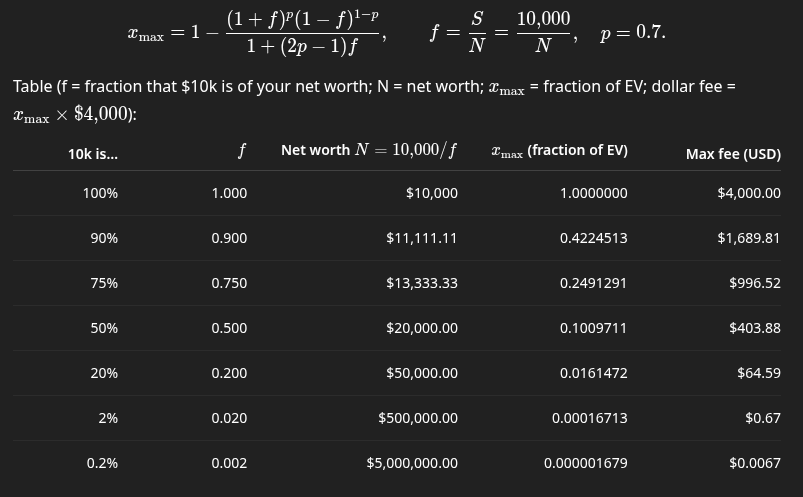
So we can see that the utility pressure of having a large part of ones net worth in the pot is huge, but falling off to near zero when we are playing with normal BRM.
So it seems that if, for some reason, you are sitting with more than ~15-20% of your net worth at a GG table, you should use the cashout option and pay the 1% fee.
Barry Carter actually wrote a
about poker insurance. He makes some good points, but he focuses only on EV and misses the deeper point about utility.
On a long enough timeframe, all of the insurance options that have a house edge built-in are a bad deal. Assuming a sturdy mental game, poker players who never indulge in insurance offers will be better off, long term, than those who do make use of them. The same is true of insurance in general. Think about it: if insurance was profitable for the customer, the companies offering it would go out of business.
This is what insurance really is: peace of mind. Insurance is never worth it from an expected value perspective, but it is often worth paying to reduce anxiety.
This again circles back to the St Petersburg Paradox. According to strict EV logic we should never pay for insurance and we should put our entire net worth into the St Petersburg Game and also put our entire net worth at a nosebleed table every time a fish sits down.
We can intuitively feel that there is something wrong with this conclusion, which can then be shown with math using a utility function.
In simplified words: what we are seeking to maximize is not the mean, but the median growth rate of our net worth.
Utility can be anything you want. It's is just a way to map chips to value.
Rake is a utility function.
ICM is a utility function.
Kelly is a utility function.
Sharpe ratio is a utility function.
The problem with maximizing EV in a vacuum is that it ignores future opportunities.


