Poker & Beyond: The Road to $100,000

Hi everyone!
Starting this thread to not only keep myself accountable, but to share my honest journey with anyone interested in poker, bankroll growth, and the search for meaning (or just a bit of fun) in this crazy game. Maybe someone will relate to what I write or even disagree — all feedback is welcome.
My name’s BoStone, I’m 39, from Ukraine, and I’ve been playing online poker for over 10 years. Right now, I’m mostly grinding NL50 and NL100 cash games — always mixing things up depending on the bankroll and the pool.
If there’s one thing I’ve learned, it’s that consistency and mental game matter much more than any magic formula or lucky run.
Now I’m starting a long-term challenge: with my current total bankroll, I want to work my way up to $100,000. Poker is the main vehicle, but I’m also experimenting a bit with crypto (still a total rookie there, not afraid to make mistakes or share what I learn).
What you’ll find in this blog:
Short updates on my bankroll (just to remind myself where it all started)
Thoughts on poker, psychology, discipline, and life on and off the tables
The occasional interesting hand, but this won’t be a “hand history clinic” — more big-picture reflections, not deep GTO analysis
Crypto experiments (for fun, honestly, still figuring things out)
Mistakes, little insights, sometimes just a stream-of-consciousness rant
Why do this?
First — to make it harder for myself to quit when the grind gets tough (public pressure works)
Second — because someone else out there might find something familiar or useful in these updates
Third — honestly, it’s just interesting. I want to document a real journey, with the ups, downs, detours, and small wins
Starting stats:
Poker: $3,550
Crypto: $433
Reserve: $1,513
-----------------
Total: $5,496
Goal: $100,000

(Yeah, $100k is a long way off — but at least I’ll have time to learn a new language, switch careers a couple times, and still get back to the grind.)
From here, I’ll be sharing regular updates, numbers, and observations — and maybe the occasional bit of non-poker life.
If you want the full archive, more details, or just random ramblings, I post everything on my website: keefeer.com
(still a work in progress, but the main parts are live).
I’m happy to hear from anyone — questions, encouragement, critiques, stories.
Let’s see where this road goes!
7 Replies
Sometimes I catch myself thinking that life outside poker starts to look more and more like a complex strategy game — with its own levels, quests, “bonuses, ” and endless temptation to hit “pause.”
Poker is all about making plus-EV decisions, managing tilt, and learning to handle losses with a cool head. In real life, it’s much the same: you get long grinds, upswings, downswings, and that slow, steady “character development” that actually decides your long-term success.
I tried to put these thoughts together in an article for my blog. Maybe some of you will relate, or find it useful in seeing routine, habits, and self-improvement from a new angle.
Here’s my latest piece: “Playing Yourself.
It's hard to believe, but not so long ago my life looked just like everyone else’s: background videos, news, constant window switching, social media, music, some game to unwind — all not because I wanted to, but because it had become a habit.
It’s a life in a cloud of noise — as if you’re a character moving forward, but with headphones playing everything at once. And you can't hear yourself.
I’ve been working for myself for years: poker, trading, my site, my tasks. Sometimes it feels like I’m “playing a game, ” only the character is me, the real one.
But unlike games, there’s no script and no restart button. Here, you either control your life, or it controls you.
The paradox: the fewer distractions, the harder it gets. All your usual crutches — YouTube, news, other people’s thoughts — disappear, and you’re left with yourself. Naked, with your desires, fears, and numbers.
It all seems clear: there's a goal, you count the money, there’s progress. But what’s missing is the “show” you could hide behind.
The real challenge isn’t just to set a big goal (I did — $100, 000), but to go down this path without unnecessary noise, without doping, without trying to fool yourself.
"When You Yourself Are the Game"
People ask why I do this. Why not just relax, play for fun, watch a series?
The answer is simple: because I’m curious what happens if I make my life the game. Not a temporary “challenge, ” not a one-month marathon, but a system where every action brings me closer to my goal.
The first weeks are always tough. Everything around tells you: “come on, it’s impossible, ” “just relax, that’s how everyone lives.” But if you hold out a bit — you get silence.
In that silence — the real you. With fatigue, with motivation, with numbers, with mistakes, with honest thoughts.
There’s a kind of joy in feeling every shift, seeing progress, even if it’s small.
Yes, only 5% of the path is behind me. Yes, sometimes there are setbacks and the urge to quit.
But if you’re going to choose a game, let it be your own.
Playing yourself is way more interesting than watching others play.
P.S.
This blog is not about success and beautiful pictures. It's a record of real movement, with all the weaknesses, daily snapshots, and interim results.
Maybe some will find it boring. But someone will recognize themselves.

Hey we are the same age and same poker background you can check out my post I'm starting with a lot less money than you but hope to make it up to 3k soon.
Check out my post I'll be following yours too. Good luck.
Hey m3dus4,
Thanks for the message! Always cool to meet someone on a similar path (same age too — love it 😄). Just checked out your post — cheering for you! Doesn’t matter where you start, the main thing is to keep moving forward and enjoy the process. $3k is a great first target — wishing you good runs and steady progress.
I’ll be following your updates too. Let’s both keep each other motivated!
Good luck at the tables!
Combined Bankroll Management: Poker, Credit Cards & Crypto
From time to time, I review my bankroll management strategy to find the right balance between stability and growth. Here’s my current approach — maybe it will be useful to someone, or at least spark some discussion.
Here’s how I do it right now:
Base Bankroll: $7, 000
This is my “safety net” — the amount I try never to drop below. It lets me play at my current stakes without having to worry about going broke or dropping down limits.
Weekly Cashout for Living Expenses:
I cash out around $350 each week (sometimes a bit more or less, depending on the situation). I try to keep this process regular so my personal finances are predictable and separated from poker.
Everything above $7, 000 gets “moved.”
After cashing out, if I still have funds above the $7, 000 base, I transfer the surplus into crypto. For now, I see this as extra value or a kind of “rakeback” — a bonus to my main grind.
If my BR drops below $7, 000 and I still need to cash out:
That’s when credit cards come into play. They act as my emergency buffer — so I don’t have to drop NL100 and grind only NL50 (which would make covering expenses much harder). Once my bankroll recovers, paying off any credit card balance becomes the first priority.
Crypto:
So far, I’ve allocated $385 to crypto. Any additional profits above the base will also go into crypto for trading, but always with careful risk management and no leverage.
Why this works for me:
Flexibility: I’m not stuck with fixed amounts. I can react quickly to downswings or heaters, moving funds where they’re needed most.
Growth: Whenever there’s a surplus, I put it to work in other areas (crypto) without risking my main poker roll.
Handling tough periods: Thanks to credit cards, I don’t have to immediately drop down in stakes or make drastic moves if something unexpected comes up — it buys me time to recover.
Crypto is a new chapter: It’s not a separate bankroll, but a way to grow my overall capital and diversify. I’m still treating it as an experiment, and taking it slow.
Current reality
Right now, I’m in a spot where my poker bankroll isn’t quite enough to consistently cash out for living expenses and put money into crypto. I’ve already made this week’s cashout, and have about one more week’s buffer.
If things don’t pick up soon (i.e., I don’t run back up to $7, 000+), I’ll have to use credit cards for living expenses and put crypto transfers on hold for a bit. That’s not the end of the world — it’s just part of the plan.
To sum up:
This whole setup is about balancing safety, flexibility, and growth. The key is to avoid impulsive moves, keep track of every transfer, and always know exactly where my real bankroll stands.
If you’ve got experience, ideas, or other ways you manage your bankroll, I’d love to hear about it in the comments or discussion. Always open to new perspectives!
Meditation is Life, Not Just a Part of Life
(or why the real game only begins when thoughts stop)
Over the years, my attitude toward self-development—both in poker and beyond—has changed drastically. I used to always search for new techniques, hacks, habits, thinking I’d add one more thing and become stronger, more stable, calmer.
Meditation was just another checkbox: everyone talked about it, so I figured I’d give it a shot. Ten minutes a day, then twenty, then sometimes more. Sometimes I’d feel relief, other times absolutely nothing. Eventually, it just became like brushing my teeth: something you do just because you’re supposed to.
But one day, I caught myself realizing: all that searching was just another way of negotiating with my own mind. Trying to make myself “better, ” to fix something, to run from anxiety or restlessness.
But all that anxiety and restlessness—those are just thoughts that feel more real than actual life.
It’s just like endless hand analysis in poker: you replay a hand over and over, thinking how you “should’ve” played, what you “could’ve” done differently… meanwhile, life keeps moving.
There’s nothing and no one except this moment
Here’s the paradox: only when you let go of control, when you stop trying to “figure everything out in your head, ” does true silence appear.
And it’s not “zoning out, ” it’s not some dull emptiness.
It’s more a sense that, right now, everything is simply happening on its own—without needing to judge, analyze, or reflect on “life” or “yourself.”
There’s no distance between you and this moment.
Reality becomes simpler, but at the same time, deeper and sharper.
And this is where the real game begins.
How does this connect to poker?
How many times have you found yourself like this: you know the theory, you’ve watched a ton of content, you break down spots, but as soon as you start playing, half your headspace is:
“What if I spew again right now?”
“Man, I was such an idiot last session, should’ve shoved there!”
“I need to recover fast / not dip into the red / prove something to someone...”
In those moments, you’re not really playing—you’re just living inside your thoughts about the game.
Reality isn’t here anymore; you’re lost in the past or future, in emotion, in endless inner dialogue.
And here’s the irony: it’s exactly in these moments that the dumbest mistakes, the biggest misclicks, and the harshest tilts happen.
How has this changed my game?
At some point, I started noticing: thinking about poker is not the same as playing poker.
Obsessing over the past, trying to “judge” myself—that’s not the game, that’s just shadowboxing with my own mind.
When pure perception replaces automatic over-analysis, you start seeing what’s really happening at the table now, not just “in your head.”
I started to literally pause the flow of thoughts when I played. Not forcing myself to “be present, ” not trying to shut my brain off, just refusing to follow every single thought that popped up.
And suddenly you start seeing not just the cards, but yourself. The interest comes back—not in the result, but in the process itself. Each spot becomes unique, because it’s no longer filtered through a dozen stories from yesterday.
Why this matters more to me than any technique
Because only this way does the excess noise fade away.
Confidence appears—not from “knowledge, ” but from trusting whatever is happening right now.
Make a mistake? So what. It’s not a problem, it’s part of the process.
On a heater? No euphoria, because it’s just another wave.
Lose? No self-flagellation, because the emotion doesn’t stick.
What actually changed in my approach:
Fewer silly mistakes “out of nowhere”—they disappear when background tension drops.
More enjoyment from playing, even in rough periods—because life and poker blend into one continuous “living, ” not just “surviving.”
The urge to endlessly review hands disappeared—one look is enough to get the point and move on.
There’s a new inner softness toward myself: not weaker, just way less energy wasted on fighting myself.
I started simply observing my thoughts, not trying to manage them, not forcing myself to “be in the moment, ” but just watching—what actually happens in my head as I play? At some point, it clicks: I’m not inside my thoughts; I’m the one observing them.
Thoughts come and go: anxiety, frustration over a hand, the urge to prove something... But if there are thoughts, and someone who observes them, then you’re not the thoughts themselves.
If you just watch this flow long enough, even the “observer” disappears. What’s left is only the game and everything happening right now. No more “someone fighting with himself, ” “controlling emotions, ” or “overthinking.” Everything gets quieter and simpler.
All of our life—just thoughts about life.
But when those thoughts dissolve, only the game remains.
And that’s when you finally get presence, results, and—most importantly—the taste of the moment itself.
That’s what meditation really is.
Not something separate from life, not instead of the game, but right here—on the screen, at the table, in silence and even in noise.
P.S.
Maybe someone else has tried playing without all that “mental baggage” and felt something similar?
Share your experience.
An honest story about yourself can sometimes be more valuable than any lifehack.
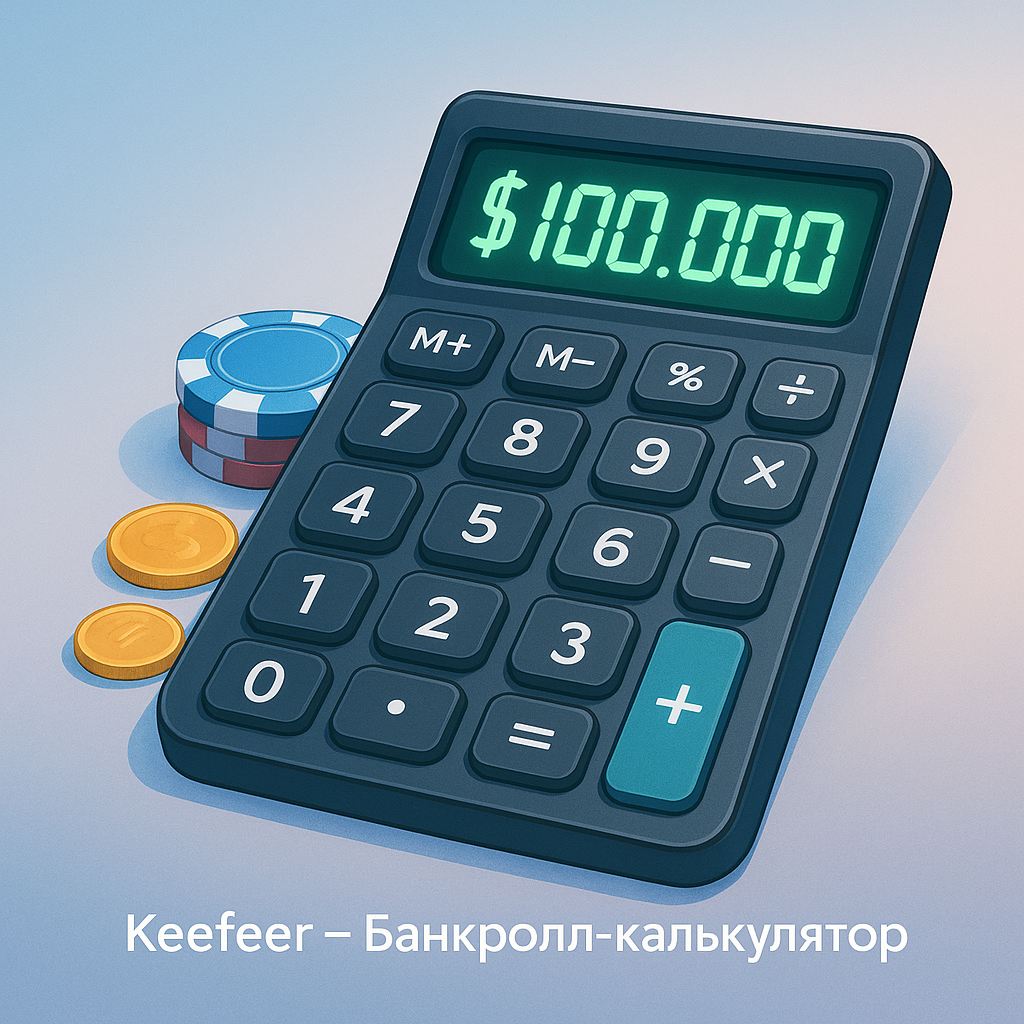
🧮 Made a bankroll calculator — if it’s helpful to anyone, feel free to use:
https://keefeer.com/tools/bankroll-calcu...
You just enter your bankroll, limit, winrate, hands per month, and planned cashouts. The calculator shows how many buy-ins you have, recommends if your roll fits the limit, and — the main thing — estimates how long it’ll take you to reach your target bankroll (in months and days), given your parameters.
If the goal isn’t realistically achievable with your numbers, it’ll tell you straight away.
It’s an easy way to see if your plan makes sense, if you need to adjust your target, or maybe rethink your current approach.
It’s still in beta, and I’m updating and improving it as I go.
If you have any ideas for features or notice something missing — let me know here!
Any feedback is appreciated.
The "Pure Source" Architecture: Why Technical Skill is No Longer Your Edge
After a period of strategic silence, I’ve come to a conclusion that might unsettle those obsessed with endless solver marathons. In 2026, technical skill is not an advantage; it is a basic hygiene factor. At mid-stakes and above, the technical gap between regulars is shrinking at an accelerating pace.
The real battle has shifted from ranges to the architecture of the operator—the person behind the buttons.
I have restructured my approach around three fundamental pillars that now sustain my game.
1. Metabolic Stability: Biology as the Foundation
Poker is a cognitive marathon. Most mistakes in the 4th hour of a session aren't due to a lack of mathematical knowledge, but due to glucose crashes or insulin spikes.
Keto & Carnivore: This is no longer a "diet" for me; it’s a tool for neurochemical stabilization. A brain fueled by ketones doesn't know "brain fog" or post-lunch lethargy.
Hormonal Leverage: Utilizing prolonged fasting protocols (ADF/OMAD) triggers the "hunter’s focus." When the body isn't burdened by digestion, all energy is redirected to the prefrontal cortex.
2. P&L Blindness: The Power of Blind Play
Perhaps the most difficult yet powerful "system hack." I have completely eliminated the monitoring of balances and session results until it becomes a technical necessity (cashing out).
Eliminating Anchors: If you know you are "down 5 buy-ins, " your brain inevitably begins to seek ways to "get even, " distorting your Expected Value (EV).
Process-Driven Dopamine: By removing the profit figure, you train your brain to thrive on execution purity. A disciplined, high-quality fold begins to provide as much satisfaction as winning a full stack. This is the transition from a gambler’s mindset to that of a high-performance processor.
3. The Information Vacuum
We live in an era of "informational obesity." Social media, news, and the endless stream of others' opinions fragment our attention.
Hard Filters: I use external tools to find necessary information specifically to avoid falling into the traps of recommendation algorithms.
The Result: The brain stops "chewing" on someone else's agenda and enters a state of deep concentration. In poker, this manifests as the ability to see table dynamics where others see only noise.
Summary
My current goal is not to "grind X dollars, " but to refine my operating system to a state where an error becomes physically impossible due to the absence of internal noise.
Poker is merely a mirror. If the Source is pure, the result is only a matter of time and volume.